Sport economics: Why the next Ashes are England’s to lose

THERE are two theories for the relationship between sport and the economy. The first is that prosperity drives sporting performance. The evidence to support this generally comes from Olympic medal tables, which show that the largest and most successful economies win more medals. The second is that sport is one of the few routes out of poverty, and that tough lives make people more resilient at sport. But how do these ideas apply to Ashes cricket?
Two years ago, it was observed that, as the Australian economy has become more formidable, the Australians have become more beatable at cricket. Australia’s GDP has risen from about 25 per cent of the size of the UK economy to over 50 per cent and, after falling back a little after the hangover from the commodity boom overshoot, is set to continue to rise.
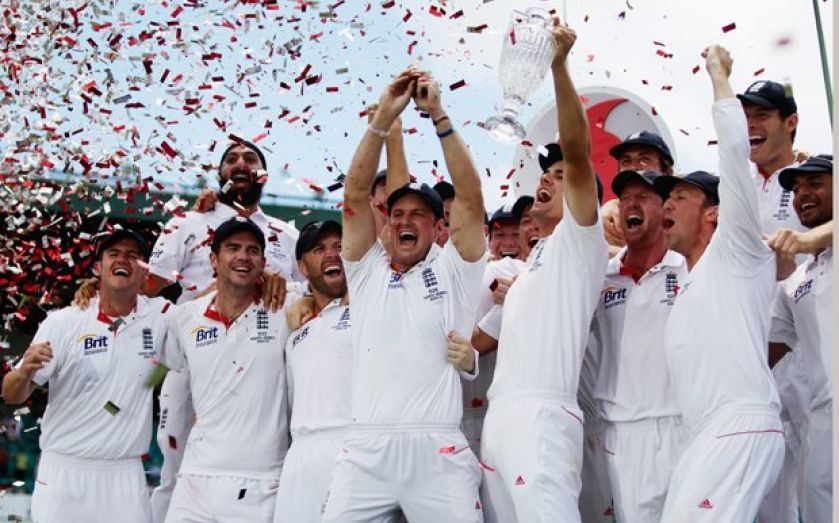
England won the Ashes for the first time since the 1980s in 2005, then lost them again in Australia in 2006-07. But after that disastrous tour, things improved for the England team as the UK economy deteriorated. They won the Ashes in 2009 in England while the economy was slumping, with GDP down by 5 per cent, and then beat Australia by a lot in 2010-11, while the Australian economy was in good shape and the UK economy still in recession. England repeated the success with a little bit of luck in 2013, before being obliterated in a 5-0 defeat last winter, as the UK economy bounced back and Australia slowed down.
So it looks like the theory works as a useful explanator of the recent period. But let’s look back a little further to see what it shows.
The early economic history of Australia is astounding. It had become the wealthiest economy in the world in GDP per capita terms as early as 1852, and remained so for the whole period till the slump in 1891-92. The 1850s were the step change in the development of Australia – its population doubled during the decade from 600,000 to 1.2m.
But in the early 1890s, there was a huge agricultural slump, the economic effects of which were exacerbated by widespread bank failures, and Australia was in major economic difficulties for 15 years. The economy started to recover in the run up to the First World War, slowed down in the early 1920s, and then boomed in the late 1920s, before suffering another dreadful slump after the 1929 Wall Street crash.
What happened to the cricket? The Ashes were created in the winter of 1882-83 (the series was drawn 2-2) and England then went on to win them in seven consecutive series – at a time when Australia remained remarkably prosperous.
But then Australia won – in 1891-92, the same year as the Australian economy slumped! GDP in 1892 in Australia fell in real terms by 12 per cent, its largest ever fall.
Australia dominated the Ashes series of the first half of the 1920s and England won the two series in the second half of the 1920s. Then the age of Don Bradman started and England won only one series (the infamous bodyline series) from 1930 to 1953. The age of Bradman coincided with the Depression, which hit Australia disproportionately. The Australian economy only really recovered with the War. Living standards in Australia in the late 1930s were no higher than the early 1890s. But while their living standards were depressed, their cricket was spectacularly good.
After the Second World War, the relationship between the Ashes and the economy has been less closely linked until recently, when the commodity-based boom in the Australian economy has created the opportunity for England to start to win again.
Of course, all this is impressionistic. What do the econometrics show?
Looking at unemployment alone, there is a clear and highly significant relationship between England holding the Ashes and the unemployment ratio. If the unemployment rate in the UK gets one percentage point higher, and in Australia it stays unchanged, the chances of England holding the Ashes rise by roughly 10 per cent (normally, the chances are about 29 per cent, so a 10 per cent rise is important).
So it does seem that when one economy is doing badly and the other is doing well, the one doing badly is more likely to hold the Ashes. Since the Australian economy is forecast to do well in the medium term, it is good news for the England cricketers.
Douglas McWilliams is the Mercers’ School Memorial Gresham professor of commerce and executive chairman of the Centre of Economic and Business Research (CEBR). He co-wrote this article with Chris Evans, an economist at CEBR. A fuller discussion of this issue will be given in “Is it really the case that economic success is negatively correlated with sporting success?” a Gresham professorial lecture tonight at 6pm in the Museum of London. Seating is on a first come first served basis.