Ed Miliband’s Green New Deal won’t deliver 400,000 ‘new’ jobs

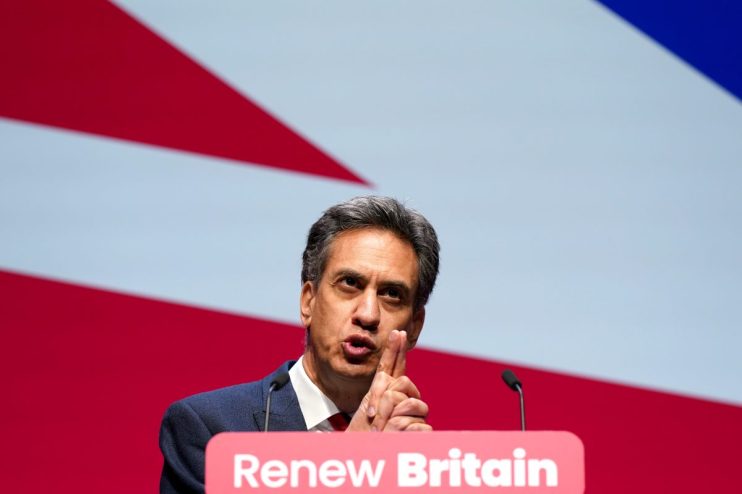
The language of “job creation” is seductive, but Ed Miliband’s promise to create 400,000 ‘new’ green jobs is deceiving, writes Matthew Bowles
Ed Miliband is back in the headlines, dusting off a familiar pledge: a “Green New Deal” involving a promise to deliver 400,000 new jobs in clean energy, doubling the existing opportunities in the sector by 2030. It’s a big round number designed to inspire hope, suggesting that Britain’s green transition will not only decarbonise but enrich us all as well.
On paper, the promise of green jobs has obvious appeal: a booming sector that puts people to work, while making the economy greener. But headline figures rarely tell the whole story. These “new” jobs are usually displaced roles shuffled around the economy, with no absolute guarantee of a net gain, and potential losses elsewhere.
The language of “job creation” is seductive. But economies aren’t built on Whitehall spreadsheets where ministers can simply insert a number in the “employment” column. Jobs are the product of investment, competition and productivity. When governments attempt to micromanage employment, the results are usually wasteful and distorted.
Energy jobs are no different. Every worker trained as a wind technician is one fewer worker available to build refineries, to drill, to manufacture or to innovate in other sectors. Pretending otherwise is political theatre. Even if we got 400,000 green jobs in the next five years, it is likely we will have lost more jobs than that elsewhere as a direct result of green policies.
Take oil and gas. According to Offshore Energies UK, there were 121,000 direct and indirect workers in the sector in 2023, a fall of 51 per cent since 2014. That’s tens of thousands of livelihoods lost, with knock-on effects in supply chains, ports and engineering firms.
Even when major green projects are announced, the economic benefits often leak overseas. The majority of turbines for our offshore wind farms are built abroad, the panels for our solar arrays imported, the supply chain of panels anchored in Asia.
New ‘green’ jobs come at the expense of old, reliable ones
Worse still, the green job narrative distracts from the real cost of Britain’s rush to Net Zero: uncompetitive energy.
For households, the numbers are bad enough. The UK already pays some of the highest household electricity prices in Europe, about 40 cents per kWh, more than a third higher than France and more than double the US.
For industry, the story is even gloomier. The most recent data from September 2025 shows that industry electricity prices are significantly higher than European competitors with prices for steelmakers 25 per cent higher than in France and Germany. Since 2016/17, UK steelmakers have paid £845m more for electricity than French counterparts and £721m more than German counterparts. For reference, the steel industry is purportedly set to be worth £7.7bn in 2025/26, meaning the overpaying compared to France is representative of a little over 10 per cent of the market.
Steel output has slumped. Chemicals and glass are in decline. The Financial Times reported that energy-intensive industry output has fallen by a third since 2021, a 35-year low. When energy is this expensive, jobs don’t just vanish in oil and gas. They vanish in a multitude of industries.
Ed Miliband’s figures rarely include these numbers. But every inflated promise of “green jobs” comes at the expense of jobs priced out by policy-driven costs. But the headlong rush to Net Zero has made Britain not just expensive, but fragile.
Oil refineries, which convert crude oil into usable fuels, are closing. Just this month, Prax Lindsey, one of Britain’s six remaining refineries, announced nearly a third of its workforce will lose their jobs as it slid into administration. Every such closure leaves the UK more dependent on imported fuels, with fewer buffers in times of crisis.
Britain’s green revolution has yet to deliver
At the same time, renewables have yet to deliver the reliability politicians promise. Britain’s wind fleet can produce record surpluses one week and almost nothing the next. When these surpluses arrive, there’s a lack of sufficient energy storage and limited grid capacity. This variability forces us to keep gas stations on standby, often importing liquified natural gas (LNG) at punishing global prices.
Reform, and increasingly the Conservatives, are questioning the orthodoxy of Net Zero. They ask whether the costs imposed on consumers and businesses can really be justified by Britain’s marginal share of global emissions. They ask whether chasing an arbitrary 2050 deadline, regardless of consequences, is a rational way to run a country.
Labour, by contrast, seems to be doubling down. Instead of admitting trade-offs, it conjures a headline figure of 400,000 jobs out of thin air. Britain doesn’t need another press release, it needs honesty. It needs policies that foster innovation rather than suppress it, and competition rather than subsidy-driven distortion. Above all it needs energy – energy that is cheap, reliable and secure.
There is an alternative, and we’ve seen it before. In the 1990s, Britain liberalised its electricity market. For a decade, prices fell, competition thrived and consumers benefitted. This model worked because the market was trusted.
If Labour wants to be serious about growth, it should stop dangling fictional job numbers in front of us and start addressing the basics. Cut energy costs. Restore competitiveness. Let technologies compete on a level playing field.
The real prize is not a jobs number scribbled on the back of an envelope. It is a resilient, affordable and innovative energy system that supports jobs across the whole economy, not just those favoured by an ideologically-driven energy secretary. Until Labour understands this, its “Green New Deal” will look less like a deal for Britain, and more like a costly illusion.
Matthew Bowles is senior policy researcher at Prosperity Institute