Ed Miliband’s pay now buy later climate policy

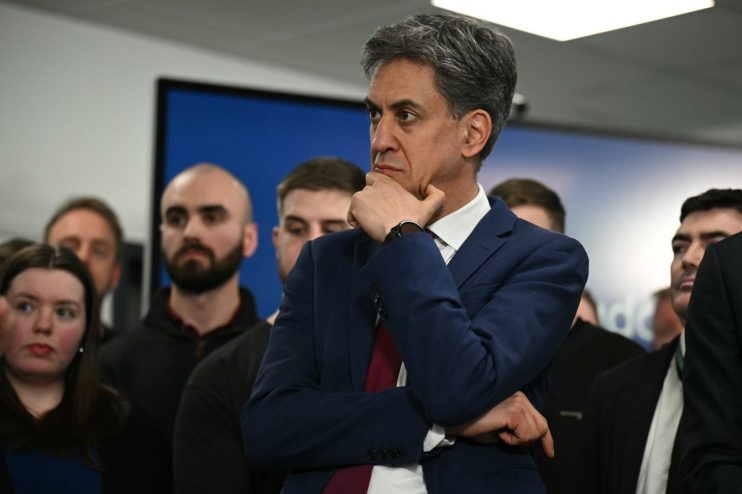
Behavioural economics teaches us that consumers weigh benefits received and costs incurred in the present much more heavily than if they’re in the distant future. That’s a problem for net zero policy makers like Ed Miliband, says Paul Ormerod
The headlines are full of bad news for Kier Starmer. But an important story last week was bad news for his Cabinet colleague, the Energy Secretary Ed Miliband.
Miliband is well known for his devotion to Net Zero. Unfortunately for him, the electorate seem increasingly less enthusiastic about the concept.
The Times newspaper carried detailed reports about research which the leading polling firm YouGov had carried out for it amongst swing voters.
There is rising scepticism about climate change itself, with one in four voters now thinking that it is not as real as scientists claim it is, a sharp increase from when the same exercise was last carried out four years ago.
Reflecting this trend, only 30 per cent of those polled are in favour of banning new petrol and diesel cars, compared to 51 per cent in 2021. A mere 16 per cent now support the idea of new taxes to encourage people to switch from gas to electricity.
Overall, the conclusion of the study was that people are far less prepared to pay for the cost of net zero than they were four years ago, a base which was itself low.
Electric cars fall short
The focus group and survey data simply reflects actual behaviour in the real world. The take up of electric cars, for example, has been far lower than policy makers wanted across almost all of Western Europe.
The costs associated with running an electric vehicle have become well known. They are expensive, often have considerably lower range in practice than claimed by the manufacturers, and are time consuming to charge.
As a result, interest in buying them has fallen far short of the projections made a few years ago by the car manufacturers.
More generally, it has proved very difficult for politicians to persuade electorates to change consumption patterns in ways which many scientists would like to see. More expensive air travel, steeper energy bills, these are not very popular.
People are being asked to accept lower increases, or even reductions, in their living standards now, in exchange for escaping potentially large costs in the future.
Economics offers insights into why this is the case, in addition to the obvious one of when the price of a product rises people usually want less of it.
A key issue is that people value benefits which are received and costs incurred in the present and the immediate future, more than they do the same amounts in the more distant future.
The Bank of England is rock solid and has never defaulted. So when it issues debt, you can be as certain as possible that you will get your money back. But the Bank still has to offer you interest, more money in the future, to persuade you to buy it now.
The question is then: how do people discount the future? What weight do they place on a cost incurred or benefit enjoyed now compared to the same cash equivalent in the future?
Behavioural economics has provided a large amount of evidence on this question. It is not at all good news for climate change activists.
In the jargon, people often use “hyperbolic discounting”. Translated, this simply means they place far more weight on small rewards or costs which occur now than on much larger ones in the more distant future.
So even if consumers knew with a substantial level of certainty what the future costs of climate change would be, their focus would still be very much on the costs incurred right now to alleviate them.
None of this is to deny the reality of climate change. But policy makers need to grasp that there are sound and rational reasons why consumers are not jumping on the net zero bandwagon.
Paul Ormerod is an Honorary Professor at the Alliance Business School at the University of Manchester, an economist at Volterra Partners LLP, and author of Against the Grain: Insights of an Economic Contrarian, published by the IEA in conjunction with Morning Wire