Effective and efficient capital markets in an increasingly digitised world


The past few months have seen a real shift in the way we are all living and working. Many of the previously accepted ways of doing things are suddenly no more, and the appetite for doing things differently and embracing new modus operandi is now rife, globally. We are witnessing a real paradigm shift, and it is encouraging how enthusiastically both individuals and businesses are innovating to cope.
It’s affecting all existing aspects of life. The great ‘WFH vs. office’ debate is an obvious one; although this does depend a lot on what the job entails, so a combination of the two is likely to be the new norm. How (and how often) we travel – both domestically and internationally – is totally different to what it was, and probably will remain so for the foreseeable future. The traditional retail and entertainment spaces have taken a real hammering with many businesses suffering, whilst digital disruptors like Amazon and Netflix have seen their business models flourish. New ways of operating have had to become accepted and commonplace as well, such as Zoom conference calls and Docusign’d agreements.
For me personally, a key sign on my barometer of change came from my mother – when a nonagenarian like her is readily making Zoom calls with her friends, having previously never touched a computer let alone a smartphone in her life, it is clear the world has shifted!
There’s no denying that change is coming, but what will that change be and what will it affect? There is a lot of talk about the ‘new normal’, but we don’t really know yet what that will look like. However, it is clear that more effective and more efficient ways of doing things are key – and digitisation is going to play a significant part of that.
Traditional capital markets
But what does all this mean for capital markets?
In essence, capital markets exist to serve the needs of those that wish to raise funds by linking them to potential investors. So, it is first worth looking at the profile of the firms and the underlying assets that are involved, as well as how effectively they are currently served by traditional financial markets. One way of doing this is to consider the current liquidity profile of the instruments that represent these firms or assets, and plot these on a ‘liquidity spectrum’.
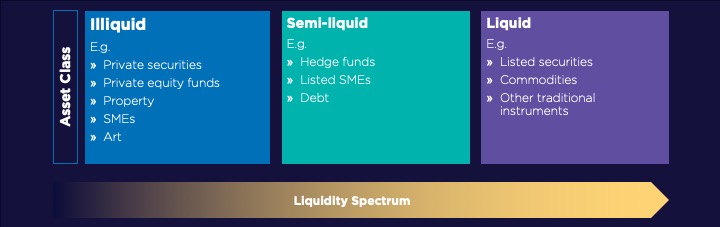
On the right-hand side of this spectrum are the typically larger firms, like Apple, Amazon or Vodafone, who are generally served well by current markets, with relatively easy access to capital and highly liquid instruments. As you move left across and down the spectrum, the firms tend to get smaller and the liquidity of the assets decreases – right down to the world of private companies and esoteric asset classes on the left that are barely served by traditional markets at all.
So current financial markets are typified as being skewed to serving larger firms (albeit with some limitations that we’ll look at later), but present barriers of entry and limitations to the rest – such as the cost of getting involved and lack of liquidity. From an investor standpoint there is discrimination too, with many smaller investors often being priced out of involvement in certain types of asset classes (e.g. commercial property, art) and having no easy way to access investment in instruments like private securities.
Digital capital markets
Step in digitisation. Digitisation will evolve capital markets to help them serve smaller companies and less liquid assets classes better, as well as improve the efficiency of more established, highly liquid assets too. And the catalyst to this digitisation is Blockchain.
The use of blockchain or DLT technology to create security tokens or digital securities that represent the fractional ownership of assets or businesses, is driving the creation of these new marketplaces. Global, 24×7 markets can open up illiquid or hard to trade assets (on the left-hand side of the spectrum) to a broader potential investor pool, thus helping to democratise financial markets and provide new channels to investment for people looking to raise capital. The technology is a catalyst for innovation too, with the tokenisation of investment funds to create new secondary markets that help reduce the headache of rebalancing and provide a permanent source of capital, being one good example.
But it’s not just about the small guys and new innovative instruments. If we look again at the spectrum and add in analysis of the benefits, we can see that blockchain and tokenisation can benefit all.
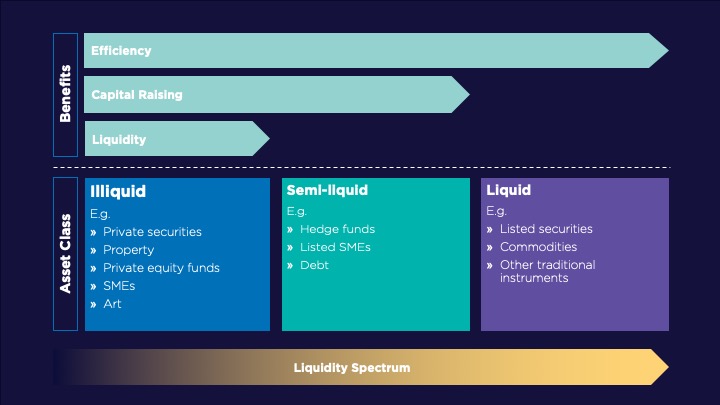
For those smaller private firms and hard to trade assets on the left, the benefits are indeed most obvious – new efficient marketplaces can provide access to new sources of capital and facilitate liquidity from broader potential investor pools.
In the middle, where some public markets and liquidity already exist, the real benefits come from opening new channels to capital as well as efficiency gains. On the right where firms are generally well served by existing traditional markets, there are benefits too. Although on the face of it these larger trading venues are well established and serve their customers well, they can be hugely inefficient in some areas, such as in post-trade. The number of intermediaries involved and the various reconciliations that take place as a result of multiple parties maintaining their own books and records, is ripe for revolutionisation. And with blockchain being able to provide a trusted single source of data to all, the possible efficiency gains here could be huge, both in terms of costs and energy.
A new marketplace for all
In summary, tokenisation and the advent of digital securities can bring benefits to the whole capital market space. It is all about creating an effective marketplace that can properly serve all sizes of firms and all types of asset class, in a highly efficient manner. On the investor side too, the resulting democratisation means more people can diversify into more types of investment – further broadening the pool of investors available and facilitating liquidity for assets that have historically been hard to trade.
These concepts and the move to more effective, more efficient ways of working were well underway before this year’s global challenges ensued. But just as we’ve seen new ways of living, working and operating kick in elsewhere as a result of these conditions, we may well see the move to fully digital capital markets accelerate as a result too.
Simon Barnby is CMO at Archax, the forthcoming global exchange for digital securities www.archax.com.