| Updated:
The elder statesman: Lord Young talks motorways and tear gas

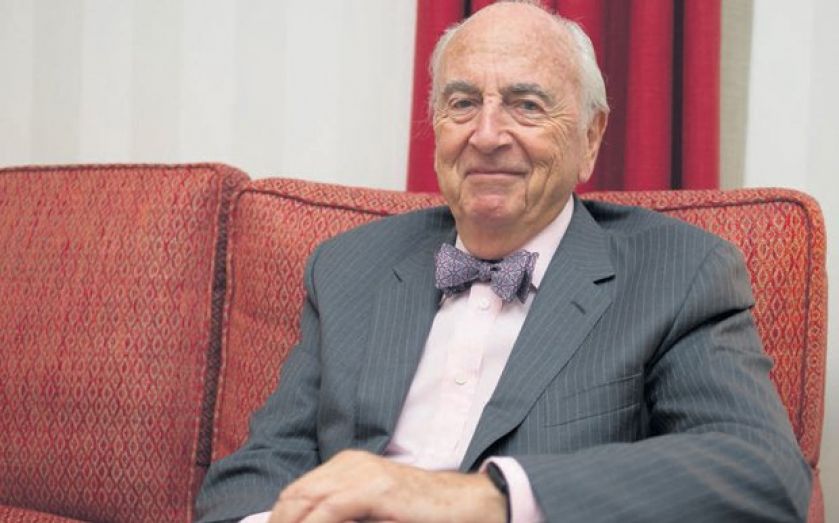
If the Conservatives win next year’s general election, Lord Young will be the oldest person to work in Number 10 ever, beating William Gladstone, who was Prime Minister until he was 83. “Margaret Thatcher asked me to go into Cabinet 30 years ago. Now David Cameron tells everybody that he and I are the only two people in Number 10 with an office to ourselves.”
Sticking it out over the decades, he’s been secretary of state for employment, minister without portfolio and has led three reports for the coalition. But Young is a rare breed of politician, because he’s also been a serial entrepreneur since 1961. Starting out life as a lawyer, he lasted just nine months. “The problem with being a lawyer is that you become an abominable ‘no’ man. And I’m a ‘yes’ man.”
He then won a job at Great Universal Stores – the precursor to Home Retail Group and Experian – and describes the relief he felt at the end of his first day – “you could actually do things, rather than tell people not to.” And in 1961, after five years with the firm, Young decided to strike out alone. “Income tax was at 83 and 98 per cent. It seems impossible now, but that’s why this country went down. All the entrepreneurial people got up and left. So I thought, ‘I’ve got to do it. I’ve got to go and start my own business.’”
SHOW ON THE ROAD
“It was the time when the motorways were being built,” explains Young. “We think of the internet changing things, but motorways really changed things. The day the M4 opened, the country shrank.” An enterprising Young did the obvious, but ingenious: wherever a motorway was built, his industrial estates followed. “You’ve got to be the person of your time,” he says.
He sold Eldonwall, his first trading estate firm, along with a group of construction and plant hire companies, in 1970. But three years on, things weren’t so rosy. Having joined the board of the firm he sold to, he was caught in the 1973 property crash. Starting from scratch afterwards, his unfailing optimism kicked in: “I went back to Go without collecting the £200, but it was the best thing that ever happened to me.” Having another crack at it in the ‘70s wasn’t particularly easy. “This country went down and down. I actually thought of emigrating.” Young and his wife even made a prospective visit to Boston in 1974, but managed to arrive the day before the Boston busing crisis began. “It’s the only time I’ve smelt tear gas. She said, ‘I don’t want to come to this crazy country,’ so we went home.”
A year later, he started joint venture Manufacturers Hanover, and Margaret Thatcher became leader of the Conservative Party. “I thought, ‘well that’s torn it, they’ll never elect a woman,’” laughs Young. Two years later, he joined the management board of Thatcher’s Centre for Policy Studies, and two years later, she was Prime Minister. Young’s foray into politics followed. “I said I’d take a two-year holiday from business to help start privatisation. That was in 1979. It was 1989 when I told Margaret that it was about time I went back to the pot.”
CULT OF THE ENTREPRENEUR
But spending 10 years mostly working on employment policy had its effect and, while subsequently moving from one high-profile role to the next, in 1996, Young set up Young Associates. He’s been investing in tech companies ever since. Now, he’s working on his third – and final – report for government, Enterprise For All. Published three months ago, it contains very few recommendations, which Young believes is the key to actually seeing them enacted. Over the next two years, enterprise advisers – a network of business people and entrepreneurs – will be rolled out country-wide to develop enterprise programmes in schools and advise heads. The report will also see a public Future Earnings and Employment Record in place from autumn 2015, which will detail ten years of employment rates and earnings for every further and higher education course in the UK. “It’ll really make universities pull their socks up,” says Young.
For him, improving education is entwined in giving everybody the possibility of being an entrepreneur. “We are in a better place than we’ve ever been. There’s more opportunity to start out than ever before, but the key thing is making sure everybody’s got the tools to have a good life.” Back in 1983, Thatcher gave him the task of trying to find an Oxbridge graduate who wanted to work for themselves. “It seems ridiculous now, but nobody wanted to. When you got out of university, you wanted to do one of three things: work for the BBC, the Foreign Office or, if you were really desperate, become an investment banker. And if you were really thick, you went into industry. There were no real opportunities in business. Everybody just wanted to get a job.” Obviously it’s completely different now, he assures me – “mavericks were not wanted. Now, they are.”
BACK TO SQUARE ONE
Young is keen to impress that it “really doesn’t take much” to start your own business now. He remembers, back in the early days, sharing a desk with his brother Stuart, who went on to become chairman of the BBC. It took two days to send out letters to potential clients – “now, it’s a click of a button. The internet has pulled down the barrier to working for yourself, and social media has changed everything. Even I’ve got Twitter and, for some reason, nearly 7,000 followers.”
Of course, he knows that entrepreneurship isn’t for everybody – he also knows why it suits him so well. “The most tedious five years of my life were when I was executive chairman of Cable & Wireless. We took profits from £530m to £1.4bn, yet I never saw a customer. I didn’t get a kick, so I left it.” Once process comes into play, he “goes out the window. I just love starting things. But I know that’s my weakness, and that’s the most important thing.”
Would he do it all again? “I wish I was starting again now. I love every second. I’ve got the best life in the world.”
DAVID YOUNG'S CV
Companies: Many
Founded: From 1961
Number of staff: Up to 4,000 (Cable & Wireless)
Job title: Nagging shareholder
Age: 82
Born: London
Lives: Regent’s Park and Graffham, West Sussex
Studied: Law, UCL
Drinking: Scotch on the rocks
Eating: Oxtail, stews
Reading: Austerity Britain, by David Kynaston
Favourite business book: Haven’t written it yet
Talents: Stubbornness
First ambition: Film director
Hero: Maggie
Motto: “See every glass half full.”
Most likely to say: “Bad news always first – good news travels faster than light.”
Least likely to say: “Can’t be done.”