Skip to content
Wednesday 12 August 2026London --:--Frankfurt --:--Zurich --:--
NewslettersSearchEN · DE
MorningWire

European business, markets and politics

FTSE 100
10,844.19
-0.17%
DAX
26,391.42
0.00%
CAC 40
8,714.94
0.00%
STOXX 50
6,551.22
0.00%
  • Europe
  • Markets
  • Business
  • Economy
  • Technology
  • Politics
  • Opinion
More
GermanyFranceBankingAIEnergyFintechPropertyCapital Markets
  • Germany
  • France
  • Europe
  • Markets
  • Business
  • Economy
  • Technology
  • Politics
  • Opinion
  • DE
Thursday 22 August 2024 5:45 am  |  Updated:  Wednesday 21 August 2024 3:56 pm

Enough with the hysteria, NHS pay rises make us all richer

By: Sam Fowles

Add as a preferred source on Google
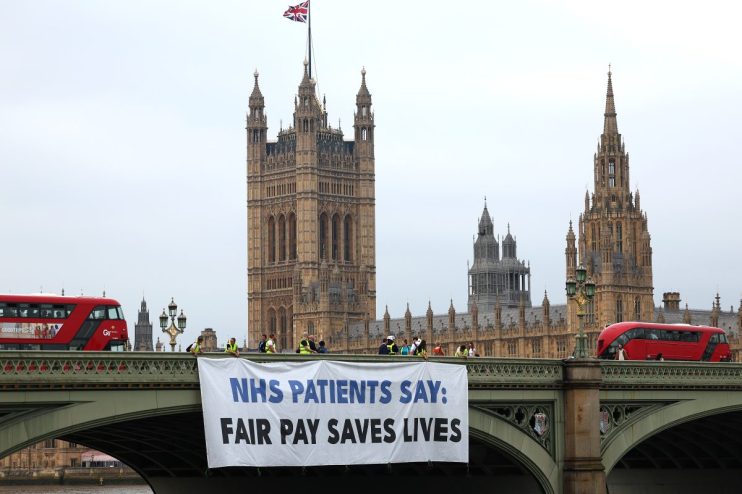
LONDON, ENGLAND - JUNE 27: Just Treatment, a protest group, unfurl a banner in support of striking young doctors, on Westmimnster Bridge, on day one of the British Medical Association (BMA) strike action on June 27, 2024 in London, United Kingdom. Junior doctors, who are members of the BMA, are striking in the final week before Britain goes to the polls. Despite receiving an 8.8% pay rise last summer and an additional 3% offer, the BMA rejected the 3% offer as it doesn't compensate for the over 25% loss in real-term pay over the past 15 years. The BMA is demanding full pay restoration to reverse these real-term cuts since 2008-09, along with a new pay mechanism to prevent future pay decreases due to inflation and the cost of living. (Photo by Peter Nicholls/Getty Images)

NHS pay rises have sparked apocalyptic headlines, but a better public sector makes us all richer, writes Sam Fowles

If one were to list the most socially valuable jobs, one would likely include doctors, nurses, police officers, carers and public transport workers. Yet pay in these professions has lagged well behind inflation for over a decade (excepting train drivers). Last week they all got a raise. This, oddly, prompted apocalyptic headlines. The same politicians and commentators who cosplay as working class when it’s a convenient excuse for stirring up hate against Muslims seem appalled at working class people advocating for and obtaining better pay. 

In fact, the public sector raise is good economics, good public policy and benefits all of us.

First, it’s good for the public sector. Almost two fifths (38 per cent) of public sector workers have taken steps to leave their jobs. Last year, 170,000 people left the NHS. If we want people to work in the public sector, then we need to pay enough to make the jobs attractive. Currently doctors and nurses can earn more and enjoy a better quality of life by working abroad. Our public services are in a parlous state. The first step to fixing them must be retaining good workers and recruiting new talent. 

Second, it’s good for the broader economy. The “public sector” and NHS collectively account for about a quarter of the UK workforce. Public sector wages have, since 2008, declined by an average of 4.3 per cent in real terms. This means a quarter of the workforce has less money to spend in the private sector. This, in turn, reduces private sector demand. The suppression of wages (and, consequently, demand) is part of the reason that the UK economy has stagnated for so long. 

Critics argue the raise will cause inflation, but the correlation between public sector pay rises and inflation is weak or non-existent. Wage-driven inflation occurs when wages outstrip prices, causing a wage-price spiral. The current rises are below the level of inflation (i.e. they’re still real-terms cuts). 

Third, it’s cheaper. If you don’t pay people enough to do a job, they’re entitled to stop doing it. The last government sought to make political capital out of picking fights with unions over strikes. Ministers subsequently admitted that it would have been cheaper to settle at an early stage. The economy does better when trains run, the sick are treated and crimes are investigated. 

What, then, is behind opposition to the public sector raise? Why doesn’t other government spending provoke the same outcry? State subsidies to the energy sector, for example, amount to around £38bn per year, nearly four times the cost of the public sector raise, and are far more distorting to the market. The real objection is about politics, not economics: the pay rises show that unions work. Criticism of the raise almost invariably degenerates into dark warnings about a “return to the ‘70s” (when hospital waiting lists were lower, everything was more affordable and the crime rate was about half of what it is today). 

The hysteria is unwarranted. Unions are democratic organisations which empower their members by giving them a collective voice. Members elect the leadership and vote on policy and big decisions (like going on strike). This makes unions more representative than some of the parties in parliament (Reform UK is a private company over which Nigel Farage exercises near total control). In a political landscape dominated by lobbyists and dodgy money, democratic organisations like the unions are a rare mechanism of genuine grassroots empowerment. Given the most strident objections to the raise come from right-wing think tanks and the populist press, perhaps their real fear is having to share power with the “ordinary people” for whom they claim to speak. 

Sam Fowles is a barrister

Read more

Andy Burnham will find there is a limit to tax rises

At its core, an ISA is a "tax wrapper," a protective shell that shields your money from income tax and capital gains tax.

Share this article

  • Facebook
  • X
  • LinkedIn
  • WhatsApp
  • Email

Similarly tagged content:

Sections

  • Opinion

Categories

  • Opinion

People & Organisations

  • NHS
  • public sector pay
  • Trade Unions
  • unions

Related Topics

  • NHS

Trending Articles

  • Five-star Mayfair hotel hit with HMRC winding-up petition

  • Nottingham Forest owner Marinakis sues Crystal Palace for defamation

  • Back to basics: Sainsbury’s gradual retreat from the British high street

  • Hargreaves Lansdown orders staff back to office

  • As it happened: Intel, Arm shares slide; Oil climbs higher

More from Morning Wire

  • Andy Burnham will find there is a limit to tax rises

    Opinion
    At its core, an ISA is a "tax wrapper," a protective shell that shields your money from income tax and capital gains tax.
  • Will Burnham take the pressure off business? Don’t bank on it

    Politics
    Andy Burnham speaking passionately at a public event, wearing a suit, highlighting his role as a prominent political figure.
  • The City will bid good riddance to Rachel Reeves

    Opinion
    Reeves Bank exterior with modern architecture, showcasing its sleek design and prominent logo on a sunny day.
  • ‘Social value’ procurement rules are an absurd waste of time and money

    Economics
    Tunnelling for the Euston link finally kicks off this week.
  • Pension pressure to help swell UK debt to three times size of economy

    Economics
    Two older women exercising at an outdoor gym in sunshine
  • Ignore Palantir’s political opponents and look at the data: this technology helps patients

    Opinion
    NHS logo on a white surface with visible water droplets, blue and white branding
  • Healey faces £24bn spending squeeze as inflation puts tax rises in play

    Economics
    Bank of England headquarters in 2025, showcasing modern architecture and iconic London skyline in the background.
  • NHS data counters claims that £330m Palantir deal has led to ‘no improvement’

    Tech
    Brit are seeking financial support from the ‘Bank of Mum and Dad’ to afford private healthcare.
MorningWire

Independent European business, markets and political news for decision-makers.

Morning Briefing

Europe

  • Germany
  • France
  • Europe
  • UK & Ireland

Business

  • Markets
  • Banking
  • Technology
  • Energy
  • Property
  • Fintech

Editorial

  • Opinion
  • Editorial Policy
  • Corrections
  • Contact

Company

  • About Morning Wire
  • Privacy Policy
  • Terms of Use
  • Cookie Policy
© 2026 Morning Wire Ltd · Published by Morning Wire Media, Bahnhofstrasse 65, 8001 Zürich, Switzerland
Privacy · Terms · Cookies · Facebook