
ESG defies naysayers as ‘sustainable’ investments become mainstream


Crises tend to accelerate trends. The upheavals of 2020 – from the global pandemic to the movement for racial justice and the ongoing threat of climate change – have undoubtedly helped propel environmental, social, and governance (ESG) investing into the mainstream. ESG-related topics have never been so central to the investment conversation. Retail funds incorporating ESG factors are growing and the connection between ESG and risk is strengthening.
But ESG also requires that investors expand their toolkits. And it poses a range of challenges to investment managers and index providers alike.
Amid the market turmoil of 2020’s first quarter, some predicted that ESG would be exposed as a bull market luxury: ‘sustainability’ is easy to champion during boom times, but when markets plunge, priorities such as securing retirement savings dominate investors’ hierarchy of needs.
Surging interest in Europe and the US
ESG has defied the naysayers by continuing to attract capital in 2020. Regulators, mostly in Europe, are an important impetus. Yet the asset growth reflects genuine bottom-up interest.
According to Morningstar research, mutual funds and exchange-traded funds (ETFs) designated as sustainable attracted $46bn (£35.8bn) of inflows in the first quarter, in contrast to the several billion in net redemptions suffered by the overall fund universe. More than 80% of sustainable assets are in Europe. But ESG-oriented funds in the US attracted record inflows in the first quarter, surpassing a record set in 2019’s fourth quarter.
Global sustainable fund assets are growing fast (in US$ billions)
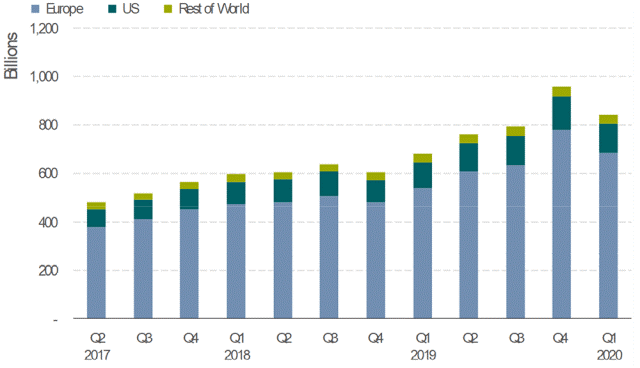
Investor preference for passive, index-tracking strategies has carried over to ESG. This trend has been most pronounced in the US, where index funds and ETFs captured 80% of sustainable flows in the first quarter of 2020, up from 60% in 2019.
In Europe, passive ESG strategies are also increasing their market share. Of course, sustainable mutual funds and ETFs represent only a fraction of the more than $30 trillion in sustainable mandates, as measured by the Global Sustainable Investment Alliance in 2018. That figure includes the likes of pension and sovereign wealth fund assets.
ESG indexes outperforming parent markets
This year has reminded us that investing is affected by a wide range of forces, including those falling into the ESG rubric. The pandemic has highlighted the importance of biodiversity, supply-chain management, human capital, and health and safety – ‘stakeholder capitalism’ is a trending term and it is clear that sustainable investing has evolved beyond its roots among values-based investors.
No wonder CFA Institute ‘now encourages all investment professionals to consider ESG factors’, viewing their integration as ‘consistent with a manager’s fiduciary duty to consider all relevant information and material risks in investment analysis and decision-making’.
Indexes that incorporate ESG into their selection criteria can be useful analytical tools. They may not be explicitly constructed to boost returns or lower risk but comparing them to their broad market equivalents can be revelatory.
In February, Morningstar Indexes published research examining the risk profiles of its ESG-screened equity benchmarks.
We found that 72% of the ESG indexes held up better than their broad market parents for the five-year period until year-end 2019.
Morningstar’s ESG indexes also acquitted themselves extremely well as equities entered a bear market in the first quarter of 2020. Their performance was consistent with that of the ESG-screened benchmarks offered by other index providers as well as with sustainable funds.
There’s a temptation to dismiss these results as a consequence of fortunate sector bets. There’s no question that above-market exposure to high-flying technology stocks and less exposure to the lagging energy sector have generally boosted sustainable investments.
But there’s more to the story, as revealed by performance attribution. For the first quarter of 2020, stock selection within sectors contributed more than sector allocation to the outperformance of the Morningstar Global Markets Sustainability Index and the US Sustainability Index.
The key seems to be the relationship between ESG and risk attributes such as quality and financial health. Research by Morningstar and others, across indexes and funds, has found that companies that score well on ESG also tend to exhibit higher profitability and stronger balance sheets, which make them more resilient during times of market stress. While relative returns fluctuate, risk attributes tend to persist.
An evolving field in which methodologies vary
Even as assets grow and performance impresses, ESG investing poses challenges. Due diligence is necessary to understand whether an index or strategy excludes stocks on ethical grounds, uses positive ESG selection or focuses on a particular issue – and most combine these elements.
Company-level ESG researchers may come to divergent conclusions because their methodologies vary. Sustainalytics’ Carbon Risk Rating, for example, can differ markedly from carbon footprint analysis because it includes a qualitative assessment of a company’s efforts to manage climate risk.
For index providers and investment managers, ESG is an evolving field. Keeping up with regulation, such as the European Union’s climate transition and Paris-aligned benchmarks, is a constant challenge.
So, too, is reflecting changing investor preferences on ESG matters, such as exclusions related to controversial weapons. Efforts to bolster reporting and standardise ESG corporate disclosures will improve the company-level data that is the fundamental building block of portfolio construction.
Charges of ‘greenwashing’ will need to be countered by demonstrating rigorous ESG research and thoughtful investment approaches.
As the post-pandemic world takes shape, there’s little doubt that ESG investing will grow further in importance. Not only are sustainable assets likely to increase, but the materiality of ESG issues will be more widely accepted.
If you liked this post, don’t forget to subscribe to the Enterprising Investor.
For more research and analysis, visit CFA Institute.
By Dan Lefkovitz, Strategist for Morningstar’s Indexes group.
Morningstar is a member of the Index Industry Association and supports the Association’s goals of independence, transparency, and competition of index providers. For more on the IIA’s work on ESG, please see the results of the group’s leading index industry survey and this recent article on ESG benchmarks featuring further comments from IIA CEO Rick Redding and IIA member firms.
All posts are the opinion of the author. As such, they should not be construed as investment advice, nor do the opinions expressed necessarily reflect the views of CFA Institute or the author’s employer.
Image credits: Getty Images / aydinmutlu