EU defence: Why ‘buy European’ really means ‘buy French’

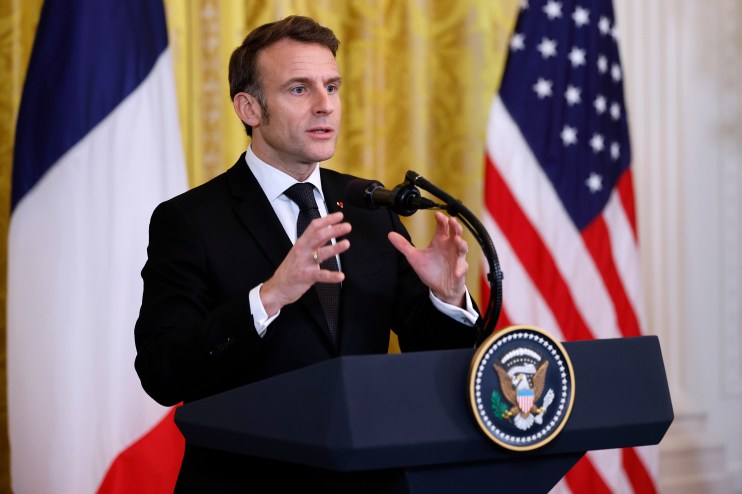
The EU’s ‘buy European’ defence spending plan is protectionist and short-sighted. And it really just means ‘buy French’, writes Eliot Wilson
The message from President Trump that Europe can no longer rely on American military power and must look to its own resources seems finally to be filtering through to the continent’s chancelleries. The European Commission has proposed a €150bn loan mechanism, Security Action for Europe (SAFE); this would be raised on the capital markets and would fund member states’ investment in urgently needed capabilities like drones and missile defence.
It is a substantial sum of money, though Germany is now contemplating an additional €500bn just for its own defence budget after the Bundestag agreed to modify the country’s constitutional “debt brake”. But this is Brussels: not only is the “free lunch” illusory but every bite can have a ripple of consequences.
What is the new EU defence spending plan?
SAFE as currently proposed would only be available to be spent with manufacturers which are wholly within the EU, Norway or Ukraine (65 per cent) and countries which have signed security agreements with the EU (35 per cent).
That stipulation would exclude not only American companies but also those in the UK and Turkey, as well as any weapons systems over which a third-party country had “design authority” or control over their use. That means it could not be spent, for example, on Patriot air and missile defence systems (made by RTX, formerly Raytheon) or any of BAE Systems’ uncrewed air systems.
In fact, 39 of the world’s top 50 defence manufacturers are excluded, but – by purest coincidence, no doubt – the rules place no limitations on products from four French companies (Thales, Naval Group, Safran and Dassault) or on Amsterdam-based KNDS, which is fifty per cent owned by France’s state holding agency, l’Agence des participations de l’État, which also happens to control shares in Thales, Naval Group and Safran.
Anyone surprised that the EU is using this loan mechanism as a protectionist and political device is naive. Brussels has come a long way from the Treaty of Rome which in 1957 sought “the progressive abolition of restrictions on international trade”. It now believes in frictionless trade within the EU’s ramparts but a Common Customs Tariff protecting Fortress Europe from without.
How SAFE will impact the UK
Advocates of these restrictions on SAFE argue that they are necessary to build up the European defence industry. Up to a point, Lord Copper. There are two additional aspects to consider.
The first is the provision allowing spending with companies in countries which have signed a security pact with the EU. This is transparently aimed at the UK: the Labour Party’s election manifesto last summer pledged to “seek an ambitious new UK-EU security pact”, and it is a major preoccupation of Sir Keir Starmer’s. However, as I wrote in this paper last June, Starmer and his colleagues hugely overestimate how much the UK matters to the EU.
Europe’s leaders see a security pact not just as an end in itself, but as a bargaining chip in a wider “reset” of the relationship between the UK and the EU which will also encompass access to fisheries and migration, among other issues. The conditions attached to SAFE would allow the EU to use the potential market for UK firms like BAE Systems, Babcock International and Rolls Royce as leverage on the British government.
How France stands to gain
This kind of industrial nationalism fits poorly with trends in defence manufacturing, however, which lean increasingly towards multinational co-operation to spread costs and risk. SAFE could not, for example, be used for the Global Combat Air Programme, the UK/Italy/Japan development of a sixth-generation stealth aircraft or the NASAMS air defence system, an American-Norwegian product made by RTX and Kongsberg.
A great deal of defence procurement across the continent involves non-EU players: the Mowag Piranha armoured fighting vehicle used by Belgium, Denmark, Ireland, Romania, Spain and Sweden is made by a subsidiary of General Dynamics, while the tracked CV90 in service with Denmark, Estonia, Finland, the Netherlands, Norway and Sweden is supplied by BAE’s Swedish subsidiary.
There is one leading player which relies predominantly on domestic or EU equipment: France. One senior figure in the UK defence industry mournfully told the Financial Times: “If the EU… is going to be transactional about this, it undermines the entire philosophy of a joint and unified Europe in defence and security terms.”
It does. The UK’s 47-year membership of the European family should have taught us that “buy European” often means “buy French”. That is disappointing but not surprising, But the EU is acting short-sightedly: the “unfair advantage” granted to EU manufacturers will not benefit them in the long run. In the meantime the EU’s military faces an artificially restricted menu when it needs the best capabilities it can find. So much for l’Entente Cordiale.