The EU needs dynamic new thinking, not lectures on unity

Even a stopped clock is right twice a day.
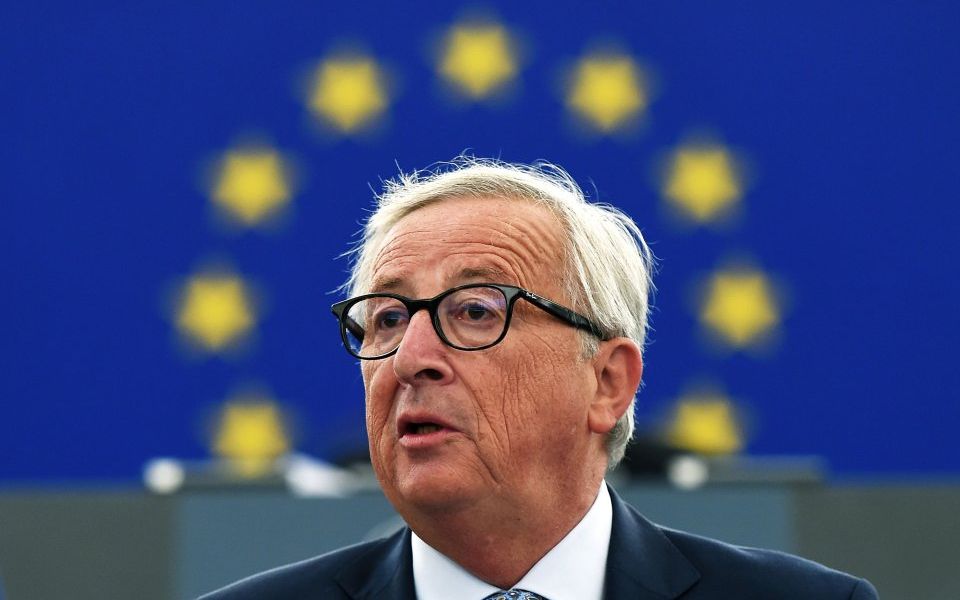
This should be adopted as the personal motto of European Commission president Jean-Claude Juncker, or at least as the tagline for his final State of the Union address yesterday.
“There is no applause when EU law dictates that Europeans have to change the clocks twice a year,” Juncker announced. “Member states should themselves decide whether their citizens live in summer or winter time. It is a question of subsidiarity…. We are out of time.”
Read more: Juncker: UK 'will never be an ordinary third country' after Brexit
He had a point. The principle of subsidiarity is that the EU should have authority only for tasks which cannot be performed at a national level. Unfortunately, ceding the power to set Daylight saving time was where Juncker’s magnanimous giveaway to EU governments ended.
The rest of his speech encouraged further integration on issues from migration to security, a bigger role for the European Defence Fund, a European Public Prosecutor’s Office, and a plea for something called “European sovereignty”.
It was a smorgasbord of platitudes and inane calls to arms (“we will always be a global payer but it is time we started being a global player too”), peppered with half-baked policy ideas, that lacked any of the cohesion that Juncker and his brand of euro-federalists would like to see across Europe.
But if it did have a central theme, it was one of lecturing admonishment: not a mediator of equals ready to listen and lead, but a schoolteacher scolding a disobedient class.
At a time when the continent is in turmoil, with populist, anti-EU parties gaining traction from Italy in the south to Sweden in the north, Juncker failed to either inspire passion for the European project or present a unifying vision for the bloc’s future.
The nod towards changing sentiment in the wake of mass immigration, with the promise of more European border guards, was undermined by the rebuke that “where borders have been reinstated, they must be removed. Failure to do so would amount to an unacceptable step back”.
For anyone who had hoped for a more flexible, dynamic, and above all realistic direction from the EU’s leaders, this was not it.
In fact, the sheer pettiness on display was breathtaking.
“No single member state could have put 26 satellites in orbit, for the benefit of 400m users worldwide,” Juncker gloated, when boasting about the Galileo satellite programme. He neglected to mention the €1bn that the UK has paid into Galileo, only for the EU to refuse Britain access post-Brexit.
While the speech was reportedly intended to focus on European security, Juncker seemed happy to play fast and loose with Britain’s intelligence and counter-terrorism cooperation, for the sake of making a point about Brexit.
And when it came to accepting responsibility for the EU’s many missteps over the past few years, he deflected. “I cannot accept the blame for every failure,” he said, implying that it is the European Council, made up of representatives from national governments, that is most at fault for the EU’s tensions.
But perhaps what was most notable about the speech was not the content, but the timing.
“Respecting the rule of law and abiding by Court decisions are not optional,” Juncker cautioned towards the end, in a thinly veiled warning to Hungary. Immediately after he finished speaking, the parliament voted for disciplinary action against Hungary for breaching the EU’s core values.
There is much to be concerned about with the Hungarian government’s move towards what its Prime Minister Viktor Orban calls “illiberal democracy”. New laws criminalise lawyers and activists who help migrants, while crackdowns on the media and pressure on the independence of the judiciary have sparked alarm across western democracies.
Nonetheless, the EU’s understandable efforts to bring Hungary into line could backfire by playing into Orban’s hands – allowing him to rail further against an EU elite. Quiet diplomacy may be better than a megaphone.
Juncker is also on thin ice when criticising certain member states for violating EU rules.
Only last week, the EU’s own ombudsman condemned the promotion of Juncker’s chief of staff Martin Selmayr as the EU’s top civil servant, in a power grab more suited to Game of Thrones than a democratic institution. The appointment “stretched and possibly even overstretched the limits of the law” and put the “wider legitimacy of the EU… at unnecessary risk”.
As a man who helped his favoured aide seize the top job with no regard for scrutiny or due process, Juncker’s lectures to other EU leaders about the rule of law ring hollow.
Juncker concluded with another maxim of stopped-clock accuracy: “Patriotism is a virtue. Unchecked nationalism is riddled with both poison and deceit.” Sadly, it is partly his own stubbornness and lack of self-awareness that has provoked the nascent nationalist movements of Europe towards the extremes.
The EU does face immense cross-border challenges – from the risk of economic crisis to the constant and ever-evolving threat of terrorism. Cooperation and unity are indeed vital to its continued success. But in a democracy, cooperation must be voluntary, not forced. And nothing in this State of the Union suggested that Juncker or his cohorts have any idea how to make that a reality.
Read more: Bank of England: Hold fire until there is Brexit certainty says shadow MPC