Is the Eurozone recovering? What traders need to know

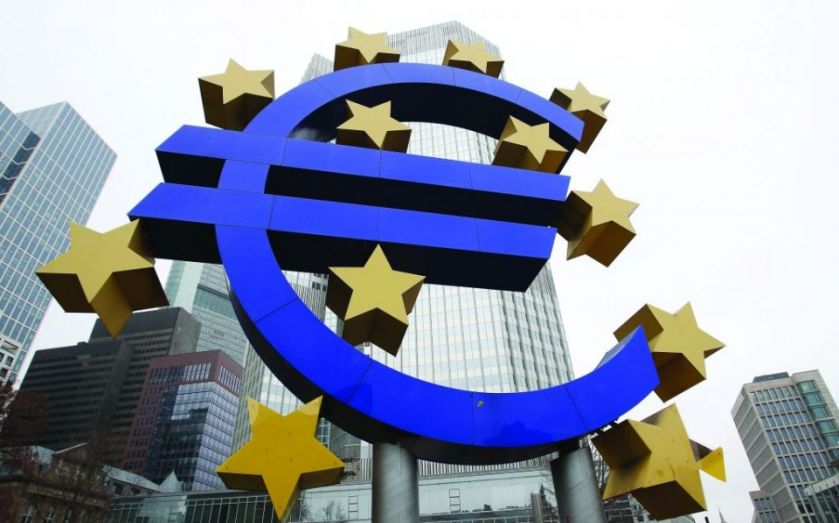
Improving credit conditions point to sustained growth.
The Eurozone economy seems like it might finally be back on track, with stock markets rallying and greater confidence that activity is picking up in a region that has long been mired in crisis.
Although German shares and the FTSE 100 fell slightly yesterday, European stocks are still trading near all-time highs. The Stoxx 600 closed at 413.63 yesterday, having reached historical highs last week. Spain’s Ibex 35 index rose 1 per cent, meanwhile, and France’s Cac 40 was up 0.26 per cent to reach 5,254.12.
Economic activity is also picking up. According to Markit’s March composite purchasing managers’ index, manufacturing production rose at the fastest pace since May 2014, while business activity rose at the fastest pace in eight months. Deflation fears are also easing, as prices fell by 0.1 per cent in March compared to a 0.3 per cent drop in February.
But is it too soon to say that Europe has finally turned the corner?
A CONFIDENCE BOOST FOR EQUITIES
Central to the revival in sentiment is the euro’s weakness. Driven by both the expectation and implementation of the European Central Bank’s quantitative easing programme – involving €60bn a month of debt purchases – the euro has seen its biggest decline against the dollar since its creation. Investors are betting that the weak currency will boost exporters in the Eurozone, helping them sell more abroad.
Indeed, the stimulus programme has been an effective confidence trick. “It emboldens businesses and households and encourages [them] to spend more money,” says Sage’s chief executive Stephen Kelly. Along with the currency’s depreciation and QE, the Eurozone also enjoyed a windfall from the fall in the oil price over the past seven months, which has not only raised consumers’ purchasing power but has also helped cut companies’ energy and raw material costs.
But indices trading near historic highs is not a clear indication that the recovery is entrenched.
“The introduction of QE has led people to become optimistic about the equities market. But when it comes to the real economy, the debate to be had is whether this actually improves demand,” says Paras Anand, head of European equities at Fidelity Worldwide Investment. Another thing to consider is that the European corporate sector is very international in its composition. Many Eurozone companies have sought new markets, prompted by better opportunities for profit outside their domestic markets, so “their performance depends on other global prospects and trends as much as the state of consumer demand in Europe,” he adds.
Despite QE’s initial success, Anand is not convinced that stimulus policies in themselves can generate results in the long run: “For any entity in the economy to have confidence, it has to be based on the prospects for long-term conditions rather than on short-term support of the economy merely in terms of liquidity,” he says.
A MIXED PICTURE OVERALL
Even as Europe takes its first steps to recovery, the results are not evenly distributed. Spain and Ireland are showing stronger signs of economic growth, followed by a fast-improving German economy. However, countries like France and Italy have not seen such a clear revival, and a total of 11 Eurozone countries failed to fulfill their anticipated growth rates last month, according to the Peterson Institute for International Economics.
Geopolitical risks also abound. There is still an enormous amount of uncertainty surrounding Greece, says eToro’s chief market analyst James Hughes. A poll by German firm Sentix found that 36.8 per cent of global investors expect that Greece will leave the euro within the next year.
On the upside, there are indications that credit conditions may be improving. After focusing on deleveraging their balance sheets in response to regulatory stress tests last year, Eurozone banks have now begun to expand their credit activity, according to a note by Fidelity’s senior vice president Dirk Hofschire. This means that loans to the private sector are on the rise for the first time since 2012, at the same time as bank lending standards are becoming easier for all types of credit (see charts). “After a contraction in the European Central Bank’s balance sheet during 2014, monetary conditions have shifted from tight to favourable,” explains Hofschire.
RIDING THE WAVE OF RECOVERY
Policymakers need to ensure that, “when the ECB finally stops pumping billions of euros into the economy, we are not going to be in the same vulnerable position,” says Hughes. But just because the recovery isn’t fully entrenched, it doesn’t mean that there aren’t good trading opportunities out there.
“Many good opportunities will arise in different sectors as the continent moves out of the worst phase of the crisis,” says Anand. But rather than picking a sector, he says that it feels like we are entering an environment for European markets where there is no clear overarching theme. “It’s going to become much more of a stock-picking market,” he adds.
Indeed, a confusing macro picture is unlikely to lead to clear market trends. The ECB is set to meet tomorrow, and its president Mario Draghi will no doubt claim that his QE programme has already successfully improved confidence in the Eurozone. But worries over Greece will continue to weigh on sentiment. Although the country successfully made a payment due to the IMF last week, it has still yet to deliver a set of reform proposals to Eurozone authorities sufficient to release the funds it needs to stay afloat.