Exclusive: Government scraps ‘game-changing’ antibody tests at NHS sites


The government has quietly scrapped antibody tests at NHS sites, Morning Wire can reveal, despite calls to increase testing of immunity levels alongside the vaccine rollout.
The Department of Health and Social Care (DHSC) yesterday deleted a section from its website advising people on how to get free antibody tests at community clinics, mobile testing sites and in primary care.
DHSC did not deny it had scrapped the option when asked by Morning Wire but said it would continue offering antibody tests “in a phased way” via home finger-prick kits.
Antibody tests are still only available for NHS staff and adult social care workers — and not to the wider public.
But the government has faced mounting calls to increase antibody testing after data released yesterday showed natural immunity to Covid may prove better protection than the Astrazeneca vaccine.
Natural immunity
Research published in Public Health England’s (PHE) first large-scale study on Covid immunity showed that antibodies from previous coronavirus infection provide at least 83 per cent protection from contracting the virus again, for an average of at least five months.
Meanwhile, the Astrazeneca vaccine provides short-term protection of around 70 per cent. The Pfizer vaccine is around 95 per cent effective, but the UK has only ordered 30m doses of the jab, compared to 100m doses of the Astrazeneca vaccine.
Scientists yesterday suggested increased antibody testing could prevent vaccines being wasted on those with a substantial level of natural immunity.
“We now know that most of those who have had the virus and developed antibodies are protected from reinfection. Immunity gives you a similar effect to the Pfizer vaccine, and much better effect than the Astrazeneca,” said Professor Susan Hopkins, senior medical advisor at PHE.
What happened to those antibody tests?
Health secretary Matt Hancock first announced the rollout of antibody tests on the same day England entered its first national lockdown in March last year.
Speaking in the Commons, Hancock said: “The antibody test, which tests whether someone has the antibodies that make them immune to coronavirus, has now been developed, and we are buying it in large quantities.”
Two days later, the Prime Minister promised the antibody tests would be “game-changing”, and declared that the government was buying up “millions” of test kits.
But an initial order of around 3.5m antibody tests from two Chinese firms proved fruitless, after the home kits were deemed too inaccurate for wide-scale use.
The government then spent almost £150m over the summer buying antibody tests from pharmaceutical giants Abbott and Roche, which PHE declared were “100 per cent effective”.
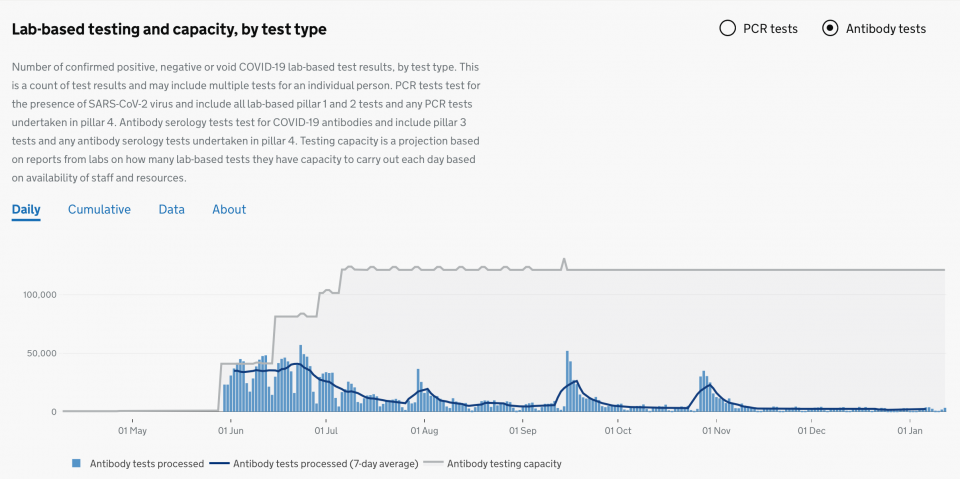
But of the 10m antibody tests ordered, fewer than 2.9m have been processed to date, with testing seeing a huge drop off since the summer.
On average, 41,000 antibody tests were being sent out to NHS workers every day in late June, as the government scrambled to meet its target to complete 200,000 tests a day — a figure which included antibody tests.
Currently, fewer than 2,400 antibody tests are being processed each day, though PHE still claims it has capacity to process 121,100 kits on a daily basis.
The contracts with Abbott and Roche, secured by DHSC and PHE respectively, have now expired.
Despite not being available to the wider public, the government has so far spent almost £800,000 on a website and IT support system for ordering antibody tests.
Three separate contracts for producing the IT system were awarded last year without competition to Hippo Digital, the same company that was handed £1.7m to produce the government’s suggesting people retrain as boxers, cinema projectionists and lock keepers.
Will they make a comeback?
Experts have suggested that ministers’ reluctance to roll out antibody tests to the wider public may hinge on worries that a positive test might be interpreted as a hall pass to flout lockdown rules.
“There’s an issue with what you’re going to do with that data,” said Martin Hibberd, a professor of emerging infectious disease at the London School of Hygiene and Tropical Medicine.
“If I had an antibody test that told me I was positive, that might change the way I behave,” he told City A.M. “I’m not sure people fully understand what the antibody test might mean in terms of a behavioural response… That’s still a vague area we don’t know enough about.”
Private antibody tests are already available for as much as £89 in pharmacies such as Superdrug.
DHSC is currently advertising three separate contracts for the production and laboratory management of antibody tests, worth a combined value of £230m.
One of these, a two-year contract worth £100m for end-to-end laboratory testing of antibody tests, suggests PHE may not be so focused on home kits after all, according to Hibberd.
“We’re pretty loaded with infections at the moment unfortunately, but that will build up the number of people that are antibody-positive, and the vaccinations are doing the same thing,” he said.
“So the antibody tests may just be for surveillance of public health and evaluating where we are on that scale. That would be very useful and informative about when we might be able to open up society again.”