Failure to cut energy demand risks ‘reckless’ waste of taxpayer money

Capping energy prices without a major drive to help people use less energy would risk a “reckless” use of taxpayers’ money, warned the Social Market Foundation.
It has called for the Government to roll out public information campaigns for reducing energy use and to ramp up energy efficiency across the country by insulating millions more houses.
The economic think tank supported the Government’s price guarantee for households – which has frozen energy bills at an average of £2,500 per year for the next two years – but argued the financial outlay had to be matched with reductions in demand.
It highlighted the announced policy – which could cost as much as double the £70bn furlough scheme – means every unit of energy used will impose a cost on the Exchequer.
The government has since announced a further commitment for six-months of emergency support for businesses, which Cornwall Insight forecasts will cost as much as £25bn.
With national debt approaching 100 per cent of GDP and annual debt interest payments on course to exceed £100bn, the SMF argued that reducing demand for energy is now “an urgent matter of fiscal responsibility.”
It said: “The central decision to allocate significant sums of public money to lower energy bills is the right one. But it must be accompanied by an equally significant effort to minimise the overall cost of that decision by reducing demand for energy.”
The UK has among the least energy efficient housing in Europe, and EDF has recently called for a nationwide campaign to boost insulation.
Philippe Commaret, EDF’s managing director of customers, told Morning Wire last month he did not understand why energy efficiency was “a bad word” and the lack of information for consumers, when loft or cavity wall insulation could reduce energy bills by as much as £600 per year.
He noted that the average insulation age of UK homes was 1976 – making the country nearly 50 years out of date with insulation.
He said: “Nobody would have would buy a car from 1976. Nobody would continue to have a boiler that has been installed in 1976. Nobody would have a kitchen that lasts from 1976 and, still, nearly two thirds of UK households have insulation equivalent or below 1976.”
Public information and insulation could drive down bills
A public information campaign could include advice on quick-fix insulation mechanism, boiler optimisation, and changes in consumer habits which could potentially save some households hundreds of pounds a year.
Meanwhile, 19m homes in the UK fall below the Government’s target of Energy Performance Certificate rating C.
This means they use more energy than they reasonably need to, largely because they are poorly insulated, which is now imposing a direct cost on the public finances.
The paper said: “As gas-generated heat leaks through our drafty roofs, walls, floors and windows this winter and next, it will take with it billions of pounds in public money. In the months ahead, insulating homes will not just be good health, climate, and welfare policy, but also a matter of fiscal responsibility.”
Earlier this week, Prime Minister Liz Truss said she wanted to leave people to make their own decisions on energy efficiency.
However, James Kirkup, the Director of the Social Market Foundation, said the Prime Minister’s views on personal choice should not be inconsistent with public information campaigns around energy efficiency.
He said: “The PM’s instinct may well be to leave people alone to make their own choices, but where’s the harm in giving them more information on which to base those choices?
Besides, those sacrosanct individual choices aren’t purely private ones when they entail the use of public money. The simple fact of the Prime Minister’s energy policy is that it means each household’s choices on energy use and energy efficiency have direct consequences for the public finances. Laissez-faire libertarianism over the use of subsidised energy has a real and direct price for current and future taxpayers.”
Energy efficiency slowdown hampers households
The Government has invested £6.6bn in total this Parliament to improve energy efficiency across the country.
Last year, it unveiled the Heat and Buildings Strategy, setting out a decarbonisation plan for households alongside commercial, industrial and public sector buildings.
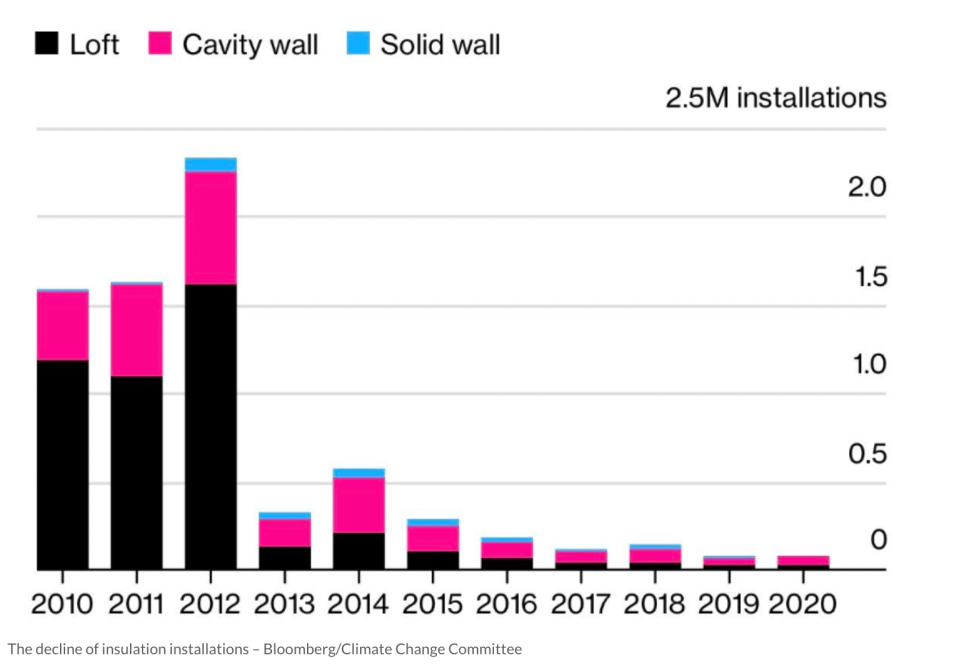
However, installation rates have dropped sharply in the past decade from over two million homes per year to just tens of thousands after former Prime Minister David Cameron slashed previous efficiency schemes – according to the Climate Change Committee.
The Energy and Climate Intelligence Unit (ECIU) has revealed earlier this month that this will see around £1.5bn wasted on higher energy bills in the next financial year alone.
Its analysis suggests poorly insulated homes in efficiency band F will also pay £1,000 per year more than houses in band C.
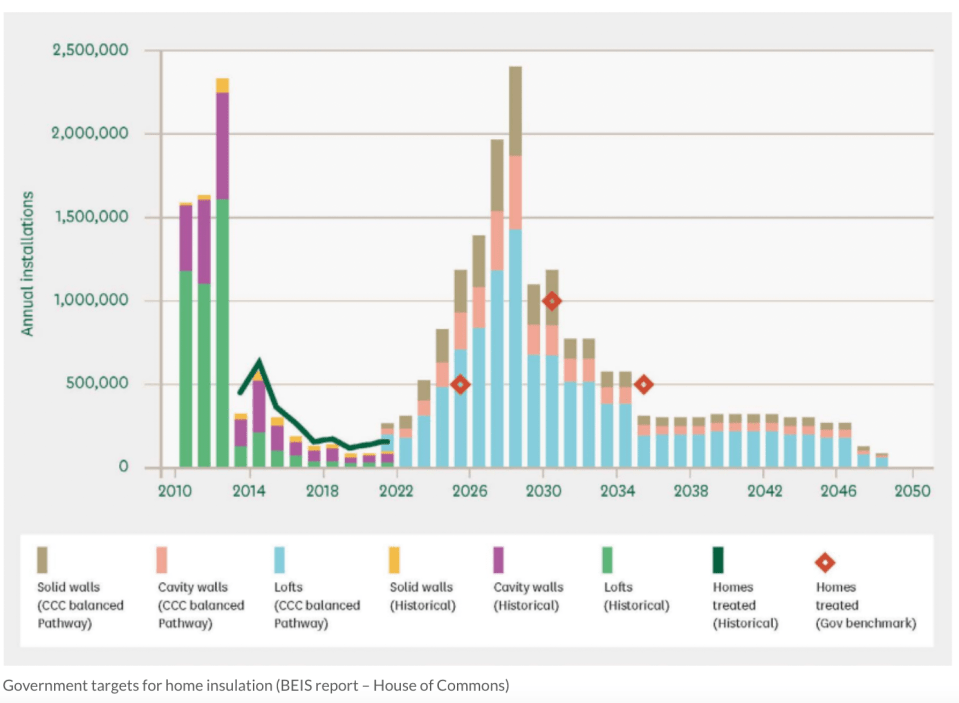
The Government has previously been accused of exacerbating the energy crisis by failing to ramp up the efficiency of British homes.
Darren Jones, chair of the Business, Energy and Industrial Strategy (BEIS) committee, told Morning Wire last month that Government inaction on insulation measures – such as loft insulation and double glazing – had left energy users exposed to ultra-high energy bills.
He believed energy efficiency measures had been neglected since the Conservative Party took office over a decade ago
He said: “The Government has made this winter much worse due to ministers’ failure to deliver a successful, national home insulation programme since 2010. Reducing the amount of heating needed to keep our homes warm is an obvious way to reduce energy bills. That’s why energy efficiency works are the permanent solution to reducing costs.”
Fine line: Energy tips or patronising advice?
Suppliers have called for customers to be encouraged to reduce energy use to ease demand, driving down prices and staving off the risk of supply shortages.
EON UK boss Michael Lewis previously called on the Government to bring in a demand strategy to go alongside its calls for supply security.
He recently criticised the business support package for failing to include measures to encourage energy efficiency.
Ahead of the latest support packages, So Energy co-founder Simon Oscroft told Morning Wire that believed consumers should be encouraged to reduce their energy use to help ease costs and minimise the need for rationing supplies this winter.
He argued that the Government could provide more information to households to cut down costs with minimal disruption to their lives.
This included lowering the boiler flow rate and reducing thermostat temperatures by just a couple of degrees, which could take £150-200 off bills.
He said: “The Government playing a role in offering advice in a more comprehensive manner would be significant and it would help. Those marginal gains on demand could be powerful.”
However, Oscroft believed a balance had to be struck between useful information and trivialising the pain facing households – which has been driven by soaring wholesale gas costs, not consumer behaviour.
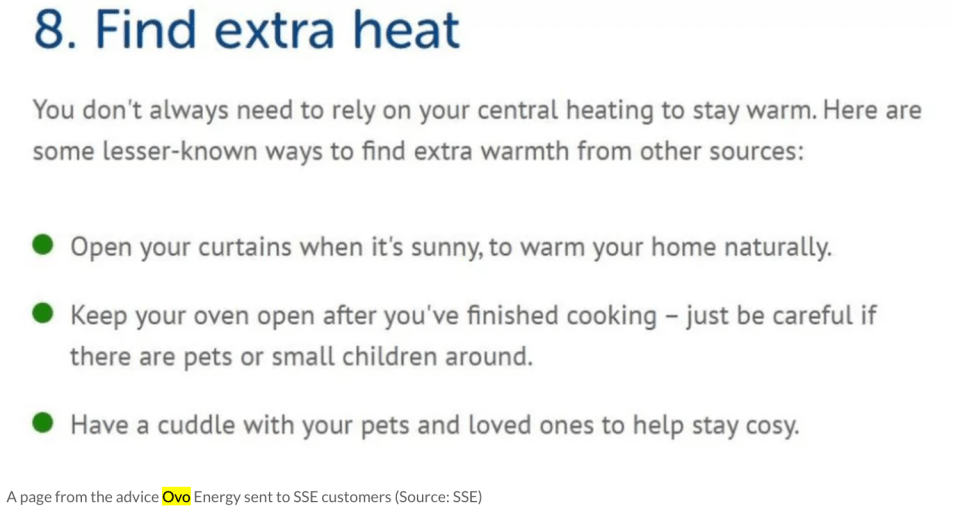
Ovo Energy was severely criticised earlier this year for offering advice to customers that was widely considered patronising – including recommending customers cuddle their pets and do star jumps to reduce their consumption.
EON UK was also slammed on social media for offering customers free socks with slogans for cutting down energy usage.
Oscroft said: “It’s obviously important that we do this so it doesn’t seem patronising, but there are tangible things that everyone can do to save money. You’re not just helping yourself. You’re actually helping everyone in this country.”