Fans will grow weary if player burnout continues in sport

With demands on players like nothing seen previously, is potential player burnout also going to have an impact on fans too?
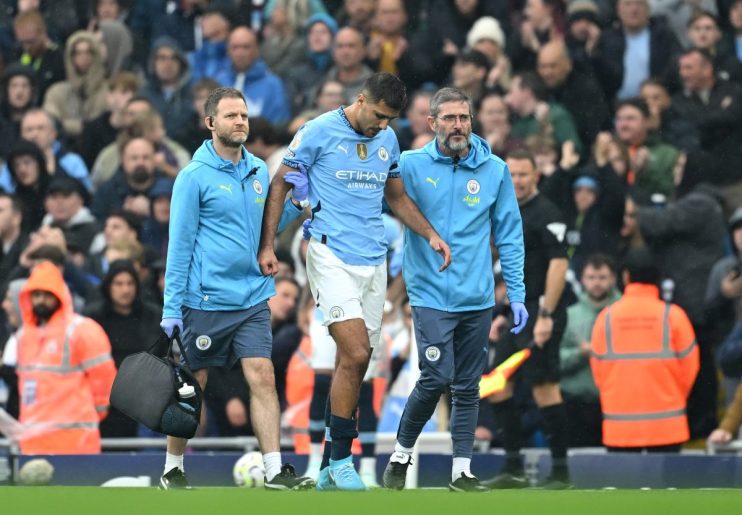
It’s a surprising thing that during a cost-of-living crisis, with households struggling and economies straining, I find myself sympathising with Rodrigo Hernández Cascante.
The £200,000-a-week Manchester City midfielder, better known as Rodri, last month threatened strike action over the number of games footballers are being asked to play.
Last week, matters escalated when the global players’ union Fifpro joined domestic leagues in suing Fifa, claiming that the international football calendar is “now beyond saturation”.
Those who bridle at a 15 per cent pay rise for train drivers will be spitting out their coffee at the idea of someone who earns more than £2,000 per match minute complaining about anything, let alone being overworked.
Union disputes are often about more than just money however and, in this case, it is conditions — not pay — that has players threatening a walkout. Fifpro claims player safety is now at “risk”; but is that entirely true?
Players vs games
While competitions are undoubtedly expanding, a recent study by CIES Football Observatory across the top 40 leagues showed that only five per cent of clubs play more than 60 games a season.
Those clubs are the biggest and therefore best equipped to manage their squads. Fifa has also fairly pointed out that these clubs voluntarily engage in far-flung pre-season tours.
Player fatigue is also not a new problem. The same arguments were being made 20 years ago by the likes of Patrick Vieira who claimed he was “cooked” after playing 66 games in a season — four more than Rodri.
On top of these more rational arguments there will be those who say, “suck it up”. This is the deal players signed up for by doing a job billions of others would love to do. You can’t have your Lamborghini and eat it.
Despite this, I find myself feeling uncomfortable with what’s being asked of many professional athletes as sport naturally becomes more commercialised and spectacularised.
The Rodri story is pertinent because at this moment he isn’t playing any games at all. He’s sidelined for the rest of the season after knee ligament damage and surgery.
You and I might not have multi-million-pound contracts, but we do have laws that protect us at work. In 50 years since the Health and Safety Act was introduced injuries at work have decreased by 85 per cent.
Debilitating
Former Fifa medical chief Jiri Dvorak made this comparison, saying: “There are rules about the maximum number of hours per day you can drive a truck, but there are no rules for footballers.”
You might think a meniscus tear isn’t comparable to a road crash, but in some sports that comparison is entirely accurate. Both rugby union and American football are facing serious legal and moral challenges to keep players safe when collisions do so much harm.
Even if most sporting injuries aren’t life threatening, they can be life debilitating. Many former athletes struggle with simple tasks we take for granted. At one point Sir Andy Murrray’s main ambition for hip surgery was merely to play with his children again pain free.
Too many careers have been curtailed too early, leading to a loss of earnings and economic hardship. This is a particular concern as athletes are being asked to do more from a younger age. In the last 10 years, there was a 55.8 per cent increase in the number of minutes players aged 23 and under were playing for top clubs.
It’s not just young athletes but female athletes that need more protection. In women’s sport, multiple studies have shown female athletes are two to eight times more likely to sustain knee ligament damage and 1.7 times less likely to fully recover.
Mental toll
While physical injuries are more visible, the mental toll of playing elite sport can have similarly destructive —and occasionally catastrophic — consequences.
The suicide of PGA Tour golfer Grayson Murray this year was a stark reminder that mental health can be a case of life and death. An NCAA study also revealed that suicides among US college athletes have doubled in the last 20 years.
It’s easy to underestimate how much the mental strain of competition can affect life outside of sport. Former England batter Marcus Trescothick, who retired because of his mental health, suffered panic attacks from the age of 10.
When it comes to mental wellbeing, ironically big money hinders rather than helps. All-or-nothing moments with millions on the line heighten the drama but also the trauma.
Fan focus
As more athletes talk openly about mental health and we understand how it affects us, you might think administrators in sport would also be doing more. But there is an increasing pressure on athletes to compete, whether through mandatory events or expanded competitions.
If athletes had more right to choose their schedules, it would be a step forward — but still not go far enough. Young athletes are notoriously bad at making good decisions for their long-term health, so it’s on governing bodies to do that for them.
You might ask why they would handicap their own product. The simple answer is that fans grow weary too. Any marketer understands the balance between supply and demand. The biggest moments in sport should be sacred and they should also feature the very best players. Perhaps the biggest issue with playing too much is that fans, not just players, get burnout.
Reading fan forums there are some signs that attitudes are softening. Perhaps the only thing fans resent more than overpaid players is greedy governing bodies exploiting overpaid players.
Matt Readman is chief strategy officer at agency Dark Horses.