Skip to content
Saturday 5 September 2026London --:--Frankfurt --:--Zurich --:--
NewslettersSearchEN · DE · FR
MorningWire

European business, markets and politics

FTSE 100
10,831.09
0.00%
DAX
26,046.40
+0.17%
CAC 40
8,278.77
-0.09%
STOXX 50
6,392.93
+0.16%
  • Europe
  • Markets
  • Business
  • Economy
  • Regulation
  • Politics
  • Opinion
More
GermanyFranceEU InstitutionsCompetitionPublic AffairsBankingTechnologyEnergy
  • Germany
  • France
  • Europe
  • Markets
  • Business
  • Economy
  • Regulation
  • Politics
  • Opinion
  • DE
Tuesday 26 November 2013 7:58 pm

Financial and economic flaws in the SNP’s plan make the case for Union

By: Express KCS

Add as a preferred source on Google

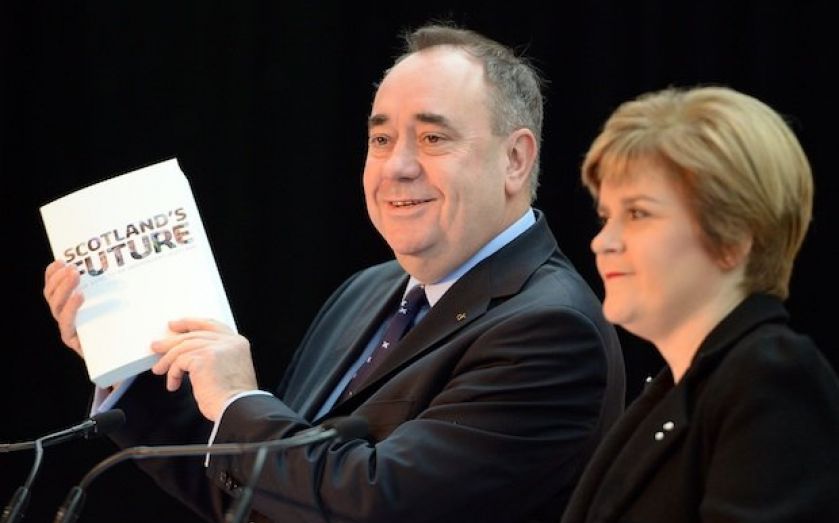
THE SCOTTISH government independence White Paper, released yesterday, fell flat. If length were the measure of success, it would be a winner. But despite hundreds of pages, it failed to answer the critical questions that Scots have about independence, and it certainly failed to make any case for breaking up the United Kingdom.

Economic and financial issues are at the heart of the debate, but we learnt nothing new about the Scottish National Party’s (SNP) plans for Scotland’s economy.

They persist in saying that the rest of the UK would be happy to join a currency union with an independent Scotland – even though this would import into the UK economy all the problems that the Eurozone is struggling with today. Even when every UK minister, and virtually every economic analyst, says the idea wouldn’t work, the SNP just claims they are bluffing. And in what looks like a throwaway line to satisfy some of their political allies, they suggest this currency union might only be temporary – undermining its future at a stroke.

A new state without a credible plan for its currency would be in an impossible situation. In particular, the position of banks and financial services companies would be very difficult indeed. This White Paper completely ignores the risk which independence would create for Scotland’s vitally important financial services sector – the biggest in the UK outside London. The SNP proposes a patchwork of financial services regulation, some of it purely Scottish, and some of it to be agreed with the rest of the UK. Why the rest of the UK would agree to take on these risks, simply to suit the SNP’s political project, is hard to understand.

The Scottish government is in a similar state of denial over the fiscal realities that would face the country. The dispassionate and comprehensive analysis by the Institute of Fiscal Studies, released last week, pointed out that Scotland would be in a much more challenging fiscal position than the UK as a whole, even on the most optimistic assumptions. It made projections for the next 50 years. The Scottish government’s White Paper looks at the budget for only the first 12 months of independence.

Even more bizarrely, the main policy announcement was a promise about childcare – something which is already devolved to the Scottish Parliament.

In fact, what this White Paper successfully emphasises is the case for the United Kingdom. The SNP is trying to claim that Scotland could keep all the benefits of being in the UK, like a single stable currency and a common system of financial regulation, while still becoming independent. This is simply incoherent – and it shows what happens when an obsessive political project is allowed to override all economic good sense.

The Scottish people will be right to reject it, because they will understand that, with the rest of the UK, they are better together.

Alistair Darling is leader of Better Together, Labour MP for Edinburgh South West, and a former chancellor.

Share this article

  • Facebook
  • X
  • LinkedIn
  • WhatsApp
  • Email

Similarly tagged content:

Sections

  • Opinion

Categories

  • Opinion

Trending Articles

  • Victoria Beckham owed £350,000 by Harvey Nichols

  • M&G: FTSE 100 giant hits out at Rayner’s ground rent cap as it suffers loss

  • Fulham owner Khan sees his £1bn stadium construction project take next steps

  • John Lewis boss: UK economy facing a ‘permacrisis’ 

  • Don’t underestimate the free trade agreement Britain just joined

More from Morning Wire

  • Jonathan Reynolds’ industrial strategy is straight out of the 60s

    Opinion
    Labour's Jonathan Reynolds unveiled the industrial strategy in June.
  • Andrew Bailey: Populism a threat to global economy

    Economics
    Andrew Bailey, Bank of England governor, discusses economic policy during a press conference at the central bank headquart...
  • Jenrick refuses to rule out bank tax 

    Politics
    Robert Jenrick speaking at a podium with British Workers First and Union Jack flags, discussing bank taxes.
  • SNP slammed for ‘mind-boggling’ food price cap plans

    Retail
    Bald man in glasses and dark suit with a purple tie and Scottish flag pin, looking to the left.
  • Burnham says the government is central to his ‘triple helix’ plan for growth

    Politics
    Andy Burnham leaves 10 Downing Street, holding a red folder, in a navy suit and white tie
  • UK economy to ‘reverse gains’ as construction drags growth

    Economics
    Retail sales slowed in September
  • South Africa need cash from New Zealand Tests but All Blacks fans not like Lions

    Sport Business
    New Zealand All Blacks perform the Haka facing South African Springboks rugby team on field.
  • As it happened: FTSE 100 rallies after JD Sports drags on blue chips; oil jumps again

    FTSE 100 Live
    Londons Stock Exchange orb with FTSE 100 display, symbolizing business and market updates
MorningWire

Independent European business, markets and political news for decision-makers.

Morning Briefing

Europe

  • Germany
  • France
  • EU Institutions
  • Europe

Business

  • Markets
  • Business
  • Economy
  • Regulation
  • Competition
  • Public Affairs

Editorial

  • Opinion
  • Editorial Policy
  • Corrections
  • Contact

Company

  • About Morning Wire
  • Privacy Policy
  • Terms of Use
  • Cookie Policy
© 2026 Morning Wire Ltd · Published by Morning Wire Media, Bahnhofstrasse 65, 8001 Zürich, Switzerland
Privacy · Terms · Cookies · Facebook