Five takeaways as Israel-Hamas conflict reaches 100-day mark

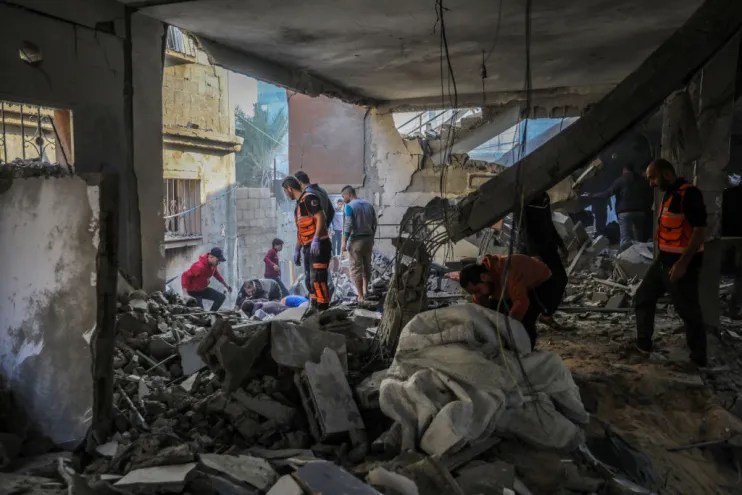
Sunday January 14 marks 100 days that Israel and Hamas have been at war.
Israel declared war in response to Hamas’ unprecedented cross-border attack on October 7 in which the Islamic militant group killed some 1,200 people, mostly civilians, and took 250 others hostage.
It was the deadliest attack in Israel’s history and the deadliest for Jews since the Holocaust.
Israel responded with weeks of intense airstrikes in Gaza before expanding the operation into a ground offensive.
It says its goal is to crush Hamas and win the release of the more than 100 hostages still held by the group.
Here are five takeaways from the first 100 days of a conflict that has upended the region:
Israel will never be the same
The October 7 attack blindsided Israel and shattered the nation’s faith in its leaders.
While the public has rallied behind the military’s war effort, it remains deeply traumatised.
Posters of the hostages who remain in Hamas captivity line public streets and people wear T-shirts calling on leaders to “Bring Them Home”.
Israeli news channels devote their broadcasts to round-the-clock coverage of the war.
They broadcast non-stop tales of tragedy and heroism from October 7, stories about hostages and their families, tearful funerals of soldiers killed in action and reports from Gaza by correspondents smiling alongside the troops.
There is little discussion or sympathy over the skyrocketing death toll and deteriorating humanitarian situation in Gaza. Plans for post-war Gaza are rarely mentioned.
While chastened Israeli security officials have apologised and signalled that they will resign after the war, Prime Minister Benjamin Netanyahu remains firmly entrenched.
Despite a sharp drop in his public approval ratings, Mr Netanyahu has resisted calls to apologise, step down or investigate his government’s failings.
Gaza will never be the same
Conditions before October 7 were already difficult in Gaza after a stifling blockade imposed by Israel and Egypt following Hamas’ takeover in 2007. The territory is now unrecognisable.
Experts say the Israeli bombing is among the most intense in modern history.
Gaza health authorities say the death toll already has eclipsed 23,000 people, roughly 1% of the Palestinian territory’s population. Thousands more remain missing or badly wounded.
More than 80% of the population has been displaced and tens of thousands of people are now crammed into sprawling tent camps on small slivers of space in southern Gaza that also come under Israeli fire.
The United Nations (UN) estimates about a quarter of Gaza’s population is starving. Just 15 of Gaza’s 36 hospitals are partially operational, according to the UN, leaving the medical system close to collapse.
“Gaza has simply become uninhabitable,” wrote Martin Griffiths, the U.N.’s humanitarian chief.
It is all connected
The war has rippled across the entire Middle East, threatening to escalate into a broader conflict pitting a US-led alliance against Iranian-backed militant groups.
Almost immediately after the Hamas attack, Iranian-backed Hezbollah militants in Lebanon began striking Israel, triggering Israeli retaliatory attacks.
The back-and-forth fighting between Israel and Hezbollah has not erupted into a full-blown war but it has come perilously close, most recently after a January 2 airstrike blamed on Israel that killed a top Hamas official in Beirut.
Hezbollah responded with heavy barrages on Israeli military bases while Israel has assassinated several Hezbollah commanders in targeted airstrikes.
At the same time, Iranian-backed Houthi rebels in Yemen have carried out a series of attacks on civilian cargo ships in the Red Sea. Meanwhile, Iranian-backed militias have attacked US forces in Iraq and Syria.
The United States has dispatched warships to the Mediterranean and Red Seas to contain the violence.
On Thursday, the US and British militaries bombed more than a dozen Houthi targets in Yemen. The Houthis vowed to retaliate, raising the prospect of an even wider conflict.
Israel cannot ignore the Palestinians
Throughout his time in office, Mr Netanyahu has repeatedly attempted to sideline the Palestinian issue.
He has rejected various peace initiatives, dismissed the internationally-recognised Palestinian Authority as weak or irrelevant, and promoted policies that left Palestinians divided between rival governments in Gaza and the West Bank.
Instead, he has tried to normalise relations with other Arab countries in hopes of isolating the Palestinians and pressuring them to accept an arrangement that falls short of their dreams of independence.
Just before October 7, Mr Netanyahu was boasting of efforts to forge ties with Saudi Arabia.
The Hamas attack, along with a spike in violence in the West Bank, have put the Israeli-Palestinian issue back on centre stage.
The Saudis have revived the possibility of establishing ties with Israel, but only if this included the establishment of an independent Palestinian state.
There is no post-war plan
As the war drags on and the death toll mounts, there is no clear path for when the fighting will end or what will follow.
Israel says Hamas can play no part in Gaza’s future. Hamas says that is an illusion.
The US and the international community want a revitalised Palestinian Authority to govern Gaza and steps toward a two-state solution. Israel objects to this.
Israel wants to maintain a long-term military presence in Gaza. The US does not want Israel to reoccupy the territory.
Reconstruction will take years. It is unclear who will pay for it or how the required materials will enter the territory through its limited crossings.
Associated Press – Josef Federman