Football and rugby are still getting head injury wrong. Is this headband the answer?

It is a dark irony that football and rugby have never been more concerned with head injury and concussion, yet the approaches of both sports remain dangerously misguided.
In their attempts to prevent the trickle of chronic traumatic encephalopathy (CTE) and early-onset dementia cases becoming a torrent, football has experimented with a ban on heading and rugby with lowering the legal height for tackles.
But both policies are fundamentally flawed, say experts, because they treat concussion as the only danger. Sub-concussive impacts are a bigger risk as they are 500 times more frequent, caused by only a quarter of the force of a concussion and usually asymptomatic.
“Calling for the banning of heading is like stopping the sale of Mars bars and expecting obesity to go away,” says Judith McMinn, who researched the topic while developing Rezon Halos, a protective headband for playing sport.
“Labelling this as all down to heading is pretty naive. If it were all about heading, why would NFL and rugby players have CTE? It’s sub-concussions from head impacts, however you get them.”
CTE was identified 80 years ago but has only recently been better understood, and the way that it works is still not widely appreciated. One of the key learnings has been that rotational forces are more damaging than linear ones, destroying brain cells and causing bleeding in the brain.
At the same time, current headgear for athletes offers limited protection. Helmets prevent skull fractures and scrum caps limit cuts, scratches and cauliflower ears, but neither protect against sub-concussive impacts and those rotational forces.
“The irony is that we have a crisis of brain injury in rugby and yet the headguard which 60 per cent of people think is protective is in fact not protective at all [against CTE],” she adds.
Sport’s failure to grapple with head injuries has troubled McMinn, a director at the Northumberland County Football Association and formerly of Deloitte and Tony Blair Associates, since her days playing school hockey 25 years ago.
She had a question: “Why are we protecting our teeth and shins but not our brains? I asked a lot of people and no one could tell me the answer.”
So McMinn set about trying to solve it herself. Having spotted a gap in the market, she assembled an international team of experts in brain injury, wearable tech design and manufacturing and set about creating Rezon Halos.
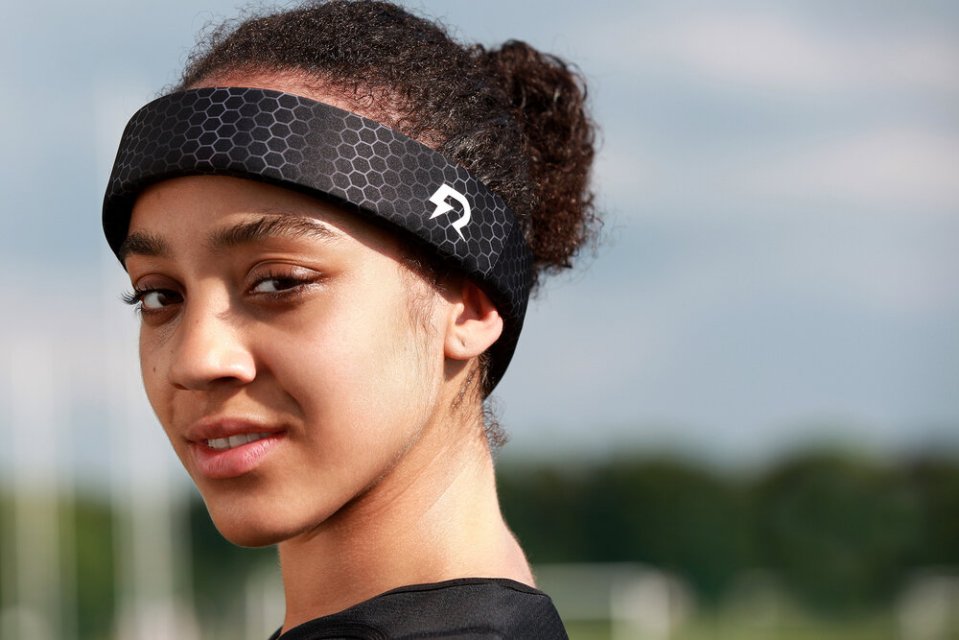
A headband made up of nine layers that reduce rotational force on the brain, the Rezon Halos are less than 1cm thick and weighs just 70g, making them the lightest and thinnest product awarded five stars by Virginia Tech, the industry standard for protective sports headgear.
It became the only legal and CE-marked protective headband in the UK and Europe in November 2021, since when it has sold thousands of units around the world, and is soon to go on sale in high street shops for the first time, priced £89.
McMinn has other, more personal motivations for her mission to minimise CTE. “My father has dementia, unrelated to sport, and I have watched how life changing that has been for him and the loss of who he is in our family. That story is not unusual.”
Dementia kills more women than men, a problem made more acute by the rise in women playing sport. “We have this generational change which is wonderful but women are at greater risk,” she says. “For 20 years we have known… but top sportsmen have never heard of it.”
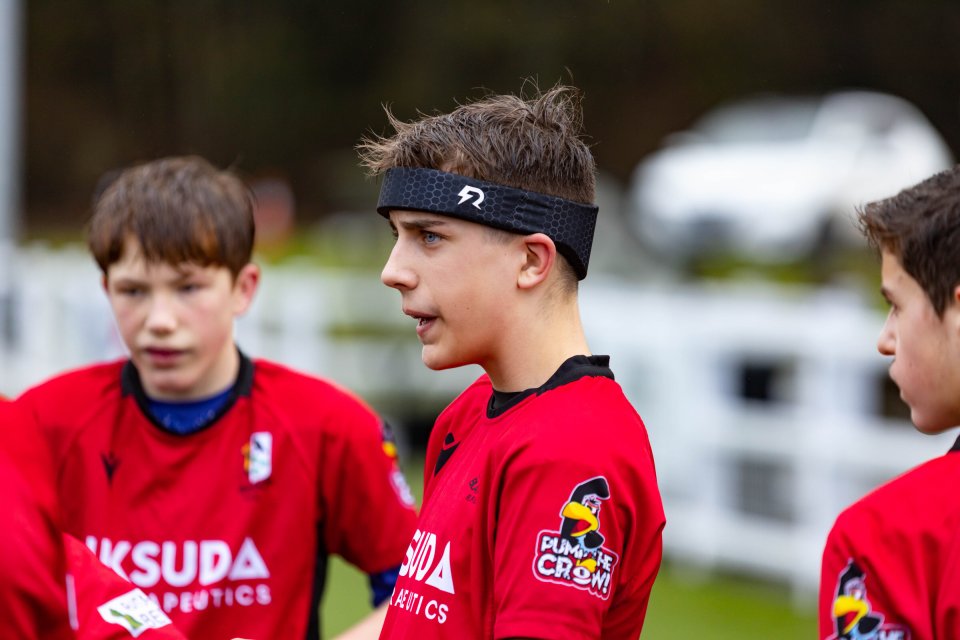
Rezon Halos are already in use at Premier League academies and Premiership rugby clubs as well as grassroots level; the challenge is achieving wider adoption. One footballer approached to endorse Rezon Halos asked for £250,000. “They should be paying me that,” McMinn quips.
“At the top level players unfortunately aren’t getting the facts. The other thing is that no one wants to be first. People think ‘I don’t see it on so-and-so, so I’m not wearing it’.”
McMinn is hopeful that will change when coaches, clubs and schools realise their duty of care should extend to offering brain protection. Ultimately, she says, it also comes down to taking personal responsibility.
“You’ve got to appreciate the brain determines performance in sport and in life,” she says. “Everything we like about good sportspeople comes from their brains: their anticipation, ability to make decisions, to think in the moment. We’re offering the ability to protect your performance.
“Even if you don’t go on to develop a neuro-degenerative disease, you’re still lowering your IQ because you are damaging your brain. It’s a greater risk if you are under 12 or a woman. That’s a biological fact. Most people don’t want to be a lesser version of themselves with age.
“People need to realise this is their own choice. Do they want their children to have brain damage? That shouldn’t be guided by whether Marcus Rashford wears one or not.”