For young Londoners, working from home is a cramped and dismal experience

Ah the great British work from home experiment: levelling the playing field, redressing work-life balance, enabling millions of people to work when and where best suits them.
After a brief period of chaos at the end of March when the nation struggled to get to grips with Zoom and Amazon sold out of laptop stands, UK workers have adapted to office-less life with aplomb — so much so that it’s proving difficult to get them back. The government’s attempt at “Back To Work Monday” this week barely registered, with businesses and employees alike choosing to maintain the home working status quo over mass transit back to the “new normal” of socially distanced office life.
It seems an overwhelming majority of workers (between 60 and 78 per cent, depending on which polls you look at) want to continue working from home at least part of the time for the foreseeable future.
But there’s a problem with pontificating about “what workers want” based on the polls — namely, which workers? Because while a majority may be enjoying their newfound freedom to send emails from their gardens, for a substantial minority, lockdown working has been a thoroughly dismal experience.
According to new research conducted by the London School of Economics and affordable housing developer Pocket Living, young Londoners living in shared properties — that is, the vast majority of the capital’s young workforce — had on average 9.3 square metres of personal space to themselves during lockdown. For context, that’s about the size of a small garage.
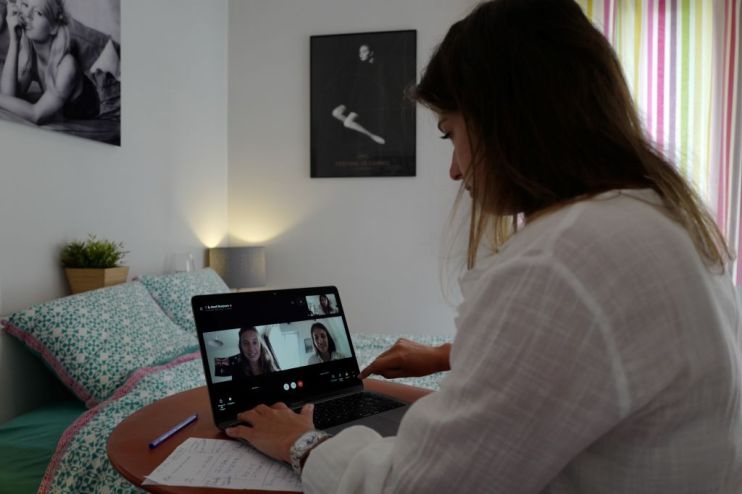
And that’s not all. Staggeringly, 37 per cent of Londoners in house shares have been working and sleeping in their bedroom. At the height of lockdown when reasons to leave the house were severely restricted, that amounts of 20-plus hours within the same four walls — disturbingly close to a prison cell.
Ask a young Londoner (or, indeed, anyone in a house share set-up, whatever their age and location) what their work from home experience has been like, and you probably won’t hear about the joys of not having to commute or how nice it is to cook while on conference calls. Instead, expect stories of struggling to find a work-appropriate backdrop for a Zoom call that doesn’t have the bed in shot, or trying to concentrate when housemates you used to like before you spent 24 hours a day together are blasting music from the next room.
Health and safety is also serious issue. I’ve been luckier than most with my remote working set-up, but an entire day propped up by pillows on the sofa or bed and staring down at a laptop has taken its toll on my neck and back. Helpful online tips that suggest investing in a proper desk and office chair conveniently overlook not only how expensive such items are (with what employers are willing to fund differing massively across companies), but how much space they take up. It turns out that not everyone has a comfortable home office to decamp to, or even a dining table that can be adapted.
I’ve heard of other challenges too: of communal kitchens repurposed as workspaces, of sputtering wifi connections that can’t cope with an entire household online at once, of confidential client calls that have to be conducted in a public park as they’ll be overheard inside.
The LSE and Pocket Living data supports such anecdotes: 48 per cent of the 581 respondents said they had no suitable place to work, 44 per cent complained of noise issues, and 43 per cent struggled with the lack of privacy. One respondent explained how they had to rebuild and disassemble their desk in a shared living room each day and night, while another — an emergency services worker — pointed out that relaxing after a shift was impossible with housemates using the communal areas as a workplace.
You would have thought that the productivity impact of forcing hundreds of thousands of people to work in unsuitable conditions would have slowly filtered into the national consciousness. Ditto the mental health challenges of removing any semblance of a barrier between work and leisure.
Strangely, such experiences simply aren’t on the radar, except tangentially when property experts muse about a mass relocation out of urban centres. (It should come as no surprise that “move out of London” isn’t a feasible option for most people, especially when employers could call staff back to the office at any moment.)
None of this is to underplay the benefits of shaking up the standard office model. Flexible hours and remote working are a godsend to working parents and others trying to juggle caring responsibilities. Staggered start times can ease congestion, reducing both pollution in cities and stress for commuters.
And for those who have an appropriate set-up, it can be refreshing and inspiring to switch up work patterns — I have thoroughly enjoyed being able to write in the garden, and my cat makes an excellent colleague. Sensible employers would do well to ask their staff how they’ve been coping, and which aspects of Covid working they’d be keen to continue long-term.
But the conversation about “what workers want” going forwards needs to acknowledge that the ability to manage let alone enjoy home working is a privilege. And for those who don’t have large houses and dedicated workspaces, continuing with this office-less trend means confinement, not freedom.
Any business considering keeping workers locked up in their bedrooms to save on office real estate should be aware of what they’re asking of their young employees.
As one 20-something friend put it it to me: “we’re not working from home — we’re living at work.”
Main image credit: Getty