Skip to content
Tuesday 1 September 2026London --:--Frankfurt --:--Zurich --:--
NewslettersSearchEN · DE · FR
MorningWire

European business, markets and politics

FTSE 100
10,824.26
+0.29%
DAX
26,258.11
0.00%
CAC 40
8,334.50
0.00%
STOXX 50
6,420.16
0.00%
  • Europe
  • Markets
  • Business
  • Economy
  • Regulation
  • Politics
  • Opinion
More
GermanyFranceEU InstitutionsCompetitionPublic AffairsBankingTechnologyEnergy
  • Germany
  • France
  • Europe
  • Markets
  • Business
  • Economy
  • Regulation
  • Politics
  • Opinion
  • DE
Monday 14 October 2013 10:31 am

Four charts that show how remittances are helping growing economies

By: Peter Spence

Add as a preferred source on Google

The World Bank published a great briefing paper on remittances this month, and the data is staggering. Remittances (the flows from non-residents to residents) are expected to $540bn (£338bn) by 2016.

We've got four charts from that paper that show just how vital remittances are to growth.

1. Remittances are huge
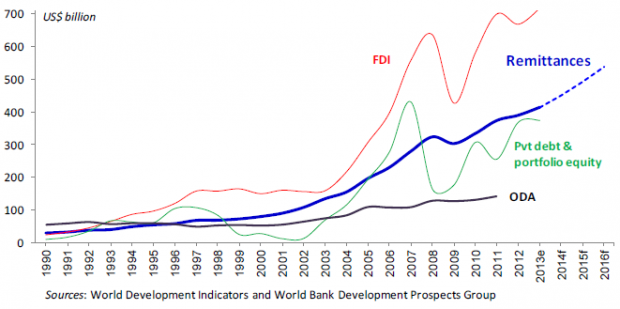
Even your armchair economist know that foreign direct investment (FDI) is vital to a developing economy. Now we're becoming aware that remittances are an increasingly large part of this picture. They're now at three times the size of official development assistance (ODA), and larger than private debt and portfolio equity flows to developing countries.

2. When we said huge, we meant it

Remittances are also massive when compared with foreign exchange reserves of many recipient countries. They're equivalent to at least half of the level of reserves in more than over 26 developing countries. The World Bank says that as emerging markets face a weakening balance of payments, the importance of remittances as a source of foreign currency earnings is increasing.

3. So huge that they account for nearly half of Tajikistan's GDP

Without any movement of labour, Tajikistan's economy would be around half the size it is now.

4. But it's still too costly to move money

It's still really hard to transfer money around the globe, and the costs aren't falling as fast as we'd like. While the G20 has been aiming to reduce costs to five per cent in five years, efforts have plateaued at around nine per cent. Despite available technology advancing and falling information costs – remittance costs have been stuck at that nine per cent level over the past 12 months.

The story of remittances is still largely positive. They're going up, and they're much larger than conventional aid. But things could be improved by reducing costs – making it easier for people to move for work and to send money home.

Share this article

  • Facebook
  • X
  • LinkedIn
  • WhatsApp
  • Email

Similarly tagged content:

Sections

  • News

Categories

  • Morning Wire Content

Trending Articles

  • Jaguar reveals the Type 01’s screen-free interior

  • Treasury ‘tells Healey’ to consider tax on banks and oil

  • Pensioners to hand over bank statements in government benefits crackdown

  • City firms mandate phone and face-to-face comms bootcamps for Gen Z lawyers

  • Jamie Carragher: HMRC petitions for Sky Sports star to be declared bankrupt

More from Morning Wire

  • Fishing retailer catches sales boost to defy summer drought

    Retail
    Four people fishing from a blue boat under a brick bridge on a river.
  • St James’s Place suffers £1bn hit to flows as investors look to dodge pension tax

    Investing
    St James's Place (SJP) (Photo Illustration by Igor Golovniov/SOPA Images/LightRocket via Getty Images)
  • Four charts revealing scale of Andy Burnham’s economic challenge

    Economics
    Due to the lack of article title, content, categories, and tags, its impossible to create a specific, keyword-rich alt tex...
  • Questions raised over FCA’s new short-selling rules 

    News
    The FCA has been urged to show change in its motor finance redress scheme.
  • The City doesn’t compete with Britain’s regions – it competes for them

    Opinion
    Canada boundary dragon statue symbolizing economic uncertainty amidst political instability
  • Why Theatre Deli is a City charity unlike any other

    Toast the City
    Bethan Ellis at Theatre Deli, showcasing a theatrical performance scene with dynamic lighting and expressive stage presence
  • Shop price inflation hits two-year high as rising energy costs hit consumers

    Economics
    Retail sales slumped in May as tax hikes and economic uncertainty hit shoppers' spending
  • All England Club slap down wealthy Indian Jindal over Wimbledon empty seat post

    Sport Business
    Business professionals discussing strategy in a modern office setting with charts and laptops on a conference table.
MorningWire

Independent European business, markets and political news for decision-makers.

Morning Briefing

Europe

  • Germany
  • France
  • EU Institutions
  • Europe

Business

  • Markets
  • Business
  • Economy
  • Regulation
  • Competition
  • Public Affairs

Editorial

  • Opinion
  • Editorial Policy
  • Corrections
  • Contact

Company

  • About Morning Wire
  • Privacy Policy
  • Terms of Use
  • Cookie Policy
© 2026 Morning Wire Ltd · Published by Morning Wire Media, Bahnhofstrasse 65, 8001 Zürich, Switzerland
Privacy · Terms · Cookies · Facebook