Skip to content
Friday 7 August 2026London --:--Frankfurt --:--Zurich --:--
NewslettersSearchEN · DE
MorningWire

European business, markets and politics

FTSE 100
10,947.72
+0.73%
DAX
26,365.44
+0.86%
CAC 40
8,735.63
+0.41%
STOXX 50
6,546.06
+0.67%
  • Europe
  • Markets
  • Business
  • Economy
  • Technology
  • Politics
  • Opinion
More
GermanyFranceBankingAIEnergyFintechPropertyCapital Markets
  • Germany
  • France
  • Europe
  • Markets
  • Business
  • Economy
  • Technology
  • Politics
  • Opinion
  • DE
Wednesday 06 May 2026 5:03 am  |  Updated:  Tuesday 05 May 2026 5:32 pm

Fractile vs Nvidia: can a UK startup undercut AI’s chip darling?

By: Saskia Koopman

Tech Reporter

Add as a preferred source on Google
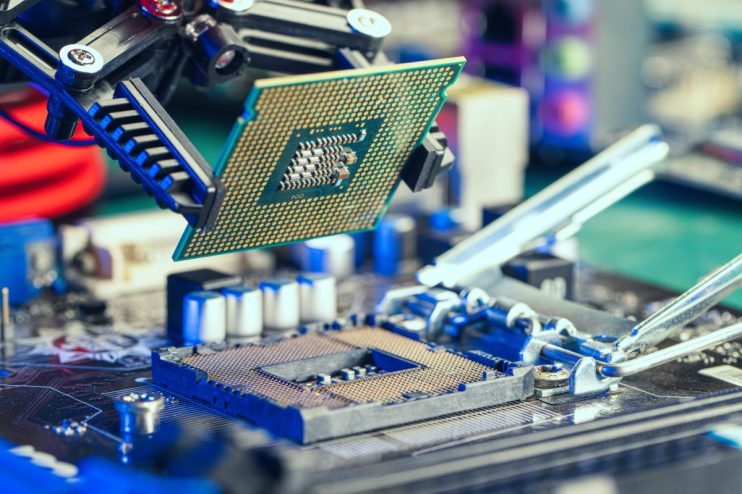
Advanced semiconductor chip with intricate circuit patterns and microcomponents, highlighting cutting-edge technology.
The numbers also pointed to the shift in Arm's own strategy

A little-known British startup is beginning to test one of the biggest assumptions underpinning the AI boom: that Nvidia will remain the unavoidable centre of the ecosystem.

Founded in 2022 by Oxford researcher Walter Goodwin, Fractile is attempting to redesign how AI chips work altogether, with a focus on speed and – crucially – cost.

The first phase of the AI boom was categorised by the ability to build ever-larger models.

Now it’s about running them, and doing so cheaply enough to sustain real-world deployment at scale.

A different way to build AI chips

Nvidia’s GPUs, originally designed for graphics processing, became the backbone of AI because of their ability to handle parallel workloads.

However, they were never purpose-built for modern large language models like the ones we rely on today.

Their core limitation is architectural – data must constantly move between the processor and separate memory (DRAM).

This movement creates latency, consumes vast amounts of energy and acts as a brake on performance.

Fractile’s approach to chip-making aims to eliminate that hurdle, by making chips that fuse memory and compute together, relying on high-speed DRAM so that data can be processed where it sits.

In theory, that process reduces the need for data transfer, which is the single biggest constraint in current AI systems.

The company has claimed that, based on simulations, this could allow models to run significantly faster and at a fraction of the cost of today’s GPU-based systems.

Nvidia is being challenged, but not replaced

Its software ecosystem and integration across cloud providers create a moat that is extraordinarily difficult to cross.

Read more

Monzo founder joins Anthropic as AI talent race heats up

Claude AI interface showcasing advanced features in a business setting

For most companies, Nvidia remains the default, not necessarily because it is cheapest, but because it is the easiest and most reliable.

Yet AI developers are increasingly constrained by supply, cost and power availability.

Running models at scale is expensive, and margins are under pressure – particularly for companies like Anthropic, which rely heavily on third-party infrastructure.

That squeeze is driving a shift towards diversification like Google’s TPUs or Amazon’s Trainium, and now a new generation of specialist chips focused on inference efficiency.

And Fractile, it seems, sits squarely in that latter emerging category.

Startups like Fractile are betting that purpose-built hardware, designed specifically for AI workloads, can unlock a step-change in both speed and cost.

If that proves true, it could reshape how AI systems are deployed, and who controls the economics behind them.

A credible challenger

Fractile’s chips are not yet in commercial use, and the timeline to deployment stretches into the latter part of the decade.

The gap between simulation and scaled production has undone many promising chip startups before.

And Nvidia is not standing still, as it shifts into more specialised AI hardware, acknowledging the same pressures that startups are targeting.

Still, the emergence of credible alternatives, particularly from a small, UK-based company, shows that more players are beginning to run with the big dogs.

Read more

Vultr and SUSE Launch Validated Full-Stack NVIDIA Enterprise AI Platform to Accelerate Production Deployments

Share this article

  • Facebook
  • X
  • LinkedIn
  • WhatsApp
  • Email

Similarly tagged content:

Sections

  • News

Categories

  • Business
  • Tech

People & Organisations

  • AI
  • artifical intelligence
  • fractile
  • Nvidia
  • nvidia chips

Trending Articles

  • Revolut founder’s wealth set to balloon amid talks of share award at $500bn valuation

  • Rupert Lowe axes pensions triple lock and pledges tax cuts in economic plan

  • Liverpool owners tipped to sell – but not to Amazon boss Bezos – by former CEO

  • As it happened: Stocks rise as oil fluctuates after Red Sea attack; US-Iran deal ‘being circulated’

  • WPP slashes jobs as revenue continues to fall

More from Morning Wire

  • Monzo founder joins Anthropic as AI talent race heats up

    Tech
    Claude AI interface showcasing advanced features in a business setting
  • Vultr and SUSE Launch Validated Full-Stack NVIDIA Enterprise AI Platform to Accelerate Production Deployments

    Business Wire
  • Exclusive: Blackstone set to back AI ‘droid’ firm at $3.5bn valuation

    AI
    Blackstone skyscraper with modern architecture under clear blue sky, symbolizing financial power and urban development.
  • Nscale taps lenders for $900m to fuel AI data centre splurge

    Tech
    AI data center with rows of servers and cooling systems, showcasing advanced technology and infrastructure innovation
  • Big Tech faces earnings test after AI spending spree

    Tech
    Googles modern Kings Cross headquarters showcasing innovative architecture in Londons dynamic tech district
  • The GCC’s AI strategy: Inside the region’s $150bn race

    Partner
    Crowd of diverse attendees at GITEX GLOBAL DUBAI tech exhibition, with GITEX signage visible.
  • South Korea is the canary in the coalmine of the AI boom

    Opinion
    Skyline of Seoul, South Korea featuring modern skyscrapers and traditional architecture under a clear blue sky
  • AI startup boss warns UK cannot become ‘dependent’ on overseas tech

    Tech
    Max Buchan discussing Valarian 2s launch at a business event, highlighting innovative features and industry impact.
MorningWire

Independent European business, markets and political news for decision-makers.

Morning Briefing

Europe

  • Germany
  • France
  • Europe
  • UK & Ireland

Business

  • Markets
  • Banking
  • Technology
  • Energy
  • Property
  • Fintech

Editorial

  • Opinion
  • Editorial Policy
  • Corrections
  • Contact

Company

  • About Morning Wire
  • Privacy Policy
  • Terms of Use
  • Cookie Policy
© 2026 Morning Wire Ltd · Published by Morning Wire Media, Bahnhofstrasse 65, 8001 Zürich, Switzerland
Privacy · Terms · Cookies · Facebook