French jeweller who loves the Queen sees fine times ahead for Cartier

Luxury goods maker’s man in London says that the market is doing just fine, writes Zoe Strimpel
Arnuad Bamberger, the head of Cartier UK, is not your typical Frenchman. He loves the Queen, has more British than European friends, and loves nothing better than a good polo match well attended by tweedy toffs. Indeed, under his guidance the jeweller has become synonymous with the sport thanks to the champagne-drenched event held at the Guards club in Windsor every July.
“The polo is something we started doing 25 years ago,” Bamberger says from behind the desk in his elegant office suite above the company’s flagship New Bond Street store, at ease in a striped grey suit and magenta socks. “It’s the sport of kings and it’s not cheap. It’s about beautiful players and their beautiful girlfriends. It’s dangerous. It’s about strength, glamour and elegance and so links perfectly with our kind of clientele.”
Bamberger arrived in England in 1992 after heading up Cartier’s export division in Paris, and hasn’t looked back. “I didn’t know what to expect,” he says. “I had doubts, but I have become a true Anglophile. London is for me the capital of the world. I love the British history, the sense of tradition, the Royals.” He is on friendly terms with the Queen, who is a Cartier customer.
World Capital
Of course, swooning over Buckingham Palace is all very well, but what about the realities of running a business in London? Next to the capped working hours and general fondness for striking for which France is known, it would seem a relief. The presence of more than 150,000 French people now working in London (34 per cent of whom work in the Square Mile, according to the Consulate) suggests as much. “I loved working in Paris,” Bamberger says diplomatically. “It’s the most beautiful city in the world and you can work hard. Anyone who wants to work, can. But London is the capital of the financial world and there’s an entrepreneurial spirit in England that you don’t find in France. It’s easier to start a business, there’s less tax and so forth.” Is France set to change into a more business-friendly environment with Sarkozy at the helm? “I voted for Sarkozy,” he says, adding carefully: “But like most of my fellow French, I have been a bit disappointed.”
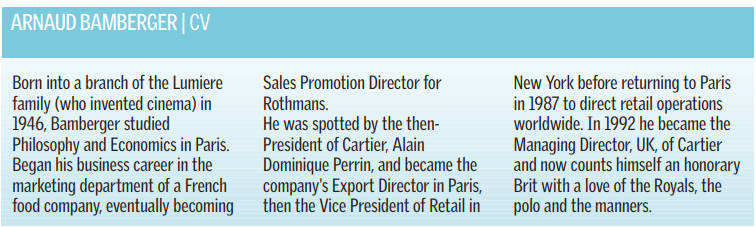
Bamberger’s background is business sales, not jewellery – he began in marketing for a big food firm in France and worked as Sales Promotion Director for Rothmans before joining Cartier. “I knew that the luxury world would be for me,” he says of the move. “I liked the environment, felt comfortable with it.” His parents must have been glamorous then? “They were glamorous enough,” he says.
Doubled Turnover
Bamberger has certainly done the rounds at Cartier – he’s worked at the company for 32 years. After several years as Export Director in Paris, he moved to New York in the early 1980s as Vice President of Retail, then returned to Paris to head up worldwide retail operations before taking the London job as Managing Director of Cartier’s UK business. His experience paid off: Cartier UK has more than doubled its turnover since he took over. Bamberger’s retail and marketing experience helped him oversee a rebranding that seems to be behind the growth of the company: “We’ve grown dramatically in the last 20 years. We were a very famous company with a huge image from 150 years ago. We put it back in the frame, made it seen as the world’s best again.” There are now 250 boutiques worldwide. “We widened our network and grew the brand and business by making desirable products,” Bamberger says.
And, despite the credit crunch, the party seems far from over. “I don’t feel there’s a limit yet,” he says. “There is a lot of new demand coming into the luxury market.” He is talking about Russia, China, Brazil and India, with Chinese growth outpacing the others at breakneck speed. “China is growing really fast. It will replace Japan as our biggest luxury market within the next five years.” There are twenty stores now in China and 15 more are set to open by 2010.
Foreign markets aside, isn’t this a terrifying time to be selling hugely expensive, unnecessary items? “The luxury market is holding up well. But we’re not idiots. Obviously we’re aware of the general unease and we are being cautious. But so far, I must confess I have not felt anything special. Not only in the high end – which I expected to continue to do well, but in the medium and entry level range too we have not seen any slow-down.”
Classic French
And with the Russian and Chinese tastes now driving the market forward, does Cartier need to tailor its classic French style to give the new buyers what they want? “Cartier has only one style, one collection,” Bamberger says. “But there are differences in what sells. For example, in China and Japan they don’t need to buy the big watches because they’ve got smaller hands and wrists. The Americans on the other hand do like the big ones.” He says jewellery tastes go in global cycles: “Sometimes we sell more platinum jewellery than yellow gold. Now we’re really in a yellow gold moment.”
Rather than chasing consumer tastes, Bamberger sees the role of Cartier as a trend-setter. There’s a sense of responsibility that could only come from an old, established company such as this: “It’s up to us to create the desirability. People come to us as a role model. We give the opportunity to have a certain status. So its quite important that we don’t lose our DNA.” Designers often seek inspiration in the archives: for example, the love bracelet so popular in the 1960s is big again. “It’s the way you market it, rather than the jewellery itself, that changes,” Bamberger says.
He’s nurtured the company into the biggest of its kind in the world, but what about his own tastes? “I buy plenty of jewellery, including Cartier, for my wife,” he says, adding with a throaty chuckle: “I can buy more now than I could in the past, that’s for sure.”