G7 coronavirus vaccine pledge: how far does it stretch?

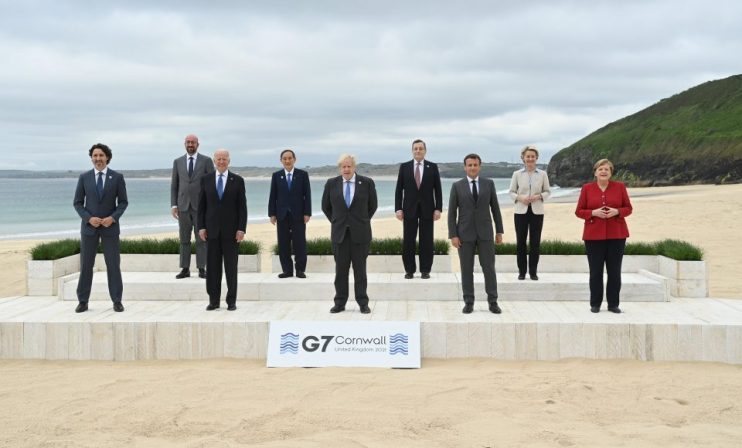
Leaders of the G7 countries will unveil a pledge to donate 1bn coronavirus vaccines to poorer nations at the 2021 summit in Cornwall.
The pledge is part of a plan to “vaccinate the world” by the end of 2022, after western governments faced mounting pressure to do more to help the poorest countries in the world immunise their populations.
The donations will be delivered through Covax, an international scheme that provides a vehicle for preordering and distributing vaccines equally among the 92 poorest countries in the world.
But ahead of the G7 summit, Unicef issued an open letter saying Covax faces a shortage of 190m doses of the vaccine.
In order to achieve Boris Johnson’s promise to vaccinate the world, a total of 11bn doses are needed. But of the 2.2bn doses already administered globally, around 560m have gone to G7 countries alone.
So far, only 1% of the world’s doses have landed in sub-Saharan Africa. Meanwhile in the UK, more than 75% of adults have received a first dose of the vaccine, with over-25s eligible for theirs from this week.
How many vaccines is each country willing to part with? Here’s a breakdown:
- UK – Prime minister Boris Johnson on Thursday announced the UK will donate 100m surplus coronavirus vaccines worldwide within the next year, 5m of which will be shared within the next five weeks.
- US – US president Joe Biden announced plans to donate 500m doses of the Pfizer vaccine to roughly 100 countries around the world over the next two years.
- The EU – European Commission President Ursula von der Leyen said the EU commits to donate at least 100 million vaccines by the end of 2021.
- France – In addition to the EU donation, France has pledged 30m doses, as well as 184,000 doses of the AstraZeneca vaccine to Senegal through the Covax scheme.
- Germany – Germany has also pledged an additional 30m doses, on top of the EU contribution.
- Italy – Italy has committed to donate an additional 15m doses, and donated €300m to Covax in May.
- Japan – Japan has pledge to donate 30m vaccine doses produced in Japan, through the Covax scheme.
- Canada – Canada is reportedly in talks to donate surplus doses through Covax, but has not yet announced how many doses.
“Drop in the ocean”
The G7 pledge was called a ‘drop in the ocean’ by campaigners on Friday, who quote it taking another 50 years for the poorest countries to vaccinate their populations at the current rate of progress.
Agnès Callamard, Secretary General at Amnesty International, said: “Pledging to provide one billion doses is a drop in the ocean and wouldn’t come close to covering the population of India, let alone vaccinating the world’s population.”
“These leaders must climb out of the pockets of Big Pharma, push self-interest aside and genuinely commit to ensuring everyone has access to vaccines, no matter where they live,” Callamard added.
A proposed cost-sharing formula
Writing in Bloomberg, former Prime Minister Gordon Brown said the G7 countries should use the summit to create a cost-sharing formula, modelled on UN peacekeeping, to help fund vaccine distribution in the poorest countries.
Brown said that Covax and the ACT-Accelerator Alliance are critically under-funded and “to bridge these agencies’ huge financing gap this year, $16 billion more is needed now, and upward of $30 billion next year.”
Based on his proposed model, Brown argues the G7 countries should pay the majority (67%) of the total funds needed, with other G20 countries like China and Russia liable for the rest.
The funding plan is similar to that used to pay for United Nations peacekeeping, and takes into account factors like each country’s income and wealth. In Brown’s suggested plan, the U.S. would pay 27%, Europe 22%, the U.K. 5% and Japan 6%. Canada, South Korea and Australia, 2% each.
“Vaccinating the world is not just an act of charity: It’s in all our self-interest,” Brown said, as he pointed out that ensuring a healthy global population could increase output by up to $200 billion.