Game of drones: The founder of SenSat on solving construction problems by simulating reality

“The internet connects all human knowledge, and for the first time in history, we can connect that human knowledge to the actual world we live in through our computers.”
It’s at this point during my conversation with James Dean, the cooly-named co-founder of SenSat, that I start to grasp how ground-breaking his technology really is.
You can build artificial intelligence (AI), but if it can’t truly understand the real, physical world, it’s relatively stunted in what it can achieve.
Take driverless cars for instance: until we get to a point where these autonomous vehicles are able to understand what’s in front of them, and can react safely to the unpredictable nature of the world, they simply won’t enter the mainstream.
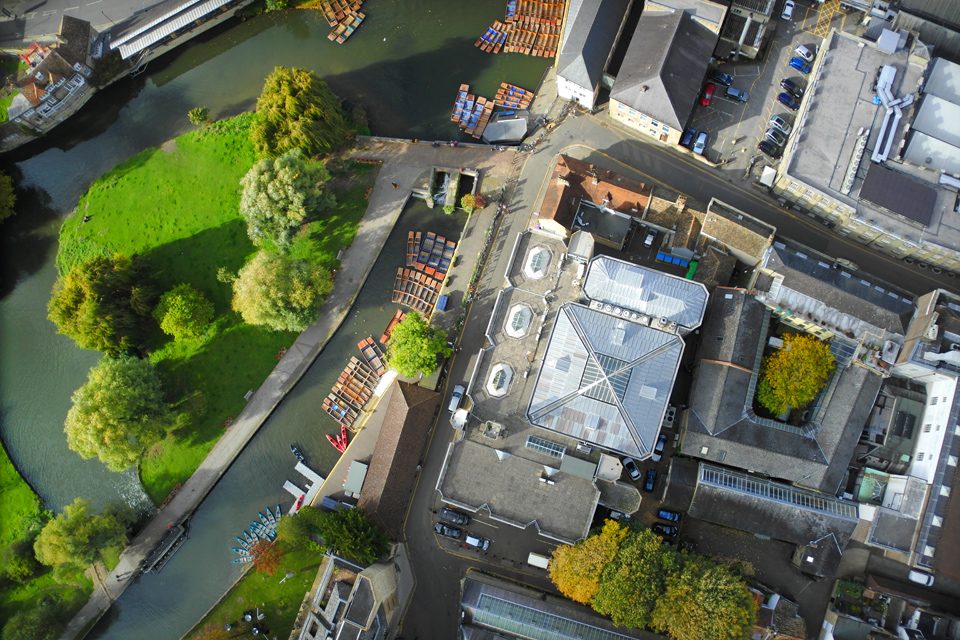
Objects, of course, are made up of atoms, which can’t be “seen” by computers. However, SenSat is helping to solve this issue by turning objects into a code which computers can read in their language. The company uses drones to create a digital replica of actual places, which can then be used to simulate the environment in real-time.
These simulations can then teach AI to understand the world.
Ground-breaking
The Shoreditch-based startup, which launched in May 2017, is already transforming the construction industry, and has been involved in some major infrastructure projects, such as HS2, the upgrade of the M1, and Triton Knoll wind farm.
When I ask why Dean and co-founder Harry Atkinson opted to focus on the construction sector, he points out that the industries which haven’t yet been revolutionised by digital developments tend to be inherently physical, such as real estate or utilities. And indeed, it is these sectors where productivity has remained stagnant for decades.
“It’s not really the industries’ fault because computers can’t get hands-on with their environment – they can’t analyse it, so it can’t help them make decisions,” he says. “But now we can take those physical working environments and make digital copies of them.”

Given that infrastructure is one of the least digitised sectors, Dean tells me that the benefits of using the technology – even for basic projects – become apparent very quickly, particularly considering the construction industry is plagued by miniscule profit margins.
For example, rather than employing someone to spend weeks measuring an area by hand, SenSat uses drone technology to take 15,000 times as many measurements in a matter of seconds.
“And we can track things much more accurately – down to the level of pebble,” Dean explains. “It’s almost a game-version of what’s actually happening, but statistically very accurate.”
The cost savings are huge too; Dean estimates that most construction projects tend to spend around five per cent of the budget on surveying. So while surveying a £100m project would typically cost around £5m, SenSat would charge around £100,000 to do the same job. This would leave a business with extra cash freely available to spend elsewhere.
While a 0.5 per cent profit margin is common among construction companies, Bam Nuttall – which used SenSat technology to help build a flood defence in Leeds – saw its profit margin reach a 10-year high of three per cent last year.
And it’s about more than money. The tech improves safety too, by removing humans from dangerous construction sites – and for many companies, that alone is enough to convince them to use SenSat.
Rogue one
When we think of drones, many of us will be reminded of the disruption at Gatwick in December, costing the airport and airlines millions of pounds.
Given how integral drones are to Dean’s business (the company has a licence to fly a drone 12km away from its pilot), I ask what he thinks needs to happen to ensure that these flying robots are being used as a force for good.
“To some extent, it’s like the Wild West – it’s like cars going out without driving licences, because anyone can fly a drone and cause havoc. So I think that the best way is to regulate it – better transparency and tracking of these things are really essential.”
In the same way that cars are registered to drivers, the SenSat chief executive reckons that all drones should be registered to the pilots. And of course the rules need to be properly enforced to deter people from going rogue.
And while Dean agrees that government rules are slow to keep up with new tech, he argues that UK regulation is by far the most advanced in the world when it comes to drones.
“I don’t blame the government, because the popularity of drones increased very suddenly – and you can’t regulate what you don’t know.”
AI in the sky
It’s hard not to be impressed by this 28-year-old entrepreneur, who manages to eloquently explain in detail how his technology works. “If you are building a 3D representation, you initially take 2D pictures – and if you take enough photos, you can use triangulation to build a 3D replica.”
He tells me that while 2D image recognition has been around since the 1970s, 3D object recognition only has about 18 months of research behind it.
“In the 2D problem, the computer only knows what something is because the human has said that’s what it is, and has no actual understanding of the image. But with 3D, for the first time ever, the computer can understand the properties of objects by using a mathematical function which describes something’s geometry in 128 dimensions. And when computers can actually understand objects, they can do a lot more analysis.”
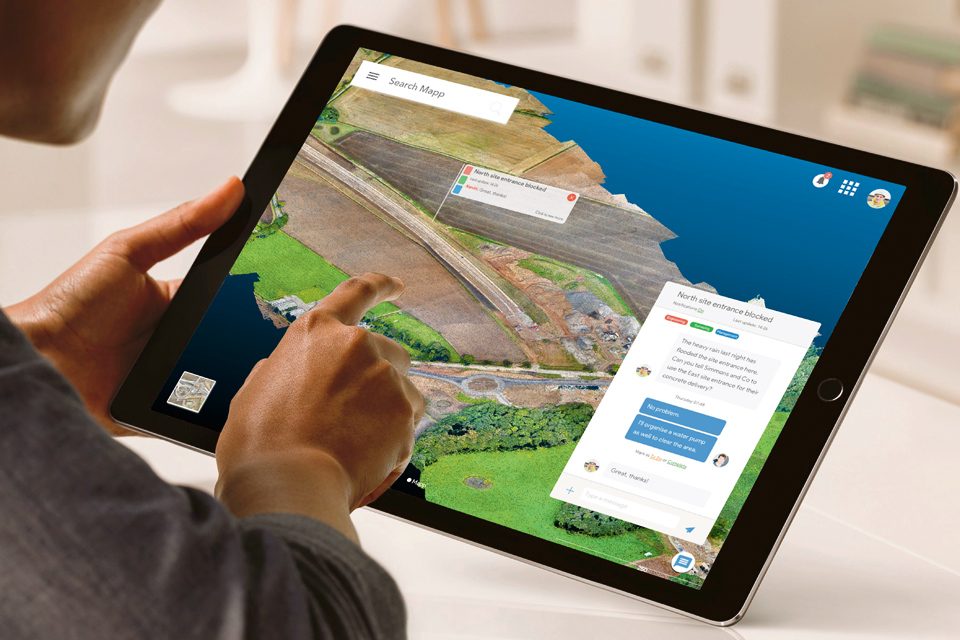
Through SenSat’s simulated reality program, called Mapp, Dean wants to build a rich environment that AI agents can understand. The company also benefits from a feedback loop – the more clients that use the technology, the more advanced it becomes.
In August last year, SenSat secured $4.5m in seed investment, and has already racked up an impressive list of 28 clients in just two years, with Highways England, National Grid, and Network Rail to name but a few.
But while construction made sense from both a commercial and technical perspective (SenSat has supported more than £3.5bn infrastructure projects to date), you can see this technology spanning a vast array of other sectors, while also enabling emerging tech like augmented reality and 5G. It could certainly prove integral to autonomous vehicles, which are reliant on a spatial understanding of the world.
Dean reckons SenSat technology is as big as the internet. And he could be right.