Skip to content
Friday 21 August 2026London --:--Frankfurt --:--Zurich --:--
NewslettersSearchEN · DE · FR
MorningWire

European business, markets and politics

FTSE 100
10,779.50
+0.29%
DAX
26,091.81
+0.42%
CAC 40
8,476.01
+0.27%
STOXX 50
6,452.47
+0.47%
  • Europe
  • Markets
  • Business
  • Economy
  • Regulation
  • Politics
  • Opinion
More
GermanyFranceEU InstitutionsCompetitionPublic AffairsBankingTechnologyEnergy
  • Germany
  • France
  • Europe
  • Markets
  • Business
  • Economy
  • Regulation
  • Politics
  • Opinion
  • DE
Wednesday 11 May 2022 2:16 pm  |  Updated:  Wednesday 11 May 2022 2:17 pm

Generation AI: Breakthrough for automation as robot ‘chef’ in Cambridge can taste food at different stages of the chewing process

By: Michiel Willems

Add as a preferred source on Google
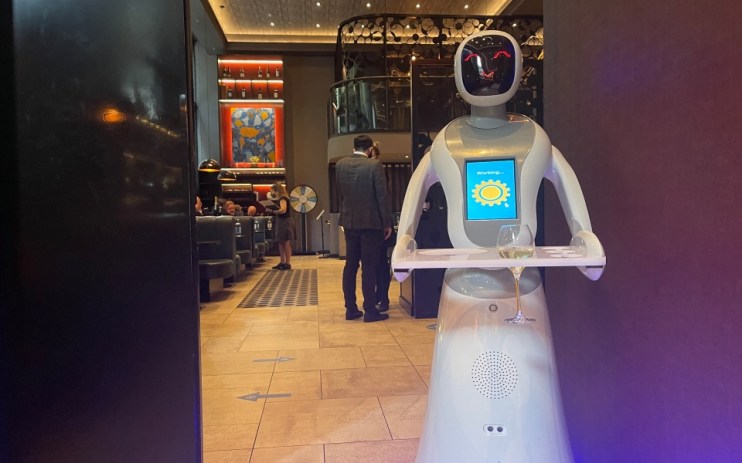
Marion the chamgagne robot
M Restaurants' Marion the champagne waitress

A robot “chef” has been trained to taste food at different stages of the chewing process to check if it is salty enough, imitating a similar process in humans.

The University of Cambridge researchers suggest their results could be useful in the development of automated or semi-automated food preparation by helping robots to learn what does and does not taste good, making them better cooks.

When food is chewed, people notice a change in taste and texture.

For example, biting into a fresh tomato at the height of summer will release juices, and as it is chewed, saliva and digestive enzymes are released, changing our perception of the tomato’s flavour.

The robot, which has already been trained to make omelettes, tasted nine different variations of scrambled eggs and tomatoes at three different stages of the chewing process.

It then produced taste maps of the different dishes.
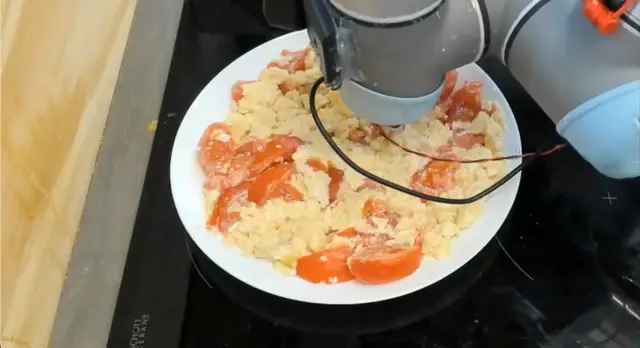
Photo issued by the University of Cambridge of a robot tasting eggs and tomato. A robot “chef” has been trained to taste food at different stages of the chewing process to check if it is salty enough, imitating a similar process in humans.

photo issued by the University of Cambridge of a robot tasting eggs and tomato. A robot “chef” has been trained to taste food at different stages of the chewing process to check if it is salty enough, imitating a similar process in humans.

The researchers found this “taste as you go” approach improved the robot’s ability to quickly and accurately assess the saltiness of the dish.

Grzegorz Sochacki from Cambridge’s Department of Engineering, the paper’s first author, said: “Most home cooks will be familiar with the concept of tasting as you go – checking a dish throughout the cooking process to check whether the balance of flavours is right.

“If robots are to be used for certain aspects of food preparation, it’s important that they are able to ‘taste’ what they’re cooking.”

Co-author Dr Arsen Abdulali, also from the Department of Engineering, said: “Current methods of electronic testing only take a single snapshot from a homogenised sample, so we wanted to replicate a more realistic process of chewing and tasting in a robotic system, which should result in a tastier end product.”

To imitate the human process of chewing and tasting in their robot chef, researchers attached a probe – which acts like a saltiness sensor – to a robot arm.

Read more

Fine dining and The Jab: A Michelin dinner with the Ozempic set

Ozempic tablet on a plate highlighting medications role in weight loss and diabetes management in healthcare news.

They prepared scrambled eggs and tomatoes, varying the number of tomatoes and the amount of salt in each dish.

Using the probe, the robot “tasted” the dishes in a grid-like fashion, returning a reading in just a few seconds.

In order to imitate the change in texture caused by chewing, the team then put the egg mixture in a blender and had the robot test the dish again.

The different readings at different points of this chewing produced taste maps of each dish.

Saltiness

According to the study, there was a significant improvement in the ability of robots to assess saltiness over other electronic tasting methods, which are often time-consuming and only provide a single reading.

Researchers say that by imitating the human processes of chewing and tasting, robots will eventually be able to produce food that humans will enjoy and could be tweaked according to individual tastes.

Dr Abdulali said: “When a robot is learning how to cook, like any other cook, it needs indications of how well it did.

“We want the robots to understand the concept of taste, which will make them better cooks.

“In our experiment, the robot can ‘see’ the difference in the food as it’s chewed, which improves its ability to taste.”

Dr Muhammad Chughtai, senior scientist at with domestic appliances manufacturer Beko, which is collaborating on the project, said: “We believe that the development of robotic chefs will play a major role in busy households and assisted living homes in the future.

“This result is a leap forward in robotic cooking, and by using machine and deep learning algorithms, mastication will help robot chefs adjust taste for different dishes and users.”

The findings are published in the journal Frontiers in Robotics & AI.

Read more

Beauty and Robot can put on a show at the Valley

Zac Purton riding in national colors at Happy Valley during the eight-runner race symbolizing World Cup quarter-finalists.

Share this article

  • Facebook
  • X
  • LinkedIn
  • WhatsApp
  • Email

Similarly tagged content:

Sections

  • News

Categories

  • Tech
  • Retail

Related Topics

  • Healthtech
  • Retail investing

Trending Articles

  • House prices in wealthy London boroughs fall by up to £300,000

  • As it happened: Miners fuel FTSE 100 recovery; oil jumps as Trump claims Strait of Hormuz

  • City law firm sues prominent Emirati business family

  • Amanda Blanc has worked her magic at Aviva

  • As it happened: FTSE 100 rallies after JD Sports drags on blue chips; oil jumps again

More from Morning Wire

  • Fine dining and The Jab: A Michelin dinner with the Ozempic set

    Life&Style
    Ozempic tablet on a plate highlighting medications role in weight loss and diabetes management in healthcare news.
  • Beauty and Robot can put on a show at the Valley

    Sport
    Zac Purton riding in national colors at Happy Valley during the eight-runner race symbolizing World Cup quarter-finalists.
  • There’s a 45 per cent chance this op-ed was written by AI

    Opinion
    Vintage 1960s typing gloves, showcasing retro office fashion and ergonomic design for typewriter use
  • IFF Announces Agreement to Sell Its Portfolio of Botanical Extracts, Vitamins & Minerals and Food Enhancement Activities to SuanNutra, a Portfolio Company of Carbyne Equity Partners.

    Business Wire
  • Bonheur by Matt Abé review: This Michelin magnet left me hungry

    Life&Style
    Elegant restaurant interior with round tables, plush burgundy booths, and textured floral wall art
  • ‘It’s military precision’: meet the chefs crafting summer’s £6k corporate hospitality dishes

    Life&Style
    Chefs preparing gourmet dishes for corporate hospitality at prestigious events like Silverstone and Ascot
  • Will Ibai take home a Toast the City Award?

    Toast the City
    CITY AM Toast the City Awards 2026 logo superimposed over an upscale bar and restaurant interior.
  • Beyond the Tour de France: How Girona became a cyclist’s paradise

    Life&Style
    Cyclists ride on a winding road with a historic building and forested hills in Girona, Spain
MorningWire

Independent European business, markets and political news for decision-makers.

Morning Briefing

Europe

  • Germany
  • France
  • EU Institutions
  • Europe

Business

  • Markets
  • Business
  • Economy
  • Regulation
  • Competition
  • Public Affairs

Editorial

  • Opinion
  • Editorial Policy
  • Corrections
  • Contact

Company

  • About Morning Wire
  • Privacy Policy
  • Terms of Use
  • Cookie Policy
© 2026 Morning Wire Ltd · Published by Morning Wire Media, Bahnhofstrasse 65, 8001 Zürich, Switzerland
Privacy · Terms · Cookies · Facebook