
Low water levels on Germany’s major rivers are causing disruptions for overland shipping – a crucial part of the country’s vital supply chains.
At the same time, drinking water supplies are dwindling in regions where less rainfall and more water use during times of extreme heat are putting pressure on municipal supplies.
But while a growing chorus of conservationists, business leaders and politicians warn that freshwater resources are increasingly sparse, that reality can sometimes be hard to see.
If you don’t live near the banks of the Rhine, where water levels have hit record lows in recent weeks, you might wonder why Germany is suddenly talking so much about drought and water conservation.
Germany introduces a ‘Low water information system’
In mid-July Germany’s Environment Minister, along with the President of the Federal Institute of Hydrology and the head of Würzburg's environment department announced the launch of the Low Water Information System (Niedrigwasserinformationssystem), or NIWIS for short.
The announcement did not generate a whole lot of attention, but the creation of the portal is itself a sign of the times. While Germany and central Europe have long been thought of as a place where water is abundant, experts agree that increasing drought and heat, due largely to human caused climate change, means that abundant water is no longer guaranteed.
"In the future, we will have serious conflicts over water - also in Germany," Environment Minister Carsten Schneider recently told Der Spiegel.
NIWIS provides an overview of water levels across Germany, including; surface waters (lakes and rivers), groundwater, and precipitation. It’s intended to help authorities, municipalities and interested people better see how pronounced water scarcity is in their region.
Rivers run low
The map below, as seen in the NIWIS portal on August 7th, shows surface water levels across Germany. Blue dots signify normal levels, whereas yellow, orange and red dots signify low, very low and extremely low levels respectively.
The pie charts show the proportion of sites with the various water levels in each of Germany's main river basins.

ln the NIWIS portal you can zoom in to see specific areas in more detail.
The river of primary concern in Germany at the moment is the Rhine, which is Germany's most important inland shipping route. Every year, some 285 million tonnes of goods travel along the river.
But shallow water is imposing limits on how much cargo can float down the river now, pushing up prices for freight and increasing pressure on the German economy.
On Thursday the newly appointed Federal Transport Minister Steffen Bilger met in Bonn with industrial executives, shipping companies and port bosses to discuss the crisis.
As a short-term solution, Bilger is in favour of lifting a ban on truck traffic on Sundays and public holidays to pick up some of the transport load. But road and rail transport face higher costs and other constraints.
ING economist Carsten Brzeski explained it this way to AFP: Unless the German government can find a rainmaker, the dry spell could be a tough blow to the economy.
Drinking water use restrictions
While diminished surface water levels are primarily seen as an economic threat, falling ground water levels are an immediate threat to drinking water supplies in a large number of German cities.
Persistent drought and heat this summer have also affected ground water levels. Nearly half of Germany's districts are now experiencing water stress according to recent reports.

Ground water use and conservation is largely a matter for municipalities and districts to manage. More than 80 districts, cities and water suppliers have already imposed some type of water use restriction.
In July the city of Munich issued a decree prohibiting residents from watering lawns during daytime hours, filling pools or washing cars at home. The city has since decided not to extend the decree beyond August 1st.
Other major cities, including; Cologne, Dresden, Mainz, Potsdam and Stuttgart, have issued similar decrees. In most places decrees simply ban 'withdrawal', that is pumping water out of lakes and rivers, but some also include limits on water use.
Even where decrees aren't in place, many cities are urging residents to be cautious with their water use.
A more extensive list of water use bans and decrees in place, as of July, is seen in this T-online report.
Not enough rain
Contributing to falling river and ground water levels this year has been a lack of rain.

The map above, which shows rain and precipitation levels over the past six months as compared to the previous period, helps to illustrate why ground and surface water levels are more affected in Germany's southern regions.
Interestingly, this pattern changes significantly if you look at precipitation over different periods of time.
Below is the same map, but showing precipitation levels in the past month, as compared to the month before.
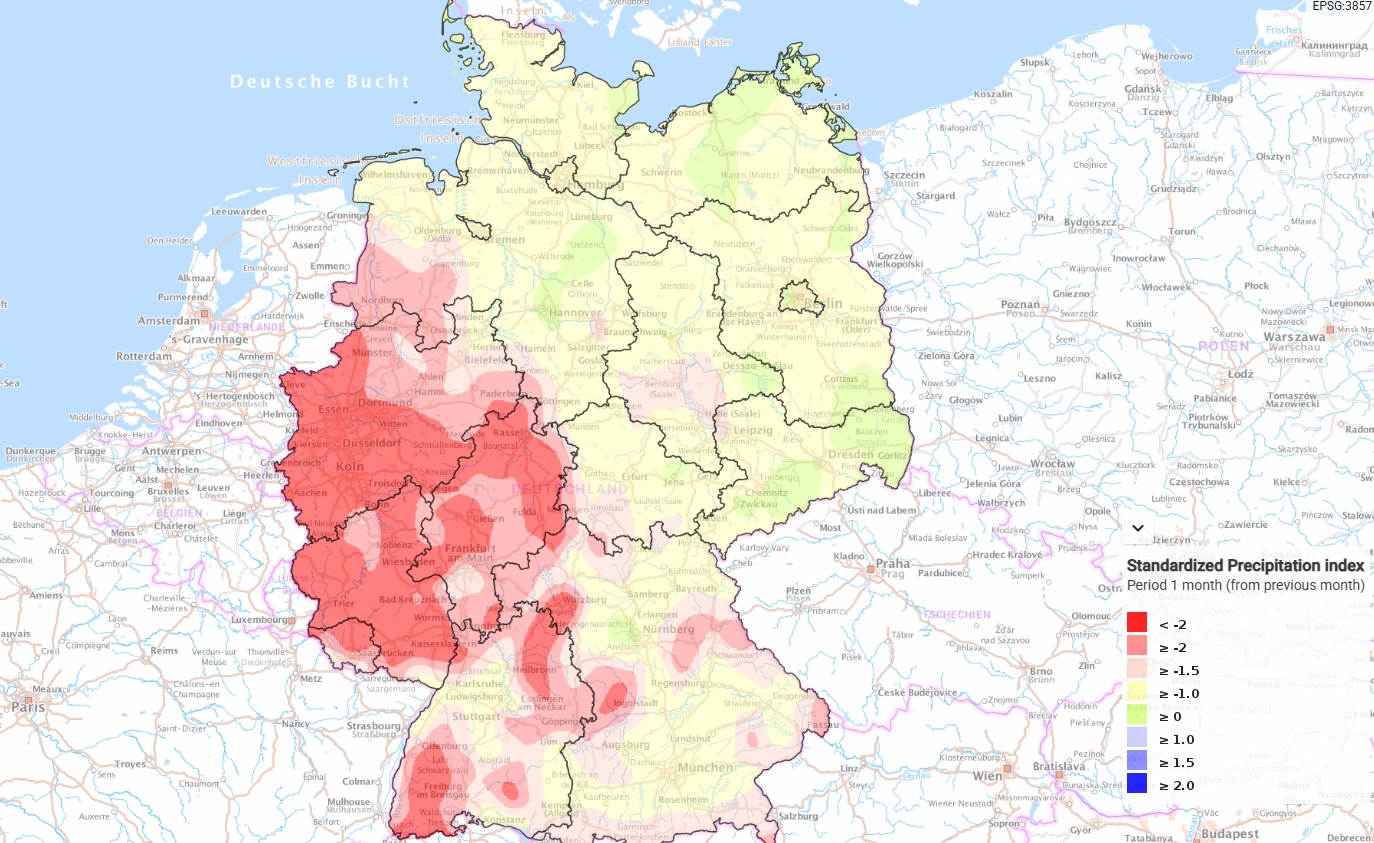
While the regions lacking the most rain change from month to month, the big picture pattern in clear: Germany is seeing less rain and more heat this summer than it's used to, and that's affecting everything from freight traffic to fishing to river cruise tourism, as well as whether or not residents may freely water lawns or wash cars at home.


