
Take a stroll down any given street in Berlin these days, and you’ll probably see one of their signs. A purple campaign poster with a two-word slogan: “unf*ck Berlin”.
But unless you’ve been following the on-going Berlin election campaign very closely you may not be familiar with Volt – the pan-European political party aspiring to improve the lives of Berliners with pragmatic, evidence-based solutions.
For a party yet to step into the halls of the Berlin senate, Volt’s got big ambitions and plenty of actionable ideas for making the capital city cleaner and more efficient. Also interesting for international residents; Volt is advocating for more voting privileges for non-German residents.
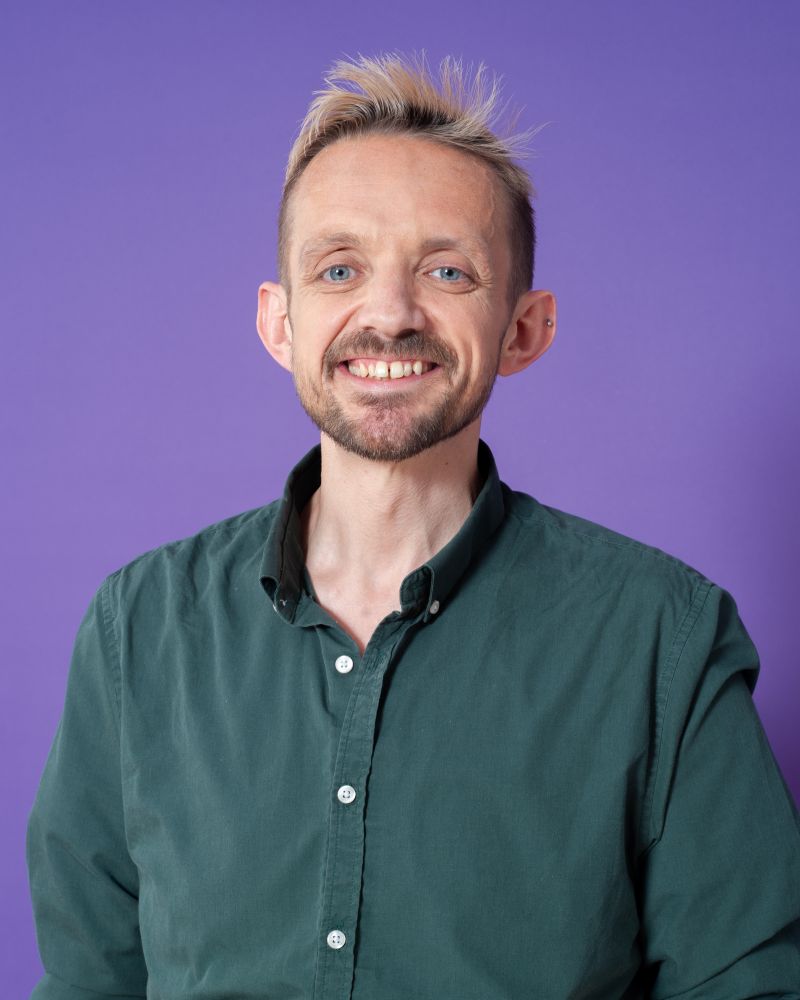
the publication caught up with Matt Bristow, a Volt candidate for the House of Representatives and for the local assembly in Neukölln’s 2nd district, to talk about how his party hopes to ‘unf*ck’ the German capital.
Bristow is British-born clinical psychologist who permanently relocated to Berlin in 2018 under the shadow of the Brexit deadline and has since gained German citizenship. As a now German citizen he is eligible to run for office in Germany.
What is Volt?
Many know Volt as a ‘the European party’, but for Bristow it’s more than that.
“The party was founded after Brexit and the first election of Donald Trump,” Bristow said. “[Volt was] looking at what was happening in politics across the world and thinking there has to be a different way of reaching people…without going down this very populist extreme route.
“The selling point for me isn't so much the European side of things, although that's kind of my initial connection to the party. It's more about the pragmatic approach…
“I’ve found that often politics gets stuck along ideological lines. Like this has to be the solution because we're ‘the party for car drivers’, or we’re ‘the party for people who don't have any money’.
“But [this approach fails to ask] is this actually a solution that works?”
He added that part of Volt’s “essence” is looking at what’s working in other cities, and bringing those solutions where they are needed. Volt’s platform includes 98 specific "best-practice" examples from cities like Amsterdam, Helsinki, Vienna and Copenhagen.
'Unf*ck Berlin'
If at first glance you thought Volt’s latest campaign slogan was misplaced, you wouldn’t be the only one. A column by Suddeutsche Zeitung put it like this: “The fascination of this city for decades has been that you can supposedly move here from any provincial village to finally be completely unbridled and with whomever you want…just the opposite of ‘unfucking’.”
But then, maybe intriguing the columnists at SZ was the point.
Volt kicked off its campaign – running up to the Berlin election on September 20th – with intentionally guerrilla tactics including stickers, chalk spray and the infamous phrase scrawled around town.
“The message is not that Berlin is awful,” Bristow said, “but that Berlin can be better, and we've got the ideas to make Berlin better.”
For example, trash
One issue that Bristow sees as a big problem in his own neighbourhood and district is rubbish and waste on the streets.
“People make jokes about it, but it's really actually something which affects people's quality of life,” Bristow said.
He added that so far, the Berlin government’s approach has centred on increasing fines for people who leave waste on the streets: “I can understand [that approach] from a political point of view…The problem is that the evidence shows that strategy doesn't work.”
Rather than threatening higher fines (with little-to-no real enforcement), Bristow suggests trying a tactic that proved successful in his home borough of Newham in London. There an effort was made to put crime scene tape over and around pieces of furniture that people illegally leave on the street to show it was being ‘investigated’.
“You didn’t even need to have a real team behind it,” Bristow said, “It’s just that moment where people thought, ‘Oh, I could get caught’ that had a huge impact.”
He added that this simple trick significantly reduced littering and fly-tipping in that area, and that these low-cost but proven solutions were what he really hoped to bring to his district in Neukölln.
“There have been cuts in all sorts of services in Berlin because we're told that the city has no money,” Bristow said. “But there are things that we can do that have been tried and tested elsewhere, which still have a huge impact.”
But not only trash
A glance at Volt’s Berlin election program shows the party is focused on issues related to: digitising administration, building affordable housing, education reform, innovation and building climate resilience among others.
Top of mind in Berlin for Bristow is digitalisation and creating a system “that works”. From his work in Berlin public administration -- as a clinical psychologist in the city's parenting and family guidance centres -- he knows that the city’s IT infrastructure is dismal.
“The IT we’ve got is decades behind what you have in the private sector, and that’s a real shame in a city that’s known for its digital startups and creative industries,” Bristow said. He cited Frankfurt, where Volt member Eileen O'Sullivan has helped drive administrative reforms as the Head of the Department for Digitalisation, as an example of a city that is making efforts to update its systems.
Two major reforms Bristow would like to see implemented in Berlin are: 1) the ‘once-only’ principle for data – meaning that information should only need to be collected once, and then securely shared between city departments as needed, rather than say collected by each department or printed and re-entered into other systems, and 2) the introduction of ‘Approval Fiction’ (Genehmigungsfiktion) to solve the endless wait times for permits and registrations – this would mean that complete applications would be automatically approved if the city administration fails to process them by a deadline.
Long-term residents should have a say
Relevant to many foreign residents in Germany, Bristow believes that long-term residency, rather than only German citizenship, should come with more chances to participate in domestic politics.
In the coming Berlin election, non-German EU citizens can vote for candidates to the city’s District Council Assemblies (Bezirksverordnetenversammlungen - BVV). The BVV acts like a parliamentary body at the district level, determining a district’s administrative policies. Bristow is also running as a BVV candidate.
"I’ve discovered some European citizens don’t realise that they have a voice, and that they’re allowed to vote in these elections,” Bristow said.
And while EU-citizens can already have a say at this level, Volt would like to see long-term residency, rather than just German citizenship, be the foundation for more voting rights.
“I think that's part of the European project which hasn't really been given enough consideration so far. If we're saying we're one area where we're all citizens, then that needs to include democratic rights as well,” Bristow said.
As a party, Volt advocates for granting voting rights, especially at the local and municipal levels, to foreign nationals who are long-term residents in Germany.
Among Germany’s mainstream parties, they are joined in this most strongly by The Left party -- which strongly advocates for voting rights for all long-term residents, even at the state and federal levels -- and the Green party, which support foreign residents' increased participation at the municipal and state-levels.
Volt's primary goal in the coming election in Berlin is to get at least five percent of second votes which would allow the party to enter the Berlin Senate for the first time. But it also has a shot at seeing members, such as Bristow himself, elected to district councils.
Asked about the current outlook for his own race, Bristow noted that in BVV races, getting just three percent of votes in a district would see Volt get some members elected to the council. Especially in Friedrichshain-Kreuzberg, Mitte, Pankow and his own district of Neukölln, Bristow believes Volt has "very good chances" to do so.
At least for now, Bristow's focus and ambitions are keenly focused in his own neighbourhood: "The thing that I think keeps anyone interested is what does that mean for my day-to-day life...What's not working? What can be improved?
"We don't have to reinvent the wheel. We can be innovative and test new things...but we need to make sure that they're working."


