Skip to content
Sunday 13 September 2026London --:--Frankfurt --:--Zurich --:--
NewslettersSearchEN · DE · FR
MorningWire

European business, markets and politics

FTSE 100
10,650.44
+0.39%
DAX
25,568.56
+0.82%
CAC 40
8,179.77
+0.78%
STOXX 50
6,325.13
+0.90%
  • Europe
  • Markets
  • Business
  • Economy
  • Regulation
  • Politics
  • Opinion
More
GermanyFranceEU InstitutionsCompetitionPublic AffairsBankingTechnologyEnergy
  • Germany
  • France
  • Europe
  • Markets
  • Business
  • Economy
  • Regulation
  • Politics
  • Opinion
  • DE
Wednesday 10 June 2020 10:29 am  |  Updated:  Wednesday 10 June 2020 11:02 am

Get the Bank of England focused on the real economy

By: Paul Ormerod

Add as a preferred source on Google
England Relaxes Strictest Aspects Of Coronavirus Lockdown
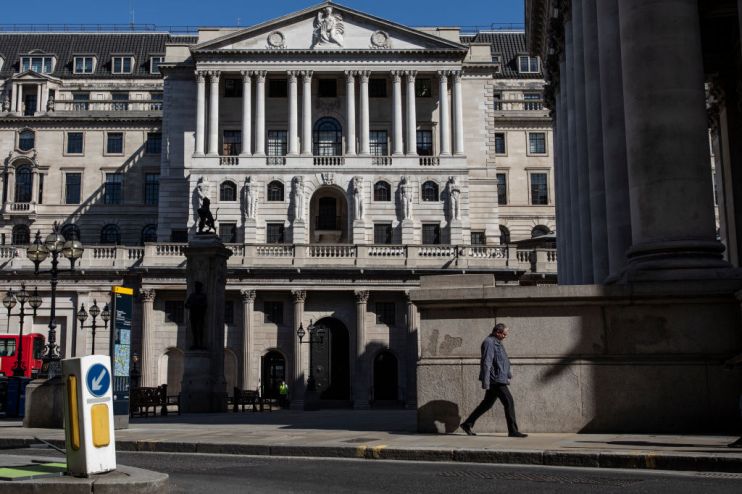
One idea: change the remit of the Bank of England from one of controlling inflation to one of controlling GDP in money terms

Economic policy is returning to its usual position of prominence. 

Fears of a major rise in unemployment are starting to worry the government more than fears around Covid-19.

The chancellor’s imaginative schemes concerning furlough and other measures to protect jobs create potential problems elsewhere. So much money is being borrowed that the ratio of public sector debt to GDP has soared above 100 per cent.  

The last time we were here was at the end of the Second World War. Then, the debt ratio was a massive 250 per cent.  

The Labour government of that time has a reputation for being the most left-wing in British history. It nationalised the mines and railways, and created both the modern welfare state and the NHS.

But it reacted to the massive level of public debt with impeccable orthodoxy. Between 1947 and 1951, Labour ran public sector surpluses to help pay off the debt. These were huge, averaging some £50bn a year at today’s prices.

Will Rishi Sunak be forced into similar levels of austerity, cutting spending and raising taxes?

A timely and fascinating Policy Exchange paper issued last week argues that this would be completely the wrong thing to do. The authors — Gerard Lyons, Warwick Lightfoot and Jan Zeber — are not noted for any previous enthusiasm for fiscal activism, which makes the treatise (as outlined by Lyons in Morning Wire) all the more interesting.

They note that there was a further, perhaps more important, way in which the public debt mountain was brought back under control, in addition to the immediate post-war austerity.

Read more

Bailey warns on inflation risks as Iran war roils UK economy

Bank of England Governor Andrew Bailey addressing financial stability concerns at a press conference

The 1950s and early 1960s saw strong economic growth. A famous phrase coined in 1959 by the then Prime Minister Harold Macmillan was “you’ve never had it so good”.  This, plus a modest rate of inflation, helped erode the debt burden steadily and surely.

The point is that the debt which the government issues is denominated in money terms. If you buy a bond for £100 now and hold it to maturity in 10 years’ time, you get precisely £100 back.

During the 1950s, GDP grew in money terms at an average annual rate of seven per cent. The debt to GDP ratio is, quite simply, the outstanding stock of debt divided by GDP. There was essentially no net addition to debt in this period. But the growth in nominal GDP meant that the ratio was halved.

To tackle today’s debt, Lyons and colleagues call for a strategy of growth. Their most striking demand is to change the remit of the Bank of England from one of controlling inflation to one of controlling GDP in money terms — a combination of inflation and real growth in the economy.

The Federal Reserve in the US is also tasked with taking the real economy — output, jobs — into account, but others such as the European Central Bank remain shackled by a pure inflation target.

This proposal would certainly shake up the Bank of England after years of complacency under Mark Carney. Given the Prime Minister’s new-found interest in the economy, it could be an idea whose time has come.

Main image credit: Getty

Read more

Tax crackdowns means high net worth Brits continue to mull UK exit

An annual property tax would be charged on houses over £500,000

Share this article

  • Facebook
  • X
  • LinkedIn
  • WhatsApp
  • Email

Similarly tagged content:

Sections

  • Markets & Economics
  • News
  • Opinion

Categories

  • Business
  • Economics
  • Opinion

Trending Articles

  • Wetherspoon boss: ‘Not up to Burnham’ to choose who is on the high street 

  • Badger Beer maker Hall & Woodhouse doubles profit ahead of tie-up with James May

  • Four interest rate hikes loom despite surprise economic growth

  • Primark sales slip as owner dresses up retailer for demerger

  • Lotus, Porsche and Corvette: the best sports cars to buy in 2026

More from Morning Wire

  • Bailey warns on inflation risks as Iran war roils UK economy

    Economics
    Bank of England Governor Andrew Bailey addressing financial stability concerns at a press conference
  • Tax crackdowns means high net worth Brits continue to mull UK exit

    Tax
    An annual property tax would be charged on houses over £500,000
  • Britain ‘taxing itself to death,’ Burnham warned

    Economics
    Andy Burnham, Mayor of Greater Manchester, in a suit and tie with a Union Jack flag in the background.
  • Burnham shelves Thames Water administration plans over costs

    Politics
    Thames Water infrastructure with pipes and maintenance workers, highlighting water management efforts in London
  • Manufacturers overcome gloomy economy as output surge continues

    Industrials
    Manufacturing sector faces mounting tribunal pressures amid economic uncertainty
  • As it happened: Vodafone leads FTSE 100 rally after TV launch; oil jumps again

    FTSE 100 Live
    Vodafone and Three company logos on a red and white sign outside a modern glass building
  • Lloyds and Natwest flaunt social credentials as fears grow of Burnham tax grab

    Banking
    City banks could be in for a tax raid come the Autumn Budget.
  • House prices suffer biggest August slump in eight years 

    Property
    Aerial view of colorful residential houses built on a hillside, nestled among green trees, representing housing markets
MorningWire

Independent European business, markets and political news for decision-makers.

Morning Briefing

Europe

  • Germany
  • France
  • EU Institutions
  • Europe

Business

  • Markets
  • Business
  • Economy
  • Regulation
  • Competition
  • Public Affairs

Editorial

  • Opinion
  • Editorial Policy
  • Corrections
  • Contact

Company

  • About Morning Wire
  • Privacy Policy
  • Terms of Use
  • Cookie Policy
© 2026 Morning Wire Ltd · Published by Morning Wire Media, Bahnhofstrasse 65, 8001 Zürich, Switzerland
Privacy · Terms · Cookies · Facebook