Give me liberty or give me death? Americans choose both

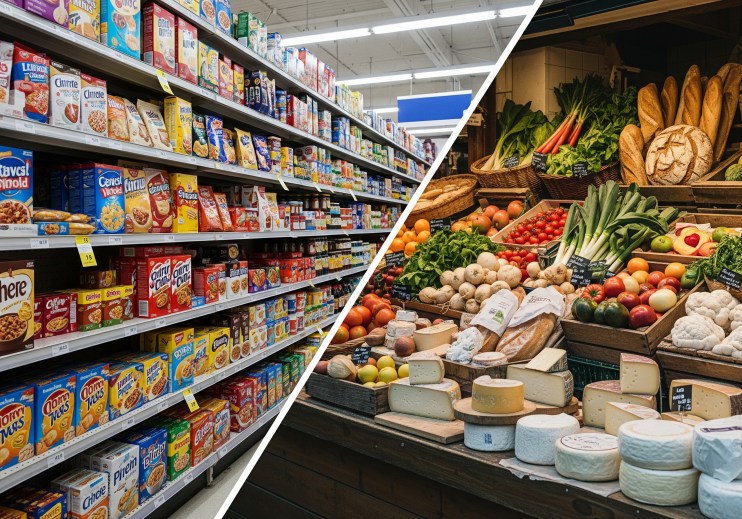
Americans’ obsession with customisation and convenience is killing them, says Lewis Liu
A few months ago, I went partying with a bunch of Gen Z Silicon Valley tech bros. This was perhaps not the best idea for a nearly 40-year-old dad, but my 10-year-younger brother was back in New York from Stanford for a few days, and I thought it would be interesting to see how “kids these days” played.
Interestingly, at some point around 2am in a rooftop bar somewhere in NoMad, we got into a heated argument about milk and eggs.
This all goes back to when my family moved back to the US three years ago. My wife “rediscovered” American produce and food. What shocked her was that “organic milk” and “organic eggs” in the US take months to expire, while they go bad after only a few days in the UK. Go down the American produce rabbit hole, and you’ll discover that American foods are filled with chemicals – everything from baby formulas to gummy bears to meat contains additives to make food look brighter and last longer on shelves.
Even McDonald’s fries tell the story: in the US, they contain more than 10 ingredients, including potatoes, vegetable oil, natural beef flavor (whatever that means!), dextrose, sodium acid pyrophosphate (I have a PhD in Physics and had to look that one up) and salt. In Europe, there are four: potatoes, salt, sugar, oil.
But I’m not here to talk about the problems with the American food supply; that’s a major issue for another day. Rather, I want to explore the mindset where “freedom”, e.g., convenience and optionality supersedes all other concerns. This leads to the food Americans consume, which makes us less healthy. But it’s an implicit choice, a multi-layered version of “Give me liberty or give me death,” a motto all American schoolchildren learn.
Problematic food
In this wine-and-beer-fueled conversation at the rooftop bar, I brought up how American food is so problematic compared to European produce, noting the odd disparity in eggs and milk. This triggered a strong reaction from the group (reminder: Gen Z Silicon Valley founder and VC types). Europe is so inconvenient, they argued, that you need to wait for seasons for certain fruits, that not everything is available via an app, and that stores close early. Try to get something on Sunday evening! These additives in our food are necessary to ensure optionality and convenience. This constant striving to be different, this relentless drive to get things done faster and “better,” is the core of American dynamism.
So I replied, “You would rather live five years shorter but have the optionality for lower-quality food any time you want?” The answer from the group was a resounding yes.
Here’s my take: Americans have always valued convenience and optionality: it’s baked into the culture. In a world where so many other things feel closed off and the middle class is being squeezed, I think Americans feel that retaining choice provides a last remaining vestige of control. However, I’m not sure most Americans are even aware of this trade-off, or have thought about it explicitly.
This need for options in every minor aspect of life, served in the most convenient way possible, is in everything American: you cannot order a coffee without specifying the exact type of milk, caffeine level, temperature, and foam density, as opposed to simply saying, “I’ll have a latte, thanks” at your local Pret. Even American bedding, the top sheet plus duvet system, is designed to provide maximum temperature control, versus the European or Asian approach of a simple comforter adjusted for the season.
All this may seem innocuous (oh no, a few extra seconds ordering coffee!), until you realize there are real societal costs. In food it leads to poorer food standards and hyper-processed products. The same negative impact on life expectancy appears in vehicle deaths, where the “freedom” to drive larger and larger cars results in substantially higher road fatality rates. Our public spaces are designed to maximize car use, contributing to far higher obesity rates. As for guns, I won’t even get started on that.
Fraying social trust
The public health issues (food, cars, guns) can be explicitly tracked. But perhaps a more insidious negative impact of this extreme desire for convenience lies in the fraying of social trust in the US. This was exacerbated by social media and will accelerate under AI, which can serve even more personalized ads and media experiences, creating a world where two people living in the same household have completely different perceptions of reality.
But this extends beyond the digital world. While social media and AI fragment our shared understanding of reality, our obsession with optionality in the physical world, especially in areas meant to be social and communal like food, physical spaces and rituals, fractures our actual communities.
I’m writing this as my family and I fly back to London, where we’ll spend the remainder of the summer. We’re coming from the French countryside, where the boulangeries offered one type of coffee, sold only three types of bread, and provided zero options for customization. The quality of that 1-euro bread was better than anything my local US supermarket offers with its $9 loaves. Healthier too, I’m sure. My kids look forward to this trip every year, where one said to me, “I love French baguettes, which are better than American baguettes.”
Bread is such a deep part of French culture, baked into the very fabric of its towns. It is a deep sense of togetherness, a deep sense of “French-ness”.
Perhaps this is the price of innovation and economic dynamism – a price I acknowledge I’m paying personally. I’m trading social cohesion and years of life for extreme optionality, embracing that absolute sense of freedom that drives everyone to be different and better than everyone else. I know I’m making this choice consciously. But for most Americans, it remains the true implicit choice they’re making: “Give me liberty or give me death.”