The glaring flaws in The Lehman Trilogy

Let’s be honest, the Lehman Trilogy first performed in 2018 has run its course and is more than a little problematic
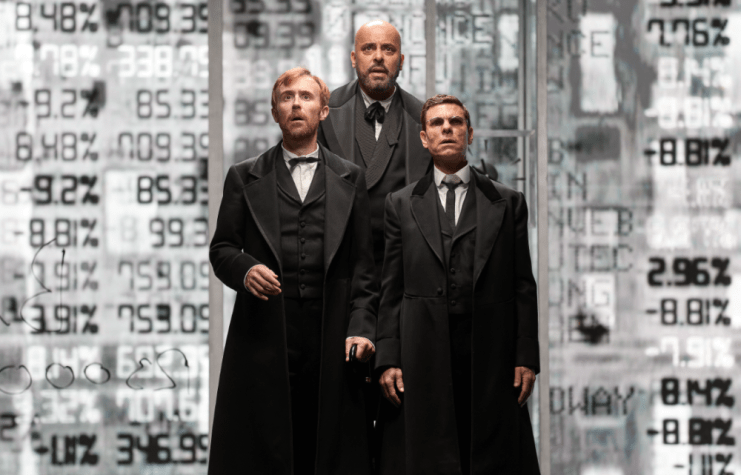
A boardroom in a glass box. The New York skyline on a screen in the background. Cardboard filofax boxes on a table. Three men in suits, performing the whole production. You already know what I’m talking about.
The Lehman Trilogy is on for its fourth run following its debut at the National Theatre (it’s on at the Gillian Lynne Theatre until January) which begs the question: why do so many people flock to see a play about finance? Well, ultimately, it’s not a play about finance but about the American dream and three brothers who made it. Sure, everything crashes and burns at the end – but by then the brothers are toast and it’s the new underclass of crass, pizza chewing yobbos who have taken charge (the Hungarian Glucksman and the Greek Peterson) so you can hardly blame the suit-cladded, umbrella wielding ever-so-sleek titular Bros.
Covering 164 years of history, you could forgive the play for being over three hours long and containing two much-needed intervals. But despite covering this colossal clump of time, it still manages to be repetitive. If I had a dollar for every time a character announced, smarmily, “he smiles” – followed by an appropriately smarmy upturn of the lips – I’d be poised to make some heavy investments on their beloved New York Stock Exchange.
The play is more worried about the suicides of a few bankers over the unemployment, starvation and homelessness undergone by thousands and thousands of Americans.
History: only for the victors?
It also evokes the perennial problem with history, which is written if not by the victors but about the victors (sure the Lehman Brothers bank collapsed but they themselves are inarguably life’s winners in comparison with their fellow immigrant families). As such, women, the slave trade and anyone who is not a highly successful banker or trader is irrelevant (bar the odd spouse and a rogue “dwarf”). Even during the Wall Street Crash of 1929, the play is more worried about the suicides of a few bankers over the unemployment, starvation and homelessness undergone by thousands and thousands of Americans (the fact one in five people are sacked is mentioned, granted, but it’s not portrayed unlike the suicides).
Stereotypes
The other is that in writing history this broad and sweeping, you inevitably end up stereotyping its players. One brother is an ‘arm’, one a ‘head’ and one the ‘potato’. Their Jewishness morphs from devout to heritage, but it can feel a little uncomfortable to see an unquestioning link made between Jews and money making. It presents the Lehmans as the inventors of investment banking and brokerage – which is simply untrue and in a global context, where religious stereotypes are particularly dangerous, this feels glib.
When the women aren’t ignored, they are played by the Bros as ridiculous caricatures. These are meant to be the most comedic parts of the play – the disagreeable and demanding divorcee who Henry Lehman marries, then regrets marrying; the musical, perfect homely wife who Mayer Lehman marries – but I would have liked to know more about the women in the periphery. So, too, would I have liked a more nuanced insight into the tensions pre- and post civil war – the Lehmans, then based in Alabama, buy their cotton from plantations in the south to sell to the north, but there’s barely a mention of slavery. Even when one brother moves north, and the other stays south, we don’t hear them discuss or debate slavery which feels like a missed opportunity.
Doesn’t a change in fortune, uh, change you?
Nor is there any probing on the ammassing of huge wealth. The Brothers and their family just… stay the same. It would have been more credible to see some sort of grappling with a colossal change in fortune. Each generation of Lehman is a little different, but they’re all equally power hungry and money hungry (bar one who “has a problem” with everything and goes into politics – successfully, I might add).
So ultimately I want to ask: what is the point of this play? It is a cute little lesson on brokerage, trading the rise of investment banking, not to mention the Great Financial Crash. But it is not a great lesson because it doesn’t devote enough time to explaining any of these momentous things (I would recommend Michael Lewis’s Liar’s Poker for a crippling satire of life on Wall Street pre-crash, it being a memoir of his time at Salomon Brothers). It’s not unlike a theatrical version of a Wikipedia page.
But it doesn’t probe the Big Questions. Usefully, it cuts out at the moment the phone rings triggering the crash of September 2008. It’s a metaphor for the way the play treats anything that falls outside of the characters’ meteoric rise: dismissal.
This is a fun watch, if you’ve got the stamina. The acting from John Heffernan, Aaron Krohn and Howard W Overshown is superb (it’s the same cast as a recent run in San Francisco but new to the West End), the set is dizzyingly cool, the choreography occasionally a stroke of genius (Bobbie Lehman dancing the twist is particularly memorable) and the production overall is like a well oiled roundabout. It’ll keep turning and turning making money for everyone involved. But with some lazy stereotyping and a stern disregard for philosophical thinking, there’s nothing deep down inside it.