Skip to content
Sunday 9 August 2026London --:--Frankfurt --:--Zurich --:--
NewslettersSearchEN · DE
MorningWire

European business, markets and politics

FTSE 100
10,901.09
+0.31%
DAX
26,319.45
+0.69%
CAC 40
8,714.93
+0.17%
STOXX 50
6,523.86
+0.33%
  • Europe
  • Markets
  • Business
  • Economy
  • Technology
  • Politics
  • Opinion
More
GermanyFranceBankingAIEnergyFintechPropertyCapital Markets
  • Germany
  • France
  • Europe
  • Markets
  • Business
  • Economy
  • Technology
  • Politics
  • Opinion
  • DE
Wednesday 18 March 2026 1:52 pm

Government drops AI copyright opt-out plan after industry backlash

By: Saskia Koopman

Tech Reporter

Add as a preferred source on Google
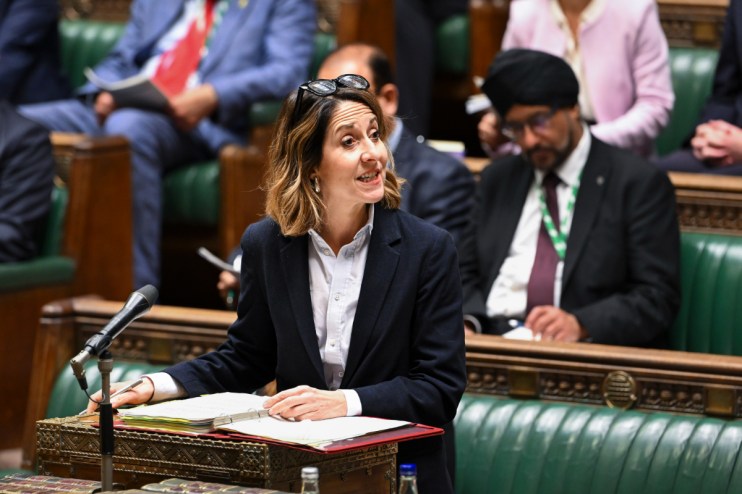
Work and Pensions Secretary Liz Kendall is in charge of reforming the state pension and benefits system
Kendall acknowledged children would still attempt to circumvent the ban

The government has scrapped its preferred proposal to allow AI firms to train on copyrighted material by default, as it shifts its approach after sustained opposition from the UK’s creative sector.

In a report published on Tuesday morning, ministers confirmed they are U-turning from the proposed ‘opt-out’ model, which would have allowed developers to use copyrighted works unless rights holders actively blocked access.

It will instead revisit the issue without a single preferred option.

The decision follows moths of cumulative criticism from artists and media groups, who have long argued the model would weaken copyright protections and undermine the commercial foundations of the UK’s £146bn creative sector.

Announcing the change, tech secretary Liz Kendall said the government had “listened” to concerns and would take more time to find a workable framework.

“At the end of 2024, the government’s preferred way forward was to enable AI developers to train on copyrighted works, with an opt-out for rightsholders”, she said.

“This was overwhelmingly rejected, we can confirm that the government no longer has a preferred option”.

The reset brings the public sector closer to the position initially set out by the House of Lords Communications and Digital Committee, which warned earlier this week against introducing a sweeping copyright exemption and instead backed a licensing-first approach.

Peers argued there was “no sound basis” for weakening copyright protections through opt-out means, and called for stronger transparency requirements so creators can see how their work is being used in AI training.

AI growth vs creator rights

Ministers have been clear they do not want to choose between supporting a fast-growing AI sector or protecting industries that supply much of the data such systems rely on.

“The UK must be an AI maker, not an AI taker,” Kendall said, while insisting creative industries remain “one of our greatest exports” and central to the government’s industrial strategy.

Read more

Anthropic payout piles pressure on UK ministers in AI copyright row

Smartphone displaying the Claude by Anthropic AI assistant app, showing the app icon and interface.

The report sets out a series of next steps rather than a definitive policy, including work on labelling AI-generated content, improving transparency over training data, and exploring how creators can better control the use of their work online.

A consultation on so-called ‘digital replicas’, where AI mimics a person’s likeness or style, is also expected later this year.

The government will also continue developing a Creative Content Exchange, intended as a marketplace for licensing digital content, though details remain limited.

For AI firms and startups, the lack of a clear framework leaves some uncertainty.

Vinous Ali, deputy executive director of Startup Coalition, said: “It is disappointing that a more concrete way forward hasn’t yet been found. However, we commend the government’s determination to get this right.”

He added: “It is critical we find a workable solution that allows our AI startups to go toe to toe with competitors operating in more enabling environments.”

That point reflects a broader concern in the sector that regulatory ambiguity could slow progress, particularly as other jurisdictions move ahead with clearer, if still contested, rules.

The US, EU and Japan have all taken different approaches to text and data mining, with varying degrees of flexibility for AI developers.

The UK’s decision to step back from its initial proposal risks extending that period of uncertainty, even as ministers position the country as a global AI hub.

And att the same time, pressure from the creative industries has intensified.

A coalition of major publishers including the BBC, Financial Times and Guardian recently warned that AI systems are already using journalism as training data without permission or payment, calling for clearer standards and enforcement.

Read more

AI startup boss warns UK cannot become ‘dependent’ on overseas tech

Max Buchan discussing Valarian 2s launch at a business event, highlighting innovative features and industry impact.

Share this article

  • Facebook
  • X
  • LinkedIn
  • WhatsApp
  • Email

Similarly tagged content:

Sections

  • News

Categories

  • Business

People & Organisations

  • AI
  • artifical intelligence
  • copyright
  • creative sector
  • DSIT
  • Liz Kendall
  • tech
  • UK tech

Trending Articles

  • Why the Loire Valley is about so much more than fairytale castles

  • Why HMRC is huge Premier League transfer window tax headache

  • Thames Water faces fresh threat to survival after pensions regulation breach

  • Back to basics: Sainsbury’s gradual retreat from the British high street

  • Thunder Call set to Strike in Shergar Cup Sprint

More from Morning Wire

  • Anthropic payout piles pressure on UK ministers in AI copyright row

    Tech
    Smartphone displaying the Claude by Anthropic AI assistant app, showing the app icon and interface.
  • AI startup boss warns UK cannot become ‘dependent’ on overseas tech

    Tech
    Max Buchan discussing Valarian 2s launch at a business event, highlighting innovative features and industry impact.
  • UK government probes OpenAI breach after ‘unprecedented’ hack

    Tech
    Sam Altman discussing OpenAIs ChatGPT advancements at a press conference, emphasizing AI innovation and future developments
  • Pensioners hit with £8bn tax bill after government freezes allowances

    Personal Finance
    City economists have warned that the triple lock pension is unsustainable and unaffordable given the state of the UK's public finances.
  • AI minister: UK sets sights on global AI leadership, not Silicon Valley emulation

    Tech
    Kanishka Narayan, prominent figure in the news, engaging in a public event or discussion, showcasing leadership and influe...
  • Exclusive: Jobs lost across Labour’s ‘growth potential’ sectors in blow to Burnham

    Politics
    Jonathan Reynolds, Labour MP, in a suit and tie, holding a notebook, looking right, with a building behind him
  • Planet Opens London Office, Expanding European Footprint

    Business Wire
  • OpenAI’s proposed ‘Trump stake’ raises ‘governance overhang’ fears ahead of IPO

    Tech
    Sam Altman discussing OpenAIs ChatGPT advancements at a press conference, emphasizing AI innovation and future developments
MorningWire

Independent European business, markets and political news for decision-makers.

Morning Briefing

Europe

  • Germany
  • France
  • Europe
  • UK & Ireland

Business

  • Markets
  • Banking
  • Technology
  • Energy
  • Property
  • Fintech

Editorial

  • Opinion
  • Editorial Policy
  • Corrections
  • Contact

Company

  • About Morning Wire
  • Privacy Policy
  • Terms of Use
  • Cookie Policy
© 2026 Morning Wire Ltd · Published by Morning Wire Media, Bahnhofstrasse 65, 8001 Zürich, Switzerland
Privacy · Terms · Cookies · Facebook