Take your seat for the Bank of England, Federal Reserve and central banks’ final act
This is the final act in central banks’ aggressive interest rate hike cycle. Well, so say most analysts.
“There’s a growing sense that the recent banking stresses will leave their mark on the global economy, even if the acute phase of the crisis seems to be over,” Dutch bank ING’s experts said in a note recently, referring to the collapse of Silicon Valley Bank, Credit Suisse and, just yesterday, First Republic Bank.
“Cracks are starting to form in the most interest-sensitive parts of the economy after what, in many cases, has been the most aggressive central bank tightening cycle in decades,” they added.
Markets have a slightly different take than the wonks in the research arms of investment banks and consultancies.
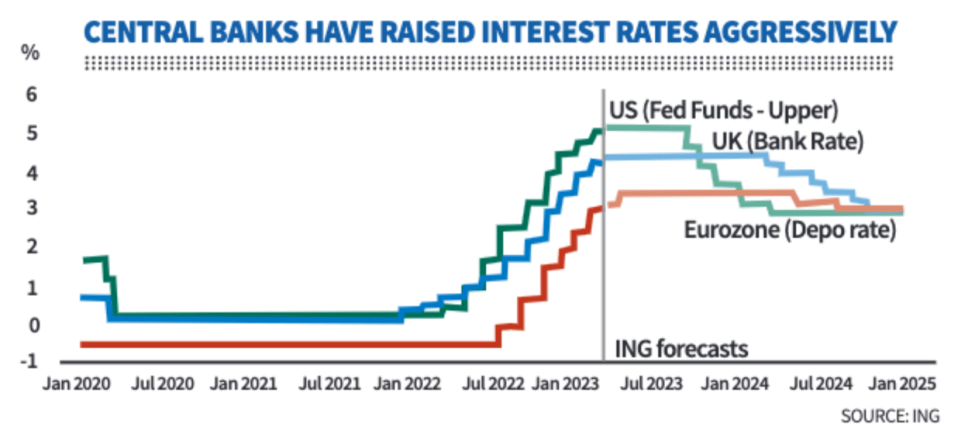
There’s unity though on suspecting the Bank of England will send rates 25 basis points higher at its next meeting on 11 May.
That same day, we’ll get fresh economic forecasts from Threadneedle Street’s best and brightest.
Doubtless another upward revision to economic growth is in store and an inflation forecast that shows it’ll be back at the Bank’s two per cent in around a year (the Bank’s trademark).
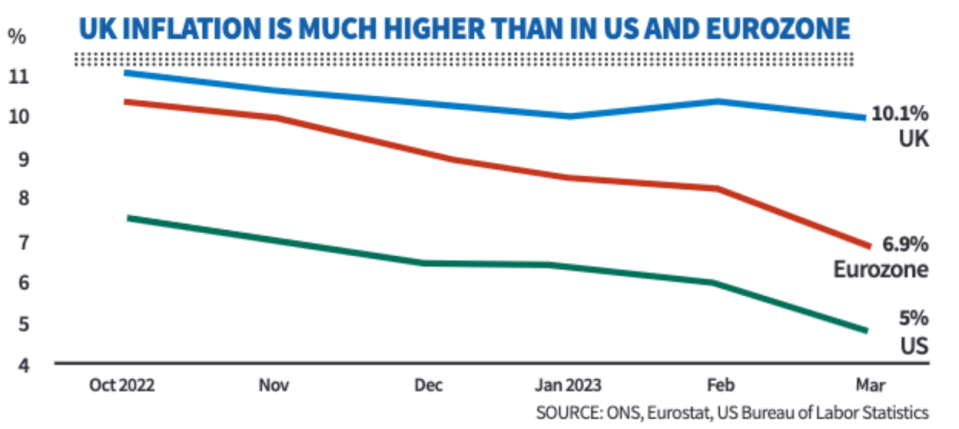
Governor Andrew Bailey and his team are grappling with the toughest inflation crunch of any rich nation – it’s still in the double digits at 10.1 per cent, aided and abetted by falling wholesale energy prices taking a while to filter through to consumer bills thanks to the regulator-managed price cap.
There’s been calls to pause hikes now to avoid piling too much pressure on households and businesses. To do so risks denting the Bank’s inflation fighting credibility even more though.
Sentiment toward the Bank is pretty poor after its chief economist Huw Pill told Brits to “accept” they’re poorer due to the huge price surge. Economically literature Pill’s remarks may be, they were never going to go down well with the general public.
Anger will probably mount after what’s likely to be a twelfth straight rate rise.
Federal Reserve chair Jerome Powell’s in a better position than Bailey. Inflation in the US has been falling since last summer, mainly because the world’s largest economy has been less exposed to the massive energy shock in Europe.
One more rate rise on 3 May of 25 basis points to a range of five and 5.25 per cent and that’s it for the Fed, markets and analysts reckon. Then Powell and co will keep them there probably until the autumn, allowing the increases’ effects to spread through the US. Cuts will follow.
Powell is trying to avoid fashioning too sharp a slowdown while bringing inflation sustainably back to two per cent – the infamous “soft landing”. Bailey still needs to make a meaningful impact on price rises in Britain.
Ongoing concerns about the health of the regional American banking sector will probably stop the Fed from carrying on tamping down on spending. First Republic Bank’s shares tanked last week after it said in its results over $100bn was pulled from its vaults in the first months of this year. It was handed over to JP Morgan yesterday.
European Central Bank (ECB) officials clearly don’t want to be the lender of last resort for the eurozone anymore.
They are intent on firmly putting the era of cheap money in the common currency bloc to the sword with a “higher for longer” approach, keeping borrowing costs at their expected peak of anywhere between 3.5 and four per cent well into 2024.
The size of the ECB’s move on Thursday is contested among market participants. Japanese investment bank Nomura ditched its call for a 50 basis point increase at the end of last week. ING reckons it’ll be a 25 point jump.
Weaker spending in the eurozone, softer core inflation and a rolling back of hawkish sentiment among officials are being seen as signals the ECB could slow its tightening pace.
Now, outside of the big three, the hiking push is tipped to carry on. Sweden’s Riksbank opted for 50 basis points last week. Norway’s Norges Bank could go for 25 points on Thursday.
One central bank sticks out like a sore thumb. The Bank of Japan has ignored global inflation taking off over the last year. It decided last week to keep rates negative.
Inflation has been falling steadily in the rich world. If economists’ forecasts are correct – they rarely are – that it’ll be back to around two per cent by the end of the year, then central banks can stop heaping misery on their respective economies after this round of rate rises.
In fact, soon consumers and businesses can look to the future with something like glee.
“Rate cuts are on the horizon, and we expect the first central banks to start loosening policy before the end of the year,” ING put it.
That would be roundly welcomed by all.
WHAT I’M READING
Huw Pill, the Bank of England’s chief economist, sparked fury last week when he said people need to just “accept” they’re poorer. In essence, he was trying to prevent so-called second round effects emerging from the inflation crunch. Wrong move, Capital Economics’ wonks reckon. Instead, he should focus on influencing “overall inflation expectations in the economy by setting expectations for the level and direction of interest rates”. Since the Bank’s first rate rise in December 2021, they’ve kept pushing back against market expectations. “If the Bank had sounded more hawkish” earlier on, it could’ve curbed inflation expectations sooner, Capital Economics added.
YOU MIGHT HAVE MISSED
Brits returning from their jet setting Easter holidays and coming back to the daily grind lifted spending at Pret stores at the end of last month. The ONS said in-store Pret transactions jumped 30 percentage points in the City in the week to 20 April. Manchester registered a huge 49 percentage point increase. In that same ONS release, data from Revolut found overall card spending dropped seven percentage points over the last week, mainly driven down by lower “entertainment” consumption.