Grant Shapps’ fight will be protecting spending for a shrinking British Army

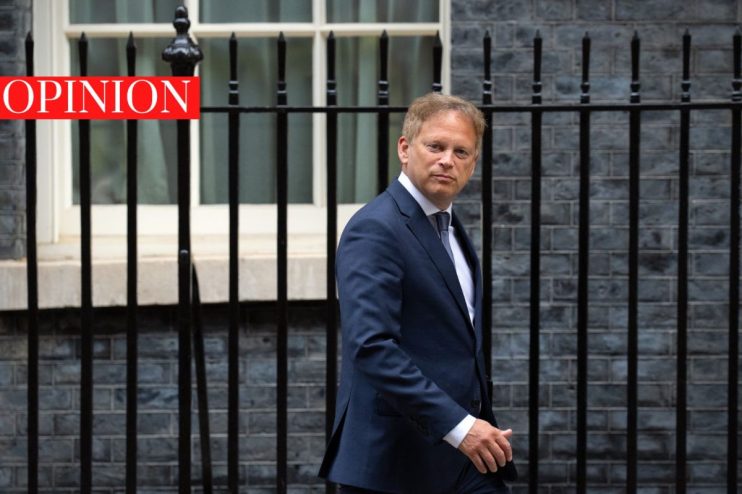
Grant Shapps didn’t get an easy gig as the new defence secretary: he’ll have to protect defence spending while dealing with the smallest Army we’ve had for centuries, writes Eliot Wilson
Last Thursday, Grant Shapps, the 54-year-old MP for Welwyn Hatfield, started his fifth job in a year, as secretary of state for defence. His name had not featured heavily in recent speculations over the job, but he is a loyal adherent of Rishi Sunak. Shapps is a light-hearted, larky figure, willing to laugh at himself, but there is also a faint air of shadiness about him, a wide boy, a chancer. Some of his business ventures explored the no-man’s-land beyond strict truth, and he is infamous for having used multiple pseudonyms.
Being defence secretary is a serious job with a heavy cloak of mystique. He was greeted at Main Building, the MoD’s Portland stone hulk on Whitehall, by the chief of the Defence Staff, Admiral Sir Tony Radakin, and will now have his own military assistant, usually a promising colonel or equivalent. It is an intensely technical portfolio, with its own vocabulary and grammar. And it never stops: since April 1969, every minute of every day there is a nuclear submarine at sea, somewhere, carrying the Trident D5 missiles which constitute the UK’s nuclear deterrent.
Shapps comes to the job in the wake of major strategic reviews. The government published its Integrated Review of foreign and security policy in March 2021, and issued a “refresh” five months ago. The MoD produced a Defence Command Paper in July which outlined how the armed forces will play their part in achieving the review’s objectives.
The headline from the command paper is that the British Army will soon be reduced to 73,500 regular personnel, its smallest size since we faced Napoleon 200 years ago. The chief of the General Staff, General Sir Patrick Sanders, is leaving his post after only two years in part because of these cuts. Although ministers point to investment in technology and equipment, it was Sanders himself who remarked dryly last year, “You can’t cyber your way across a river”.
The idea is that the Army should be able to deploy a war-fighting division, around 10,000 soldiers, which could operate with full capability and independence. This is a geopolitical necessity, and a requisite to be regarded as a credible power. But one senior US general recently told the outgoing defence secretary, Ben Wallace, that the Army was no longer seen as a top-level fighting force. It may sound sycophantic, but we cannot afford to diminish our good reputation any further with Washington, who’s our most likely ally in any major military deployment.
Shapps has few effective levers to pull. We are currently at full stretch – pulling our weight in NATO’s forward-deployed military force in Estonia, and the second-largest bilateral aid donor to Ukraine, to the tune of £4.6bn. But the Army is riddled with problems. Boxer, its new wheeled armoured fighting vehicle, has just begun industry trials, while Ajax, the family of tracked vehicles which the Army will use, has been beset by delays and will not be fully operational until 2028. Until then we are in a situation of make-do-and-mend – like we have been for 20 years.
Wallace’s resignation letter left a strong warning for his successor and for the prime minister. He cautioned that “we must not return to the days where Defence was viewed as a discretionary spend by Government and savings were achieved by hollowing out.” One of Shapps’s fundamental roles will be to guard the spending increases which Wallace secured and ward off any attempted raids by the Treasury. His vaunted communications skills will need to be directed towards his colleagues as well as the electorate to remind them of the need to maintain at least current levels of spending.
The cuts cannot go very much further: there is a critical mass for an army to maintain full-spectrum capability and the ability to conduct expeditionary operations, and it is thought to lie somewhere between 60,000 and 70,000. If we go below that, there will be some tasks we just cannot carry out.
Ben Wallace has been a notably good defence secretary. Grant Shapps knows he is a caretaker until next year’s general election, without much time to do any good. But there is plenty of time to do harm. The new minister will need every bit of his supposed Whitehall expertise simply to hand on a Ministry of Defence which is untouched after his time in office.