Parents are enjoying new-found flexibility in their working day. Younger staff are picking up the slack

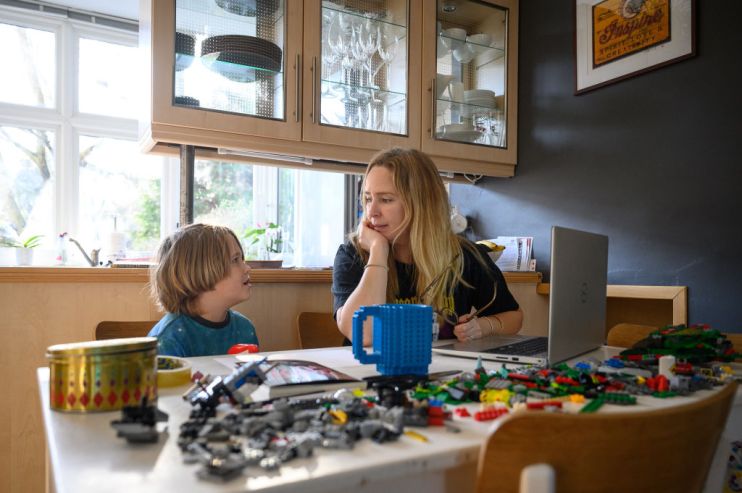
As parenting becomes the latest cause of intergenerational workplace tension, Eliza Filby asks if greater flexibility for parents punishes Gen Z
“I am genuinely perplexed that my younger staff equate my need to do nursery pick-ups with their desire to attend a yoga class,” complained one senior manager to me last week. And this is not the first time I’ve heard this gripe. Gen Zers are increasingly risking the wrath of their seniors by equating their own need for self-care with the pressures of parental responsibility.
But back up for a second; put aside this extreme framing and ponder for a moment the perspective of the twenty-something. As one Gen Zer explained to me, the rhythm of her working week is often entirely governed by her manager’s 8am school drop offs and 5pm pick-ups, and the regular 6am and 8pm barrage of emails when her kids are asleep. As a junior, she of course appreciates the unspoken rule that she is the one that must accommodate, but she also finds there is little or no allowance made if she doesn’t immediately respond to her manager’s early AM or late PM emails. She also observes that parents evenings and sports days are diarised in stone, with the assumption that everyone else will accommodate this.
It’s a situation that reflects the clash of two legitimate perspectives rooted in different generational experiences of work. While the manager, who is also a mother, embraces the hard-won workplace flexibility that helps her juggle her dual responsibilities, the Gen Z junior sees it as an inflexible and challenging situation, to which she is expected to conform. But she finds it difficult because she has entered the workforce at a time when flexible working is considered a right rather than a perk.
Yet, there’s another layer of misunderstanding here. One Gen Zer told me that older colleagues like to remind her she will be rewarded with a degree of autonomy and flexibility when she herself becomes a mother. “But I’m pretty sure I don’t want kids.” And she is not alone. One recent poll found that 45 per cent of 18-34-year-olds were unsure whether they wanted children with one in four ruling it out completely.
And before we think this is just younger people, this perspective is shared by older colleagues, especially childfree women – 43 per cent of Gen X graduate women do not have children. They made their way in a workplace environment when the key women’s issue was, justifiably, integrating motherhood in the workplace, but it was also something that they themselves never benefited from. In my work with companies, I’ve noticed the growing confidence of older women talking about the realities and their perspectives of being childfree.
For a long time, companies have worked hard to prove their progressive offerings not just for mothers but also fathers, incorporating same sex couples into policies and offering shared paternity leave, as well as fertility support and extended leave for premature babies. It’s also now common for employers to offer some form of childcare vouchers and returner programmes for new mums. Appreciating the progress made here doesn’t mean we should deny the work still to be done, especially as the gender pay gap now is essentially a pregnancy penalty. But the point is that it has often been framed as a zero-sum game – as if their pregnancy is a burden on others, while female workers are cast into either being ‘mothers’ or ‘non-mothers’.
It would also be a mistake to assume that ‘parent chat’ transcends the generational divide, because parenting itself looks very different in the 2020s than it did in the 1980s. Nor can we make clumsy assumptions about who becomes a parent, when or how.
So perhaps our Gen Z employee is serving an important role in highlighting the dominance of parental policies when it comes to offering flexibility and providing support. Perhaps what she’s really after is a little more empathy for her own situation or choices, and empathy is the great lubricant of office life, smoothing over differences. Corporate policies, whether on WFH or parental flexibility, are often rigid but company culture needn’t be. Life in the 21st century is increasingly about individuation and integrating difference, and the companies that help manage these, without others feeling slighted or alienated, will reap the benefits.