Skip to content
Monday 14 September 2026London --:--Frankfurt --:--Zurich --:--
NewslettersSearchEN · DE · FR
MorningWire

European business, markets and politics

FTSE 100
10,706.80
+0.53%
DAX
25,433.56
-0.53%
CAC 40
8,130.10
-0.61%
STOXX 50
6,273.53
-0.82%
  • Europe
  • Markets
  • Business
  • Economy
  • Regulation
  • Politics
  • Opinion
More
GermanyFranceEU InstitutionsCompetitionPublic AffairsBankingTechnologyEnergy
  • Germany
  • France
  • Europe
  • Markets
  • Business
  • Economy
  • Regulation
  • Politics
  • Opinion
  • DE
Wednesday 15 September 2021 11:00 am  |  Updated:  Tuesday 02 November 2021 3:47 pm

Hikes to national insurance funds a level of public services we can’t afford

By: Paul Ormerod

Add as a preferred source on Google
UK Daily Politics 2021
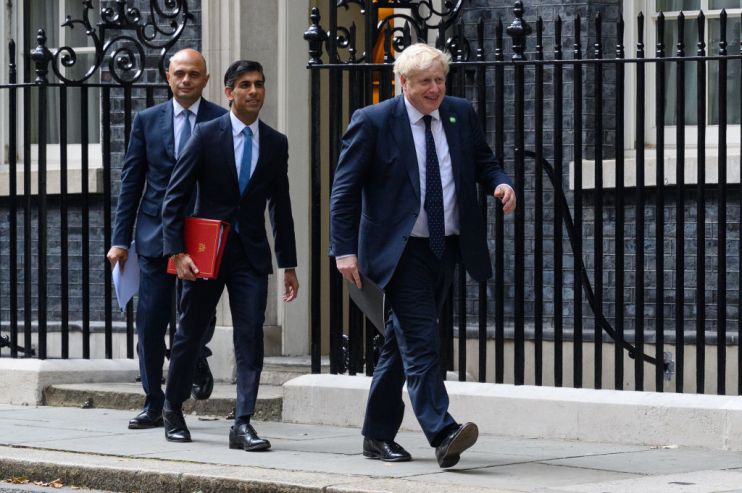
Health Secretary Sajid Javid, Chancellor of the Exchequer Rishi Sunak and Prime Minister Boris Johnson outside Downing Street after the PM announced a hike in national insurance. (Photo by Leon Neal/Getty Images)

The government’s plan to increase National Insurance has sparked the predictable furore. 

The pressures to raise taxes to pay for the level of public services the electorate have come to expect is hardly new. 

The welfare state was created immediately after the Second World War. For a time, the financial demands were held in check. Over the period from 1946 to 1958, for example, the cumulative amount of net borrowing by the government was zero.

Since then, even in normal years, the government has routinely spent far more than it has raised in taxes. The annual average is roughly 3 per cent of GDP. This may not seem much, but even a small percentage of GDP is a huge number. In fact, at today’s prices, this works out to be around £60bn. 

But for a long period, the value of the outstanding stock of government debt relative to the size of the economy – GDP – remained low. Between the late 1970s and the late 2000s – when the financial crisis hit – this ratio stayed under 50 per cent. 

This was despite the fact that a lot of new debt was being issued every year to finance the deficit.

The key to this apparent puzzle is two-fold. After allowing for inflation, the amount of goods and services produced expanded on average by 2.5 per cent a year. Over these three decades, the economy more than doubled in size. Further, inflation in the 1980s was high and prices effectively doubled.

With GDP growing rapidly, through a combination of real expansion and inflation, new debt could be issued without increasing the ratio of the total debt issued, relative to the size of the economy.

Looking ahead, it is hard to believe that the economy will grow at 2.5 per cent a year over a sustained period. Historically, this is a high figure. Inflation is very unlikely to return to the 7 per cent average of the 1980s. This means it will be nigh on impossible to keep the amount of debt relative to GDP in check. 

With the current demand for public services, debt will never be controlled. The Government may find unlikely inspiration in council tax. This is a highly visible tax. People see the money disappearing from their personal bank accounts into that of the council. They wonder how the money is being spent. As a result, it is a very unpopular tax.  

At the moment, only a minority of income tax payers have to fill in a return and transfer money directly to HMRC. For most people, the money is deducted through PAYE and they never see it.

Getting all income taxpayers to file a return and hand the cash over would concentrate their minds. It would act as a political restraint on government spending in the way in which council tax keeps local authorities in check already.

Read more

Government debt repayment ‘could rise to half’ of total taxes

UK public finances and sovereign debt crisis

Share this article

  • Facebook
  • X
  • LinkedIn
  • WhatsApp
  • Email

Similarly tagged content:

Sections

  • Opinion

Categories

  • Opinion

Trending Articles

  • Wetherspoon boss: ‘Not up to Burnham’ to choose who is on the high street 

  • Four interest rate hikes loom despite surprise economic growth

  • Reform hits back at Tory plan to ‘abolish inheritance tax’

  • Lotus, Porsche and Corvette: the best sports cars to buy in 2026

  • Burnham eyes youth minimum wage rethink as jobs crisis bites

More from Morning Wire

  • Government debt repayment ‘could rise to half’ of total taxes

    Economics
    UK public finances and sovereign debt crisis
  • UK economy grew unexpectedly after Burnham took over as Prime Minister

    Economics
    Andy Burnham, Mayor of Greater Manchester, speaking with hands gesturing, wearing a suit and glasses.
  • State pension set to pile pain on next generation of taxpayers, Healey warned

    Politics
    Andy Burnham and Angela Rayner interacting with children at an outdoor event
  • Burnham insists defence uplift ‘can’t come at expense’ of welfare

    Economics
    Andy Burnham, Mayor of Greater Manchester, speaking with Chancellor John Healey listening intently in the background.
  • UK founders cast doubt on Burnham’s pro-business push

    Entrepreneurship
    Andy Burnham, Mayor of Greater Manchester, in a professional setting.
  • Burnham should go on a ‘cost of doing business’ tour

    Economics
    Andy Burnham, Mayor of Greater Manchester, in a dark suit and glasses, listening intently at a wooden table.
  • Retailers urge Healey to unwind national insurance hike to boost jobs

    Retail
    Bald man in white shirt and red tie reading a restaurant menu with a lapel microphone attached
  • Businesses urge Healey to reduce cost pressures in pre-Budget campaigns

    Economics
    John Healey speaking at a podium with the UK Royal Coat of Arms, gesturing with his left hand during his speech.
MorningWire

Independent European business, markets and political news for decision-makers.

Morning Briefing

Europe

  • Germany
  • France
  • EU Institutions
  • Europe

Business

  • Markets
  • Business
  • Economy
  • Regulation
  • Competition
  • Public Affairs

Editorial

  • Opinion
  • Editorial Policy
  • Corrections
  • Contact

Company

  • About Morning Wire
  • Privacy Policy
  • Terms of Use
  • Cookie Policy
© 2026 Morning Wire Ltd · Published by Morning Wire Media, Bahnhofstrasse 65, 8001 Zürich, Switzerland
Privacy · Terms · Cookies · Facebook