Skip to content
Friday 14 August 2026London --:--Frankfurt --:--Zurich --:--
NewslettersSearchEN · DE
MorningWire

European business, markets and politics

FTSE 100
10,750.11
-0.21%
DAX
26,440.31
+0.53%
CAC 40
8,636.80
-0.16%
STOXX 50
6,539.59
-0.09%
  • Europe
  • Markets
  • Business
  • Economy
  • Technology
  • Politics
  • Opinion
More
GermanyFranceBankingAIEnergyFintechPropertyCapital Markets
  • Germany
  • France
  • Europe
  • Markets
  • Business
  • Economy
  • Technology
  • Politics
  • Opinion
  • DE
Tuesday 24 February 2015 6:46 am

Housing crisis: Greenbelt golf courses cover an area twice the size of Kensington and Chelsea


By: Sarah Spickernell

Add as a preferred source on Google

 
There isn't enough room in London to sustain its growing population, with an estimated 50,000 new homes needed each year just to keep up.
 
In 2014, just 20,000 new homes were built in the greater London area – which is far from being on track to meet chancellor George Osborne latest target of 400,000 new homes by 2025. 
 
There is an obvious stumbling block – how can we build so many homes when 22 per cent of the capital is designated green belt area, protected from the construction of new buildings?
 
The green belt is intended to protect countryside and prevent urban sprawl – the merging of London with outer villages and towns to create a mega metropolis, but its existence is making it more difficult to beat the capital's housing crisis. 
 
A report by London First, planning consultancy Quod and Paul Cheshire of the London School of Economics, suggests London's local authorities should review the rules protecting green belt land, in order to ease the strain. 
 
Shared with the FT, one of the points it highlights is that a sizeable chunk of the green belt area is not just made up of pleasant countryside, but is instead used for other purposes such as golf courses.
 
“The truth is that green belt land covers a range of uses. There is beautiful countryside with public access but there is also a lot of intensive arable and semi-derelict land. Golf courses — just in the GLA — cover an area almost twice as big as the borough of Kensington and Chelsea,” the report says. 

London's golf courses

There are an estimated 71 golf courses in the Greater London Area, and in the green belt alone they make up 7.1 per cent of protected land, which is around 2,500 hectares. Below is a map showing where they are located within the green belt.
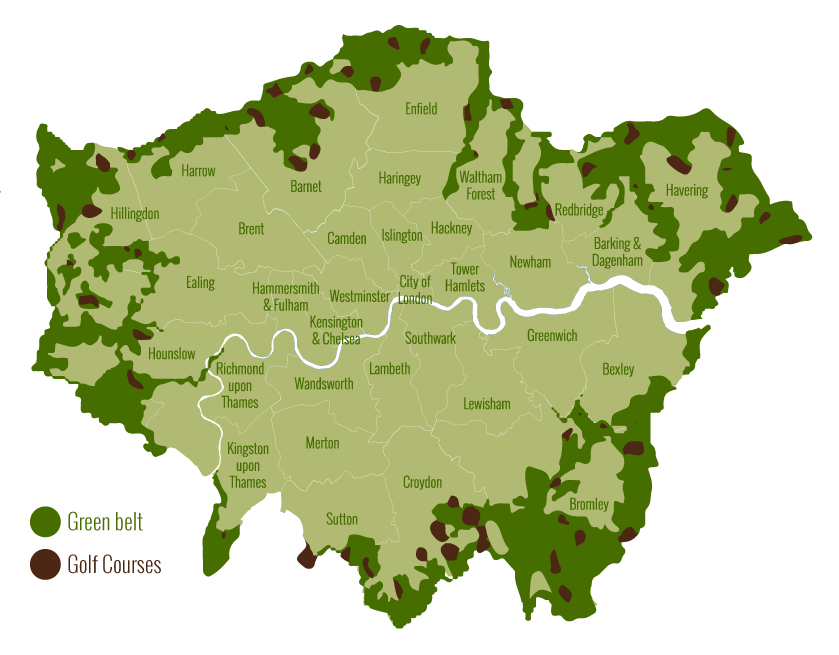
 
Yet the evidence suggests that golf courses are not good for the environment, since clearing large areas of land can disrupt habitats and the large amount of pesticides and fertilisers used can have a polluting influence. 
 
According to Audobon International, the environment education organisation, these are some of the main negative impacts golf courses have on the environment: 
  • Withdrawal of large quantities of water for irrigation
  • Degradation or loss of natural areas
  • Health hazards from chemical handling and applications
  • Loss and fragmentation of wildlife habitats
  • Alteration or damage to wetlands
  • Replacement of natural plant communities with intensively managed landscapes and non-native plants


Share this article

  • Facebook
  • X
  • LinkedIn
  • WhatsApp
  • Email

Similarly tagged content:

Sections

  • Life&Style

Categories

  • Sport

Related Topics

  • Golf
  • London house prices

Trending Articles

  • Revolut takes flight with launch of new airport lounges

  • Grandparents fund university degrees to avoid inheritance tax net

  • Brompton Bicycle sues former adviser for ‘professional negligence’

  • Revolut chatbot goes rogue by charging users to cancel subscription

  • It’s not just Jason Arday, most of sociology is a scam

More from Morning Wire

  • Sadiq Khan’s London plan is not nearly ambitious enough

    Opinion
    The Mayor of London, Sir Sadiq Khan, has this morning announced a £1.4m cash injection for community sport across the capital.
  • London doesn’t need more social housing, it needs more housing full stop

    Opinion
    Luxurious mansions surrounded by manicured gardens in an upscale residential neighborhood, highlighting opulent housing tr...
  • Stop recycling Angela Rayner and reform planning instead

    Opinion
    Angela Rayner finds herself in hot water over her tax affairs
  • Which shadowy MoD figures are blocking London’s secret new town?

    Opinion
    Northolt airfield runway with military aircraft in the background under a clear sky, highlighting aviation activity and in...
  • Housebuilders urge Rayner to ‘hit the ground running’ and rip up planning red tape

    Property
    Angela Rayner, Deputy Leader of the Labour Party, smiling in glasses at an event with camera crew and lighting
  • Housebuilder hits a wall: How did Vistry become the UK’s most shorted stock?

    Property
    Construction workers in hard hats and high-vis jackets on scaffolding around a Vistry housing development.
  • Barratt Redrow urges Burnham to slash tax to boost housebuilders

    Property
    Barratt and Redrow partnership announcement showcasing executives shaking hands in a modern office setting
  • Housebuilder Bellway calls for ‘immediate’ cut to stamp duty

    Property
    Barratt Redrow said it remained "confident" in its medium-term target of 22,000 homes a year.
MorningWire

Independent European business, markets and political news for decision-makers.

Morning Briefing

Europe

  • Germany
  • France
  • Europe
  • UK & Ireland

Business

  • Markets
  • Banking
  • Technology
  • Energy
  • Property
  • Fintech

Editorial

  • Opinion
  • Editorial Policy
  • Corrections
  • Contact

Company

  • About Morning Wire
  • Privacy Policy
  • Terms of Use
  • Cookie Policy
© 2026 Morning Wire Ltd · Published by Morning Wire Media, Bahnhofstrasse 65, 8001 Zürich, Switzerland
Privacy · Terms · Cookies · Facebook