How the UK could cut public spending Singapore-style

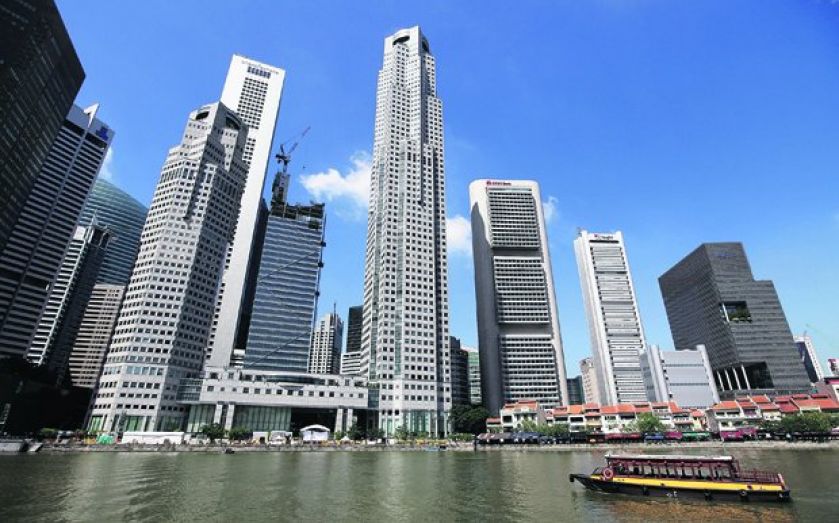
TOMORROW’S Budget will make it all too clear that, to get Britain’s public finances into a healthier state, further tight control of spending will be necessary. But as I’ve shown in my Gresham professorial lectures on how the West must adapt to cope with globalisation, recent spending restraint has been nowhere near enough to keep us competitive, or to avoid squeezed living standards as we adjust to a “supercompetitive” East.
In the UK, we currently spend close to 45 per cent of GDP within the public sector. Tomorrow, the chancellor will probably tell us that there are plans to bring this down to around 40 per cent. That will be some feat.
But this is where an interesting concept in economics called the Scully Curve becomes relevant. It is like the Laffer Curve – which represents the relationship between tax rates and government revenue – but has a stronger scientific basis. The Scally Curve says that there is a relationship between economic growth and public spending as a share of the economy.
When public spending is too low, the economy lacks the public infrastructural support to grow strongly. When it is too high, public spending crowds out the entrepreneurial sector and causes taxes to be so high that they destroy incentives. The latest estimates of the Scully Curve from the Fraser Institute in Canada show that the difference between public spending at 25 per cent of GDP (as in much of Asia) and 45 per cent (as in the UK) can be between 3 per cent annual per capita GDP growth in the former and 1.5 per cent annual per capita GDP growth in the latter. If this really is the case, it heightens the need to bring the public sector in the UK down as a share of the economy, to address the challenge posed by the lean states of Asia.
What can be done to achieve this?
There are examples in Asia of successful economies, like Singapore and Hong Kong, where only around 17 per cent of GDP is taken up by public spending. It is interesting, however, that no one before has tried to work out what we would have to do to match them. I’ve started this analysis for my lecture tomorrow night, and it is most revealing.
Obviously, Singapore’s 17 per cent figure does not compare directly with our 45 per cent. Singapore has a Central Provident Fund (CPF), which is not included in the official figures for public spending, but whose receipts in 2012 were just over 7 per cent of GDP. This Fund pays for pensions and some sickness benefits. Singapore also spends relatively little on its state health system, and we should also adjust for that. Accounting for both, therefore, and Singapore is actually spending about 28 per cent of GDP on those things on which we spend 45 per cent.
But within this, the Singaporeans spend twice as much as a share of GDP as we do on defence, three times as much on public housing, twice as much on education, and five times as much on transport. So many of the critical public services in Singapore are much better funded than they are in the UK.
Singapore saves money by spending about half as much on health as a share of GDP as we do (even though it has lower infant mortality, and higher life expectancy), and spends virtually nothing on social security (although, of course, pensions are accounted for through CPF contributions). In addition, Singapore does not spend money on miscellaneous areas of public spending, like leisure and agriculture, while the country’s law and order costs are half those of the UK as a share of GDP.
Obviously this is just a cursory analysis, and it would be very interesting to look at it in more detail. But it does suggest that there is a lot more to be done to bring public spending under control in the UK if we are to return to persistent strong economic growth. As things stand, the economy is likely to grow strongly for a year or two. But without better underpinnings, the growth could peter out after then.
Douglas McWilliams is executive chairman of the Centre for Economic and Business Research, and the Mercers’ School Gresham professor of commerce. He will discuss this issue in more detail in “Does Globalisation mean that we have to cut public spending?”, held tomorrow at 6pm in the Museum of London. Seating is on a first come first serve basis.