How the dark arts of advertising are shaping the UK’s election campaign

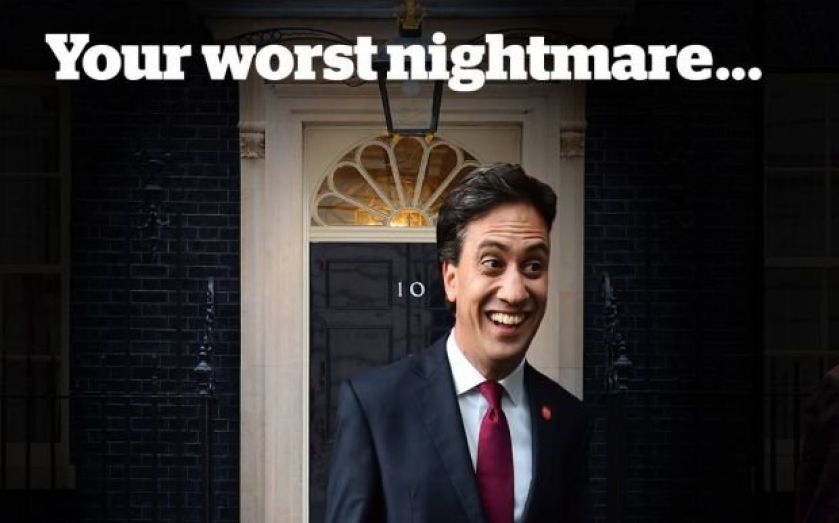
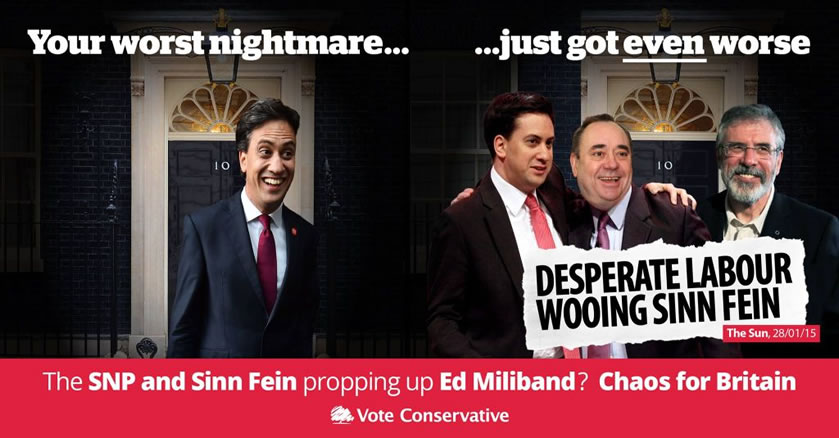
You have been warned (Source: Conservatives, Facebook)
“Your worst nightmare just got worse,” warns the headline on one of the latest Conservative Party election posters, painting a picture of Ed Miliband and Alex Salmond united in guffawing victory on the steps of Number 10. A Labour/SNP coalition would mean “chaos” for the UK, say the Tories.
The Twitter community was quick to dissect the ad in great detail when it was released last month. Some said it was a mistake to even plant the idea of Miliband in Downing Street into the minds of the electorate. It would only serve to make him a more plausible PM. Others got stuck into the poor quality photoshopping, claiming that the Tory admen had fattened up Miliband in the image.
But, really, none of that matters. The sort of people with the time and inclination to analyse political posters in such forensic detail are not the targets that the Tories have in mind. The real aim of political advertising is always to preach to the small number of floating voters with a quick, simplistic message that taps into their pre-existing prejudices. The pollster Robert Worcester calls these people “the 4 per cent”. His theory is that 30 per cent of voters are committed Labour supporters, another 30 per cent are Tories, 20 per cent are loyal to a selection of minor parties, leaving just 20 per cent who are uncommitted. And only 4 per cent of the electorate are both floating voters and live in marginal constituencies. These are the people who ultimately decide elections, so these are the people that admen target. They are also less likely to be politically engaged but consider it a patriotic obligation to vote, says Worcester. So bold, uncomplicated messages tend to have a particular impact.
No-one understands this better than the creative team at M&C Saatchi, who have fought bloody battles on behalf of the Conservative Party on the electoral front line since 1979, when they made their name with the iconic “Labour isn’t Working” poster. Jeremy Sinclair, the creative supremo behind the Saatchi success story, has a set of very convincing maxims on the art of the political ad. “Posters will always be important in elections because if you can’t bold your message down to a simple five word headline then, chances are, your message probably isn’t right in the first place,” he says.
But times have changed and the main parties can’t afford the sort of billboard bombardment they used in the 80s and 90s. Membership is dwindling for Labour and the Tories, while business and union donors are proving more frugal too. Instead, the parties rely on releasing posters on a single site, or sometimes just online, hoping to stir up enough controversy for the images to be re-run by newspapers and TV news bulletins for several days. The best way to do this is by provoking the opposition into an angry response with iffy accusations and spurious attacks. Knowing the Saatchi team, they would have manipulated the image of Miliband as obviously as possible in order to goad their opponents into a war of words. Sinclair’s guiding campaign motto has always been “hit first, hit hard and keep on hitting”. Miliband should brace himself for several more body blows before this campaign is out.
Labour’s campaign chief Douglas Alexander has claimed that his party’s own ads will eschew such personal attacks. But this doesn’t necessarily mean they won’t be negative. Labour has swerved making attacks on David Cameron because the polls show that Miliband cannot beat the Prime Minister in a personality contest. Their ads are endeavouring to keep their leader out of the firing line by focusing on their favourite issue, the NHS. “The Tories want to cut public spending back to the levels of the 1930s, when there was no NHS,” claims one recent poster. This certainly taps into the pre-existing fears of the British public but only manages to do so in a rather lengthy 19 words. As has so often been the case over successive election campaigns, Labour’s team are struggling to hit their messages home with as much blunt and brief bravado as their Conservative rivals.
In any case, both sides have picked their central themes and show every intention of sticking with them through to the bitter end. For Labour’s admen, it’s all about striking fear into our hearts about the future of the NHS; for their Tory counterparts, it’s all about spooking us about Labour’s economic policies. Don’t expect much variety in the messages you see screaming out from poster stands over the next few months. Fear and repetition will always be the political ad man’s not so secret weapons.
Sam Delaney is the author of Mad Men And Bad Men – What Happened When British Politics Met Advertising (Faber & Faber, £14.99).