How graffiti became the nation’s favourite artform

Once sidelined as a reckless illegal pursuit, you might’ve noticed more street art than ever recently, and in more obvious public spaces. Graffiti has long been a sign of protest, even revolution, but over the past two years public art and graffiti have symbolised the national mood more often than we might realise.
Images of rainbow flags for the NHS under the pandemic were commonplace on most street corners, and memorials of men like George Floyd taught a whole generation about the Black Lives Matter movement in the wake of horrendous and tragic police violence.
These murals are sometimes legally commissioned, but are often illegal but publically beloved, so the line between street art and graffiti is always blurred.
Speaking to City A.M, Birmingham street artist FokaWolf explained where the two art forms converge: “A lot of street artists are artists first, then they go out on the street, whereas graffiti I find it’s the other way around, they start on the street and then they go the other way,” he says.
The rise of graffiti or street art since the pandemic has been noted by academics including Sue Farran and Rhona Smith, whose piece “Graffiti in a time of Covid-19” describes the era as a time of “artistic anarchy.”
They acknowledge the tension between loveable street art that can also be illegal.“Some reports have described such work as ‘murals’ rather than graffiti, thereby conferring a degree of artistic respectability, on what might otherwise be damned as vandalism,” they say of pandemic-inspired pieces denoting masks or health workers.
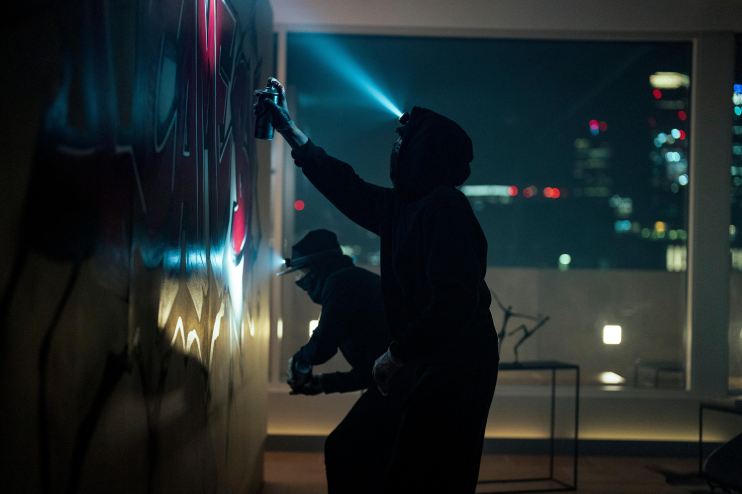
New Netflix film I Came By humanises graffiti artists with portrayals of two young men, played by George McKay and Percelle Ascott, who illegally spray graffiti on rich people’s houses. They’re both struggling in life and in some way let down by their London lives, whether by their family units, their mental health or their careers.
The feature takes a progressive stance, taking time to examine why young men in their positions might find expression and identity in graffiti. Hugh Bonneville plays the victim of the attackers but – not to give anything away – the victims aren’t who you might initially think.
“It was good timing really,” I Came By writer-director Babak Anvari told Morning Wire “Because [the film] was getting closer and closer to green light, and these things were happening around the pandemic, it shows how timely it is.”
Anvari has been inspired by graffiti movements his whole life, especially during the past five years during the pre-production process. “There’s this ongoing debate about whether graffiti is art or whether it’s vandalism or an act of protest, it’s a grey area and I find that grey area fascinating.”
Foka Wolf, whose work typically involves snide swipes at advertisers and the wealthy, took a more empathetic tone during Covid. He says he “was well behind” families making their own murals and hanging them in the windows during the lockdown, but sees the public shift in perception of graffiti as the product of boredom rather than necessarily that Brits were making more of a conscious effort to get into public art.
“No one had anywhere else to go,” he says. “You were stuck in. You couldn’t go to an art gallery or a nightclub, you were resigned to hanging out on the streets. ‘Let’s go and look at this mural as there’s nothing else to do.’”
“I feel like people’s perceptions of graffiti are sort of changing anyway,” he adds. “Here in Birmingham people still look down on graffiti, but if you go to Bristol they’re starting to see the positive impact murals can have, especially in a business area, to brighten it up a bit.”
Whereas ten years ago public art was still stigmatised, high profile galleries now trade in contemporary street artists (no, not just Banksy) and the walls opposite high-net-worth offices and members clubs in Shoreditch are engulfed by brands paying high prices to manifest their logos into ‘street art,’ if you can still call it that.
The art form has become so popular that Anvari agrees with me when I say my hunch is that street art can be a cynical ploy by brands vying for cultural cache: “Street art can be a sterile or sanitised version of graffiti,” he says. “There is a massive crossover.”
Could commodification by brands be damaging the culture of street art? “I think some people were doing NHS stuff just for the sake of it,” says Foka Wolf. “It happens with a lot of stuff – people just piggyback on the back of things.”
There’s no doubt that public displays of work, illegal or otherwise, have become more common and are making money for big firms by exploiting a decades-long tradition rooted in rebellion.
But when it gets art out in the public domain more than it used to, there’s surely a massive benefit in terms of making art freely available. “Street art a democratic way to put art out there because everybody has to see it and everybody can judge it,” surmises Foka Wolf. “With galleries you’re only going to get a certain sector of society walking through a gallery. With street art it’s in the public realm.”