How London could become a 15-minute city, without leaving its centre behind

It was 2020, and Anne Hidalgo, the mayor of Paris, was launching her re-election campaign. Paris was “capable of inventing a new history without forgetting its past”, she said back then, while introducing the concept of the “15-minute city”. Fast forward two years, and Hidalgo is still the mayor of an increasingly green, accessible Paris. What was once a previously little-known urbanist idea is now a concept touted by experts globally.
The brain behind the concept is Sorbonne professor Carlos Moreno. He believes cities to be complex systems: their workings influence the city dwellers’ wellbeing and health. He dreams of a city where one can reach a place of work and key amenities like hospitals, schools and parks in a 15 minute walk or bike ride. This can “transform the quality of life of individuals and reduce the environmental impact”, he says.
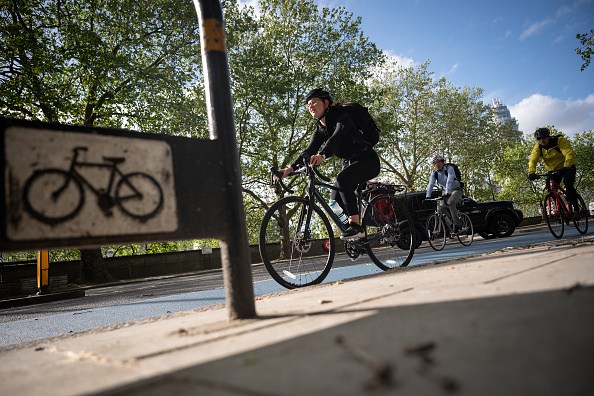
In practice, this means more bike lanes, pedestrianisation of streets, more green spaces and community clubs. Less of that awful 50 minute commute to work, and more of that friendly chat with your local barista. A no-brainer. In practice, it requires an overhaul of the infrastructure and the planning system of the city.
Moreno says that his idea is by no means unique to Paris, but applicable to any large-scale urban area. So what would a 15-minute version of London look like?
London is “by its own nature a collection of small towns and villages grown over time”, says Stephen Edwards, CEO of Living Streets, a charity campaigning for everyday walking. Several neighbourhoods already have much of the amenities Moreno talks about. Social housing is scattered across the city, not clustered in the outskirts like in Paris. There are GP practices in every area, as well as green patches and offices in most.
When it comes to the transport infrastructure, however, things become more complicated. “All roads basically lead into the City – actually moving around in outer London is more complex”, says Peter Murray, co-founder of New London Architecture. The ability to move easily is key not only within neighbourhoods, but also between them. Where walking or cycling might not be possible, people still need public transport. But because London’s transport is skewed in favour of the city’s epicentre, this can prove difficult.
This is because historically, the City has played a magnet role – attracting people for the opportunities it could offer. This, in turn, generates money for the local economy, as people working in the City grab a bite during lunch break or go for drinks in the evening. To be able to feel like a part of it, people make trade-offs, either accepting a long commute or getting a small flat somewhere near the centre. If you start pulling the threads of a 15-minute city, taking from the centre to redirect it to other places, “it risks unravelling”, says Nick Bowes, chief executive of think-tank Centre for London.
The challenge is how to create a 15-minute city that is fair for everyone. It wouldn’t necessarily be the high-skilled workers in the City who would lose from a pivot away from the centre – it would be the lower-income sandwich shops and cafes that would go bust.
The solution to this puzzle is perhaps to see the 15-minute city as a flexible framework more than an irrevocable goal. Moreno himself, for instance, acknowledges that the 15 minutes benchmark can be extended depending on the geography of a place. The basic tenets of the idea – stronger communities, more walking, fewer emissions – are applicable to London. Mayor Sadiq Khan is already on board. The ultra low emission zone (Ulez) and a push on cycling lanes fulfil exactly that purpose.
Equally, the struggle to make neighbourhoods inclusive, lively places could be beneficial for the City too. Over the weekend the City almost becomes a ghost town. Introducing food markets, cultural events, and eventually more housing would turn the area into a real neighbourhood. Canada Corporation is finally waking up to the idea.
There are huge social and environmental gains to be made from a focus on local life. There is increasing demand for it, after the pandemic. Keeping a lively centre and enriching neighbourhoods shouldn’t be mutually exclusive.