How private equity swallowed up the UK – and why it’s unsettling regulators

Private equity has been buying more and more of the UK over the past decade, with thousands of listed or private businesses now snapped up by buyout funds and venture capital investors.
Iconic British businesses like Morrisons, Pret A Manger and Asda have been swallowed up by private capital, with deals like the takeover of Hargreaves Lansdown also looming on the horizon.
Private equity deals in the UK reached a peak of over 1,900 in 2021, with £152bn spent in the space of 12 months, according to data from Pitchbook. In total, more than a trillion pounds has been spent in UK private equity deals since the start of 2014.
While the industry was fuelled by a decade of low interest rates, the number of deals fell as central banks began a monetary tightening cycle to combat inflation in 2022.
However, rate setters have now begun loosening once again and almost £50bn of transactions were struck in the first half of this year. It could mark the start of another period of bumper dealmaking in the UK and beyond.
But how much of the UK economy is already now owned by the sector? And should regulators and politicians be concerned about its dominance?
Private equity’s jobs boom
A new data set put together by Bank of England economists has revealed that over two million Brits are employed by private equity-owned firms – or around 10 per cent of the private sector workforce.
Meanwhile, private equity backed companies account for around five per cent of UK private sector revenue every year, and a whopping 15 per cent of UK corporate debt.
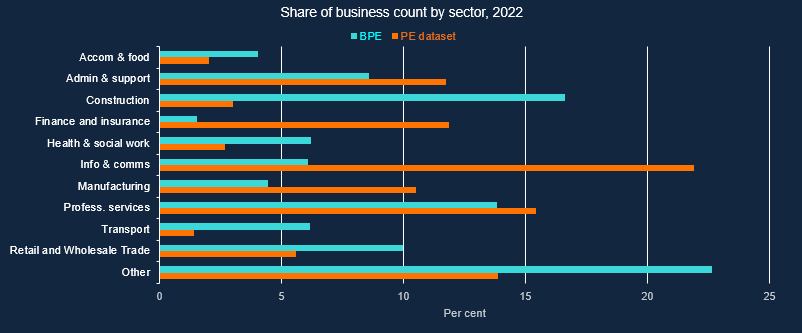
Private equity backed companies tend to be more concentrated in tech, finance and insurance, and professional services than other UK businesses, the data reveals.
However, transport and construction, as well as health and social work and retail businesses, are comparatively underweight.
Looking at the geographical distribution of private equity companies, and it is clear private capital is concentrated in certain pockets around the country.
Almost 35 per cent of employees at private equity backed companies work in London, compared to just over 20 per cent of the total UK workforce.
The other disproportionately private equity area of the country is Yorkshire and the Humber, with almost 15 per cent of private equity employees working there.
Is there a systemic risk?
However, the concentration has triggered fears that pockets of the country could be vulnerable to any difficulties the sector runs into.
“These concentrations across sectors and geography could leave the overall PE-backed market more exposed to shocks affecting particular sectors and regions,” the analysts at the Bank warned.
The warnings follow a series of alarm bells from the central bank over the past year over the stability of private equity backed companies and the potential ripple effect it could have on the wider economy.
In March, the central bank’s Financial Policy Committee (FPC) cautioned against the volume of cash that has been lent by big banks to buyout firms as it kicked off a review of the £6.3 trillion sector.
While rising interest rates have ramped up the cost of financing takeovers and triggered a slowdown in the pace of dealmaking over the past two years, there are fears that the sector could still be vulnerable to sudden shocks.
A sudden slide in the value of private equity backed firms could trigger a chain reaction and a squeeze on banks, the Bank warned earlier this year.
“Finance for riskier corporates could be particularly vulnerable to a significant deterioration in investor risk sentiment,” the FPC warned at its quarterly meeting in March.
“More recently, higher interest rates have made it more difficult for private equity funds to raise investment, contributing to downward pressure on asset valuations,” they added.
Private equity-backed companies appear more vulnerable than other UK businesses, according to the new report, with a larger proportion of these firms having low interest coverage ratios, negative return on assets, and a low liquidity ratio.
The businesses also have a larger share of risky credit, using private credit and leveraged loans more often than other UK firms.
“These instruments typically have shorter tenors than bonds, resulting in a steeper refinancing requirement for PE-backed corporates,” the analysts explained.
“If investors pull back from these markets, certain firms could reduce employment and investment thereby amplifying downturns. In the extreme, these firms could also default and lead to losses for lenders.”
While warnings over the stability of the sector have been rife, private equity’s dominance has not been seen as a ticking time bomb in all quarters.
Financial Conduct Authority chief Nikhil Rathi struck a more dovish tone to his peers at the Bank of England in May, as he said he was “not convinced” of private equity’s systemic risk and City watchdogs should not go into “overkill regulatory mode” on the sector.
The industry has also been pushing back against its perception as a risk to the economy.
Michael Moore, chief executive of the trade body British Private Equity and Venture Capital Association (BVCA), said the private equity “model of active ownership focuses on delivering long-term growth”.
“Where leverage is used, it is part of a capital structure appropriate to the business using it,” he said. “Lenders are sophisticated commercial parties and are incentivised to ensure that the arrangements promote the company’s growth prospects.
“As we saw during the global financial crisis, the PE model is tried and tested. Private capital has been an important part of the UK economy for over 40 years, showing its resilience through different economic cycles.”
The Bank of England looks to be reining in interest rates and buyout firms are on the prowl for targets once again. Whether regulators will look to swoop in and clip the wings of the sector, however, is yet to be seen.