How should the UK respond to Donald Trump’s tariffs?

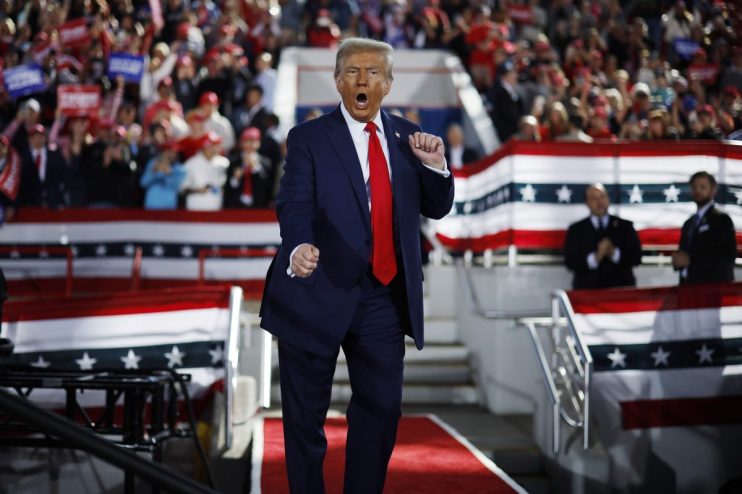
The UK will have to walk a trade tightrope when Donald Trump takes office for the second time early next year.
Trump’s taste for tariffs is well known, proudly proclaiming in the election campaign it was the most beautiful word in the dictionary.
He has threatened to impose a blanket tariff of between 10-20 per cent on all foreign goods entering the US, a pledge he has reiterated since winning November’s election.
Trump’s ire is largely directed to countries with which the US suffers a large deficit in goods. The obvious example is China, but the US also has a large goods deficit with the EU.
“Trump hates trade deficits with a passion,” Rebecca Harding, a senior fellow at the British Foreign Policy Group told Morning Wire. “He wants the US to export more and Europe to export less, that’s the simple truth of it,” she said.
When it comes to US-UK trade, however, things are a little more complicated: Both countries report a surplus with each other due to the way services exports are accounted for in the national statistics.
Whatever the state of play, Trump is much less concerned by services trade than he is by goods trade. This means services exports, which make up the vast majority of the UK’s reported surplus with the US, are unlikely to face the same sort of tariffs as goods.
As a result, many analysts think that the UK is relatively well-placed to weather the first round of a trade spat, and could even sign a deal with the US.
“Trump is predisposed to the UK, and will likely want to see some sort of defence, AI and quantum joint productive capacity also, and all these things would be very good for the UK,” Shanker Singham, chief executive of Competere and a former UK and US government advisor told Morning Wire.
Singham said the government should avoid imposing retaliatory tariffs on the US, pointing out that they would have little impact on getting Trump to change his approach.
“This only works if retaliation is likely to cause the other side to change, and the UK market is not big enough to have this effect on the US,” he said.
The only outcome of imposing tariffs would be to put up costs for businesses importing from the US, likely making it more expensive for consumers in the long-run.
So, in the immediate future, the best approach might be to sit tight and maintain freedom to manoeuvre, while attempting to persuade Trump not to go any further.
In particular, Singham said the government should avoid taking sides when it did not need to, urging the government not to jeopardise the chances of a trade deal with Trump.
“It is crucial that any improvement to the UK-EU Trade and Co-operation Agreement does not cross the line and impact the UK’s independent trade policy and regulatory autonomy, as this will be critical to doing the deal with Trump when it comes,” he said.
At the moment, this appears to be Keir Starmer’s preferred approach. In a speech on Monday, he rejected the idea that Trump’s presidency necessarily imposed a choice on the UK.
“Against the backdrop of these dangerous times, the idea that we must choose between our allies, that somehow we’re with either America or Europe, is plain wrong,” he said.
However, the concern is that Trump’s tariffs – particularly his 60 per cent tariff on Chinese products – might spark a trade war in which the world’s largest markets end up forming their own protectionist blocs.
Harding argued that the “the important question for the UK is not whether to impose tariffs in response, it is which ship to jump on in the event of a global trade war”.
European officials are already discussing possible responses to Trump’s tariffs. In an interview earlier this week, Christine Lagarde suggested that the EU could buy more of certain goods from the US to try and pacify the president.
But Harding said this was “an emollient rather than a deterrent”. After all, Trump hates trade deficits.
Emily Fry and Sophie Hale, economists at the Resolution Foundation, warned that the UK might indeed be forced to make a choice in the event of a trade war, at least when it comes to goods trade.
“Such unilateral openness could be hard to sustain if the EU became anxious about the UK being a backdoor for goods from the US and beyond,” they wrote in a report published today.
When it comes to goods trade, nearly half (47 per cent) of all UK goods exports go to the EU. Maintaining strong trading ties should “remain a priority,” they noted.
With services the position is, again, slightly more complex. The EU remains the UK’s largest trading partner, accounting for 36 per cent of UK services exports, but the US is close behind, buying 27 per cent of UK services.
Services trade has accounted for a large majority of growth in UK exports since Brexit. Fry and Hale therefore argued that it needed to be at the centre of the government’s trade strategy.
“The Government should respond by doing what it can to avoid taking sides on tariffs, easing cross-channel trade for goods, and taking a truly global approach to reducing barriers to the flow of services trade in and out of Britain,” Fry said.
For now though, officials in the UK – like their counterparts around the world – will be working hard to prevent Trump’s threats from escalating into a trade war. If that fails, am urgent rethink might well be in order.