
How the climate change revolution has lit a fire under the heating industry


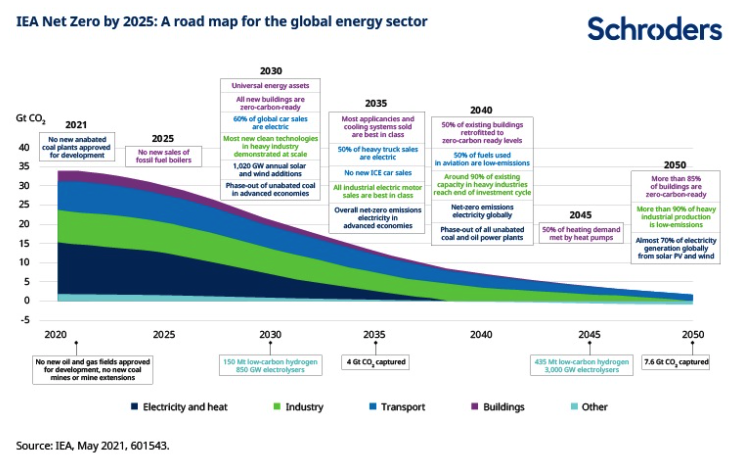
Climate policy over the last few years has seen the rise and rise of “net zero” targets, to the extent that around 70% of global emissions are now covered by a net zero policy. Converting these long-term ambitions into a clear plan of action is the next step, and the recent publication of a net zero roadmap by the International Energy Agency (IEA) is an important contribution to achieving this goal.
The IEA report makes it clear that deployment of existing clean technologies needs to accelerate immediately: this is not tomorrow’s trend.
The IEA report also calls for bans on fossil fuel boilers to start being introduced globally in 2025, driving up sales of electric heat pumps. The looming cutoff points for commonplace consumer goods, such as gas boilers, highlights what a stark break from the past the net zero pathway will be.
Heating: the challenge and the solution
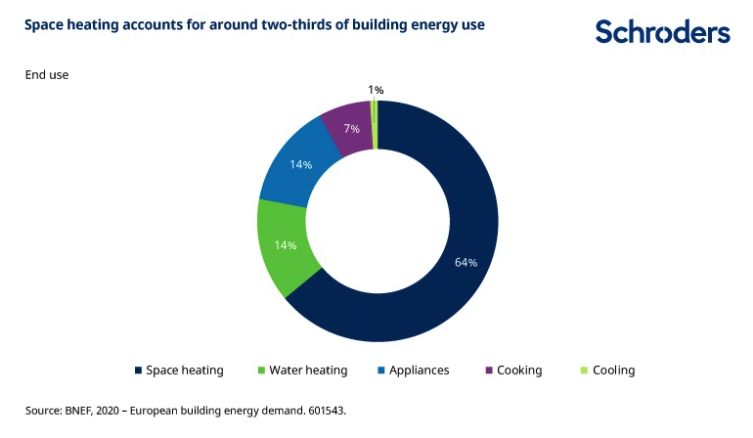
Heating is a major source of emissions. In Europe, buildings account for 36% of emissions, and 40% of energy demand. Space heating accounts for around two-thirds of that energy demand and most of this demand is met by products reliant on fossil fuels. Heat pump technology is readily available and has strong environmental credentials. A heat pump running on green electricity can reduce heating emissions by more than 90% compared to a gas boiler.
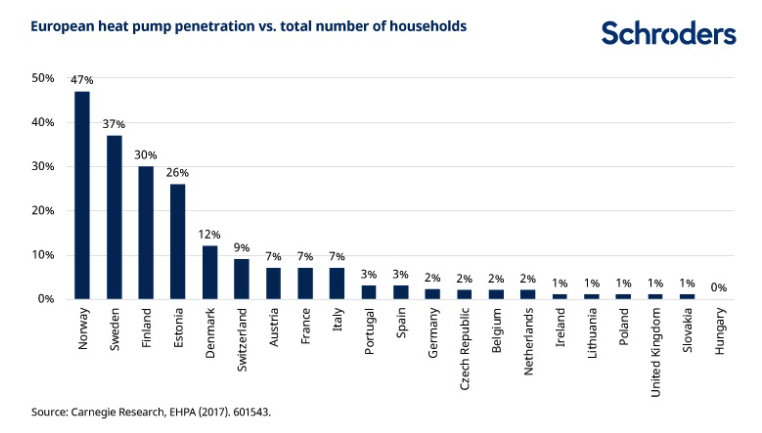
Under the IEA’s roadmap, heat pumps meet 50% of heating demand by 2045, from a tiny starting position today. However, heat pumps are not the only way to decarbonise heating, hydrogen can also play a role, as can district heating systems (a system for distributing heat generated in a centralised location through insulated pipes). There are certainly certain parts of the world to which heat pumps are better- or worse-suited, depending on factors such as the cost of the prevailing technology, and how well-insulated the housing stock is. This explains why heat pumps are often used in the Nordics, but rarely in the UK at present.
Discover more from Schroders:
– Are we now on the road to net-zero?
– What investors can learn from Bill Gates’ climate warning
– Why the going is about to get tougher for investing in climate change
But to get drawn into a debate over which technology ‘wins’ risks missing the point: all of these technologies will need to grow massively. Where the market conditions aren’t currently conducive to heat pumps or other low carbon solutions (for example, because gas is a cheaper option), carrot and stick policies, such as those suggested by the IEA, will likely be introduced.
What does this mean for investors?
As investors in climate change we are particularly interested in industries approaching inflection points, as these breaks with history often result in growth that is underappreciated by financial markets (which are more accustomed to thinking of trends in a linear way). Sometimes these inflection points occur as one technology expands and reaches cost competitiveness with another (as was the case with onshore wind and solar).
However, they can also occur more abruptly when an incumbent technology is simply banned, as could soon be the case with new gas boilers. The heat pump market has been growing at a low single digit rate on average over the past few years, and penetration rates are still largely below 10% outside of the Nordics. Policy intervention could completely revolutionise this market.
– For more visit Schroders insights and follow Schroders on twitter.
Topics:
Important Information: This communication is marketing material. The views and opinions contained herein are those of the author(s) on this page, and may not necessarily represent views expressed or reflected in other Schroders communications, strategies or funds. This material is intended to be for information purposes only and is not intended as promotional material in any respect. The material is not intended as an offer or solicitation for the purchase or sale of any financial instrument. It is not intended to provide and should not be relied on for accounting, legal or tax advice, or investment recommendations. Reliance should not be placed on the views and information in this document when taking individual investment and/or strategic decisions. Past performance is not a reliable indicator of future results. The value of an investment can go down as well as up and is not guaranteed. All investments involve risks including the risk of possible loss of principal. Information herein is believed to be reliable but Schroders does not warrant its completeness or accuracy. Some information quoted was obtained from external sources we consider to be reliable. No responsibility can be accepted for errors of fact obtained from third parties, and this data may change with market conditions. This does not exclude any duty or liability that Schroders has to its customers under any regulatory system. Regions/ sectors shown for illustrative purposes only and should not be viewed as a recommendation to buy/sell. The opinions in this material include some forecasted views. We believe we are basing our expectations and beliefs on reasonable assumptions within the bounds of what we currently know. However, there is no guarantee than any forecasts or opinions will be realised. These views and opinions may change. To the extent that you are in North America, this content is issued by Schroder Investment Management North America Inc., an indirect wholly owned subsidiary of Schroders plc and SEC registered adviser providing asset management products and services to clients in the US and Canada. For all other users, this content is issued by Schroder Investment Management Limited, 1 London Wall Place, London EC2Y 5AU. Registered No. 1893220 England. Authorised and regulated by the Financial Conduct Authority.