Skip to content
Wednesday 12 August 2026London --:--Frankfurt --:--Zurich --:--
NewslettersSearchEN · DE
MorningWire

European business, markets and politics

FTSE 100
10,844.19
-0.17%
DAX
26,391.42
0.00%
CAC 40
8,714.94
0.00%
STOXX 50
6,551.22
0.00%
  • Europe
  • Markets
  • Business
  • Economy
  • Technology
  • Politics
  • Opinion
More
GermanyFranceBankingAIEnergyFintechPropertyCapital Markets
  • Germany
  • France
  • Europe
  • Markets
  • Business
  • Economy
  • Technology
  • Politics
  • Opinion
  • DE
Thursday 22 August 2019 4:40 am  |  Updated:  Wednesday 21 August 2019 5:43 pm

How the offices of tomorrow can prepare for climate change

By: Elaine Rossall

Add as a preferred source on Google
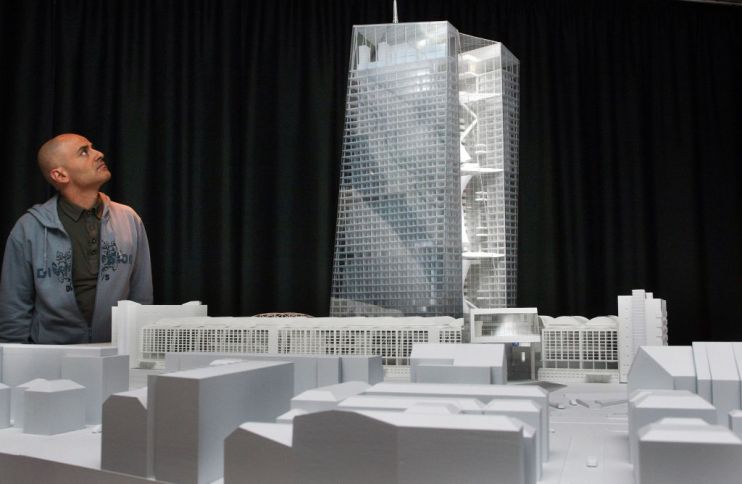
A man looks at a new model of the future headquarters of the European Central Bank designed by the Vienna-based Coop Himmelb(l)au architecture office, 08 October 2007 in Frankfurt/M. The new building being constructed in Frankfurt's east is scheduled to be finished in 2011. The ECB is currently headquartered in the "Eurotower" skyscraper in the centre of Frankfurt. AFP PHOTO DDP/THOMAS LOHNES GERMANY OUT (Photo credit should read THOMAS LOHNES/AFP/Getty Images)

Until relatively recently, climate change was spoken about as an abstraction.

We knew it was a serious problem, but most people put it to the back of their minds. It felt too distant, too remote. We would agree on the need for “action”, nod sagely, then get back to our day jobs. 

That time has passed. Climate change is real and it’s here. Temperatures are rising and the weather is becoming more unpredictable. Cast your mind back to this summer’s extraordinary heatwave, which sent most of Europe darting to the nearest public fountain or air conditioned building. 

We need to start asking practical questions. How will we cope with a summer climate that is closer to present day Barcelona than Barnet? How will we deal with increased flooding and extreme weather? What elements of our society, culture, and infrastructure need an overhaul?

These questions aren’t a thought experiment – they’re urgent, and they need answers. And this is particularly true for my industry. 

Workplace architects and developers are having to face our future climate today. The offices we build now will be expected to stand well into this century, probably the next. The cranes in the sky are constructing places our grandchildren will live and work in. 

The new Guide to Specification from the British Council for Offices (BCO) provides an outline for a new way of thinking. It sets out recommendations for how the UK’s workplaces should be designed, looking at a range of future challenges and opportunities, from the fourth industrial revolution to new thinking around wellness. 

For climate change, the Guide has many important – and timely – recommendations. Overall, it acknowledges that we need to build workplaces equipped for a more volatile climate.

Tomorrow’s Britain is going to be warm. This is a terrifying thought for those of us working without air conditioning. Unsurprisingly, newly built workplaces must feature new cooling systems. But these can’t all rely on draining power from the National Grid – think of the increased fuel use and carbon footprint.

Read more

Arch Construction Risk Report Reveals Top Challenges Facing Sector Amid Rising Volatility

Instead, buildings will need to employ features like chilled ceilings and beams that use cold water and consume far less energy. Workplaces must also feature improved ventilation that makes use of the cleaner city air that will follow the (hopefully) mass adoption of electric cars. 

Depending on their location, some workplaces will also need to prepare for increased flooding risk. We envisage future workplaces being built on plinths, raising workers from the great floods below. Others could be protected by specially designed surrounding landscapes that absorb flood damage – a sort of mini-version of the “Big U” flood defence system currently being built in Manhattan. 

And this isn’t just a challenge for architects and engineers. Property investors can no longer blithely ignore the issues of climate change. Investment should be focused on buildings that are prepared for a new weather pattern, rather than those that pretend change isn’t coming. 

Similarly, insurers must begin to award lower premiums to buildings that feature proper climate resilience. This way, developers are incentivised to plan for our brave new world. 

This should all be in addition to increased work to limit the effects of climate change. We have a duty to do all we can to keep temperatures low.

Developers are undergoing a drive to reduce carbon emissions to net zero by 2050, which can be achieved in all manner of ways. One ingenious approach is for buildings to generate their own energy using solar panels and, in less dense environments, wind turbines. IT and lighting systems can be designed to reduce energy consumption, while buildings can be built with more sustainable materials.

Smarter use of energy can help limit emissions, while better designed buildings can help prepare for the change in climate that is already highly likely. And the offices of tomorrow can lead the way.

Main image credit: Getty

Read more

Meet the new energy minister who believes lower growth is “good news”

Katie White, a woman with curly blonde hair, smiling in a navy blazer and white collared shirt against a dark background.

Share this article

  • Facebook
  • X
  • LinkedIn
  • WhatsApp
  • Email

Similarly tagged content:

Sections

  • News
  • Opinion

Categories

  • Business
  • Opinion
  • Property

Related Topics

  • Climate change

Trending Articles

  • Five-star Mayfair hotel hit with HMRC winding-up petition

  • Nottingham Forest owner Marinakis sues Crystal Palace for defamation

  • Back to basics: Sainsbury’s gradual retreat from the British high street

  • Hargreaves Lansdown orders staff back to office

  • As it happened: Intel, Arm shares slide; Oil climbs higher

More from Morning Wire

  • Arch Construction Risk Report Reveals Top Challenges Facing Sector Amid Rising Volatility

    Business Wire
  • Meet the new energy minister who believes lower growth is “good news”

    Opinion
    Katie White, a woman with curly blonde hair, smiling in a navy blazer and white collared shirt against a dark background.
  • Miami heat: Why climate could be key in 40C England v Norway World Cup quarter-final

    Sport Business
    Business professionals discussing strategies in a modern office setting with charts and graphs on a large screen in the ba...
  • From Mongolian camels to Tibetan verbs: the absurdity Ed Miliband’s aid spending plans

    Opinion
    Ed Miliband speaking at a podium during a press conference, addressing energy policy reforms and climate change initiatives.
  • El Nino heatwaves to ‘fuel inflation next year’

    Economics
    Firefighter in helmet and uniform watching a blazing forest fire at night, red glow in the sky
  • Get ready for new energy minister Miatta Fahnbulleh’s war on London’s drivers

    Opinion
    Miatta Fahnbulleh, director of New Economics Foundation, smiling and holding red documents, wearing a black blazer.
  • Grid operator issues fresh heatwave warning over power supplies

    Energy
    Air conditioning vents in a grid pattern, illustrating cooling solutions during a heatwave
  • Miliband refused to meet motor trade body to discuss zero emissions mandate

    Transport & Infrastructure
    Ed Miliband speaking at a podium during a press conference, addressing energy policy reforms and climate change initiatives.
MorningWire

Independent European business, markets and political news for decision-makers.

Morning Briefing

Europe

  • Germany
  • France
  • Europe
  • UK & Ireland

Business

  • Markets
  • Banking
  • Technology
  • Energy
  • Property
  • Fintech

Editorial

  • Opinion
  • Editorial Policy
  • Corrections
  • Contact

Company

  • About Morning Wire
  • Privacy Policy
  • Terms of Use
  • Cookie Policy
© 2026 Morning Wire Ltd · Published by Morning Wire Media, Bahnhofstrasse 65, 8001 Zürich, Switzerland
Privacy · Terms · Cookies · Facebook