Skip to content
Friday 7 August 2026London --:--Frankfurt --:--Zurich --:--
NewslettersSearchEN · DE
MorningWire

European business, markets and politics

FTSE 100
10,947.45
+0.73%
DAX
26,358.16
+0.83%
CAC 40
8,741.08
+0.48%
STOXX 50
6,546.32
+0.67%
  • Europe
  • Markets
  • Business
  • Economy
  • Technology
  • Politics
  • Opinion
More
GermanyFranceBankingAIEnergyFintechPropertyCapital Markets
  • Germany
  • France
  • Europe
  • Markets
  • Business
  • Economy
  • Technology
  • Politics
  • Opinion
  • DE
Thursday 16 January 2025 6:00 am  |  Updated:  Wednesday 15 January 2025 5:04 pm

How ‘twin deficits’ have fuelled turmoil in the gilt market

By: Chris Dorrell

Add as a preferred source on Google
Tax Trap: Another 74,000 taxpayers were added to the punitive £100,000-£125,000 income bracket during the 2024/25 tax year
More Brits are set to pay income tax.

The gilt market has suffered a tumultuous start to the year, with investors taking fright at UK government debt and yields surging to the highest level in decades.

The sell-off eased slightly on Wednesday following positive inflation figures, but the rate paid on government bonds remains well ahead of where it was just a few weeks ago.

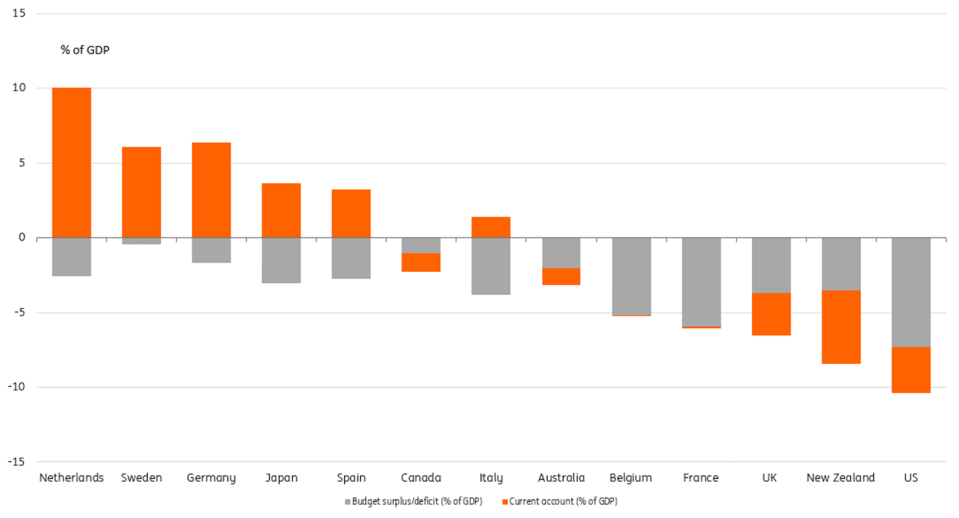
A number of analysts have pointed to the UK’s ‘twin deficits’ as a central driver of the turmoil. In effect, these help explain why the UK has been more exposed to international market movements than other similar economies.

So what are these two deficits, and why are they intensifying pressure in the gilt market?

The first is simply the fiscal deficit, the difference between government expenditure and tax receipts.

A deficit implies the government is pumping more money into the economy than it is taking out, funded through extra borrowing, which increases demand and adds to inflationary pressures.

This has been a concern for investors in the wake of the Budget, primarily because the government has increased public spending by around £70bn every year for the next five years.

Forecasts suggest the Budget will push up inflation by 0.5 percentage points, although early indications suggest the impact might be bigger.

Investors will want a premium to protect against the risk of inflation.

A growing deficit can also make investors nervy because it implies the need for extra borrowing now and – in the absence of economic growth – tax rises or spending cuts in the indeterminate future.

Investors may start to think the government is not as serious about paying back the debt, and so demand a higher interest rate.

Worries about fiscal deficits have climbed up the agenda recently due to mounting levels of debt and anaemic growth (with the exception of the US).

Read more

‘Moron premium’ – Westminster turmoil has ‘cost taxpayers £35bn’ since 2022

Westminster Houses of Parliament under clear sky, iconic London landmark representing UK government and politics

The combination of high debt, high interest rates and slow growth makes a particularly toxic combination and increases the risk of an ever spiralling debt pile.

But many advanced economies have a fiscal deficit. Indeed, at 4.4 per cent of GDP in the 2023/24 fiscal year, the UK is by no means the worst offender on this front.

According to the IMF’s latest projections, the UK’s deficit will be 3.7 per cent of GDP. That’s the same as Italy, better than France at 5.9 per cent of GDP and significantly better than the US at 7.3 per cent.

And this is where the second deficit – a current account deficit – comes into play.

A current account deficit implies that the UK is essentially borrowing more from abroad than it lends. Why does this matter?

“The argument goes that with twin deficits, you’re reliant ‘on the kindness of strangers’ to lend money to you – and in that case you’ve got to look an attractive investment proposition or offer enough compensation in terms of interest rates,” Chris Turner, an FX analyst at ING, says.
Source: ING, IMF

Around 30 per cent of gilts are held abroad, according to Deutsche Bank. So, if the investment case is not looking good, interest rates – gilt yields – will have to rise.

It is fair to say there’s some uncertainty about the outlook for the UK. The economy has been stagnant since the middle of last year and business confidence has plummeted thanks to the Budget. The investment case, therefore, is not entirely appealing.

The prospect of Trump’s second presidency has also spooked markets, which leaves the UK exposed if investors just want to hold safer assets.

“When global risk sentiment declines, the UK is more vulnerable to funds flowing to safer shores,” Paul Dales, chief UK economist at Capital Economics said.

George Saravelos, an analyst at Deutsche Bank, added that the “marginal price setter” of the value of gilts was the yield on US Treasuries, rather than domestic policy considerations.

“The more a country relies on foreign financing for its domestic debt issuance, the more exposed it is to the global environment,” he said.

Read more

Borrowing costs jump after Burnham ‘fiscal flexibility’ remarks

Andy Burnham smiling at a public event, wearing a suit and tie, representing positive leadership and community engagement.

Share this article

  • Facebook
  • X
  • LinkedIn
  • WhatsApp
  • Email

Similarly tagged content:

Sections

  • News

Categories

  • Economics

People & Organisations

  • bond market
  • Budget
  • current account
  • deficit
  • Gilts
  • Rachel Reeves
  • UK economy

Trending Articles

  • Revolut founder’s wealth set to balloon amid talks of share award at $500bn valuation

  • Rupert Lowe axes pensions triple lock and pledges tax cuts in economic plan

  • As it happened: Stocks rise as oil fluctuates after Red Sea attack; US-Iran deal ‘being circulated’

  • Liverpool owners tipped to sell – but not to Amazon boss Bezos – by former CEO

  • WPP slashes jobs as revenue continues to fall

More from Morning Wire

  • ‘Moron premium’ – Westminster turmoil has ‘cost taxpayers £35bn’ since 2022

    Politics
    Westminster Houses of Parliament under clear sky, iconic London landmark representing UK government and politics
  • Borrowing costs jump after Burnham ‘fiscal flexibility’ remarks

    Economics
    Andy Burnham smiling at a public event, wearing a suit and tie, representing positive leadership and community engagement.
  • UK borrowing costs soar as Iran ceasefire collapses

    Markets
    Rising borrowing costs depicted amid escalating tensions following the Iran war, illustrating economic impact on global ma...
  • Temporary inflation slowdown set to boost Burnham

    Economics
    Rising inflation graph with increasing percentage symbols, highlighting economic trends and financial market impact
  • ‘False dawn’: June inflation falls to 2.6 per cent but analysts say rises ahead

    Economics
    Till sales growth slowed to 2.7 per cent in the last four weeks
  • As it happened: Stocks rally as defence shares surge on John Healey as Chancellor

    Markets
    Massachusetts Attorney General Maura Healey, smiling and gesturing, speaks at a podium.
  • Trump reinstates US blockade of Strait of Hormuz

    Markets
    Iranian military vessels patrol the strategic Strait of Hormuz amidst escalating tensions in the region
  • As it happened: Stocks reach new record as investors shrug off Iran war fears

    Markets
    LSEG building entrance with company logo and reflections of a church tower and trees in the glass facade
MorningWire

Independent European business, markets and political news for decision-makers.

Morning Briefing

Europe

  • Germany
  • France
  • Europe
  • UK & Ireland

Business

  • Markets
  • Banking
  • Technology
  • Energy
  • Property
  • Fintech

Editorial

  • Opinion
  • Editorial Policy
  • Corrections
  • Contact

Company

  • About Morning Wire
  • Privacy Policy
  • Terms of Use
  • Cookie Policy
© 2026 Morning Wire Ltd · Published by Morning Wire Media, Bahnhofstrasse 65, 8001 Zürich, Switzerland
Privacy · Terms · Cookies · Facebook