Humanity “three minutes to midnight” on the Doomsday clock

The world is apparently teetering closer to all-out catastrophe than it has been since the height of the Cold War.
We are, in the words of the Bulletin of the Atomic Scientists Science and Security Boards, back at “three minutes to midnight” on the hands of the “Doomsday Clock“.
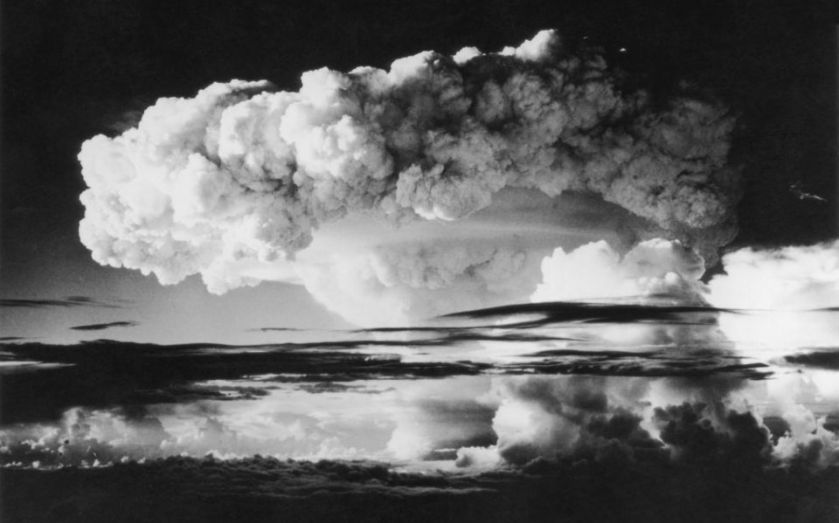
The last time we were this close to the end of life as we know it above-ground hydrogen bombs were being tested as part of the arms race between the United States and the USSR.
The scientific group said the current world situation was “highly threatening to humanity—so threatening that the hands of the Doomsday Clock must once again be set at three minutes to midnight”.

This is how close we are to Doomsday in 2015
This brings us two minutes closer to catastrophe than in 2014.
We’re also worse than the first time the Doomsday Clock was introduced back in 1947, when we were seven minutes from midnight.
The closest we have ever been to disaster was in 1953, when the world was two minutes away as the US began testing the H-bomb, its first thermonuclear device, quickly followed by the Soviets.

Tick tock
The furthest we have ever been from the Doomsday scenario was 1991 when the Cold War was officially over and the Strategic Arms Reduction Treaty signed. Back then we were a whole 17 minutes from catastrophe.

The board cites two main reasons for its concerns – climate change and nuclear weapons, specifically modernisation of weapons and “outsized” arsenals.
These “pose extraordinary and undeniable threats to the continued existence of humanity, and world leaders have failed to act with the speed or on the scale required to protect citizens from potential catastrophe,” the group claims. “These failures of political leadership endanger every person on Earth.”
On the subject of climate change, the group is pretty unequivocal:
The science is clear: Insufficient action to slash worldwide emissions of greenhouse gases can produce global climatic catastrophe. Even a so-called “limited” nuclear weapons exchange will produce massive casualties and severe effects on the global environment. We implore the political leaders of the world to take coordinated, quick action to drastically reduce global emissions of heat-trapping gases, especially carbon dioxide, and shrink nuclear weapons arsenals.
We also implore the citizens of the world to demand action from their leaders. The threat looms over all of humanity. Humanity needs to respond now, while there is still time.
When it comes to nuclear weapons the group highlights “huge and expensive programmes of nuclear arsenal modernization that all nuclear weapon states are pursuing.”
The US, UK, Russia, France and China are all referenced as contributing to this despite being members of the Nuclear Non-Proliferation Treaty. Countries outside NNPT, such as India, Pakistan, Israel and North Korea, are also mentioned.
“As the world’s nuclear nations engage in sweeping nuclear weapons modernization efforts, the gears in the machinery of nuclear disarmament seem to be grinding to a slow halt,” the report says.
“There are far too many nuclear weapons in the world, and world leaders – particularly those in the United States and Russia – have failed to live up to their responsibility to control and reduce the nuclear threat.”
There are, however, other reasons to be concerned. Political institutions were “proven arthritic” by the failure to respond quickly enough to Ebola – despite medical scientists having “a good grip on what to do to quell the outbreak”.
Cyber attacks are also raised as a potentially significant threat, as are advances in artificial intelligence.
“The Bulletin is concerned about the lag between scientific advances in dual-use technologies and the ability of civil society to control them,” the report explains.
“The threat is serious, the time short. The Bulletin of the Atomic Scientists does not move the hands of the Doomsday Clock for light or transient reasons,” it adds. “The probability of global catastrophe is very high, and the actions needed to reduce the risks of disaster must be taken very soon.”
