Skip to content
Wednesday 12 August 2026London --:--Frankfurt --:--Zurich --:--
NewslettersSearchEN · DE
MorningWire

European business, markets and politics

FTSE 100
10,844.19
-0.17%
DAX
26,391.42
0.00%
CAC 40
8,714.94
0.00%
STOXX 50
6,551.22
0.00%
  • Europe
  • Markets
  • Business
  • Economy
  • Technology
  • Politics
  • Opinion
More
GermanyFranceBankingAIEnergyFintechPropertyCapital Markets
  • Germany
  • France
  • Europe
  • Markets
  • Business
  • Economy
  • Technology
  • Politics
  • Opinion
  • DE
Monday 14 July 2014 10:00 am  |  Updated:  Friday 07 June 2019 1:07 am

The International Monetary Fund calls for Eurozone to start doing QE right now

By: Michael Bird

Add as a preferred source on Google

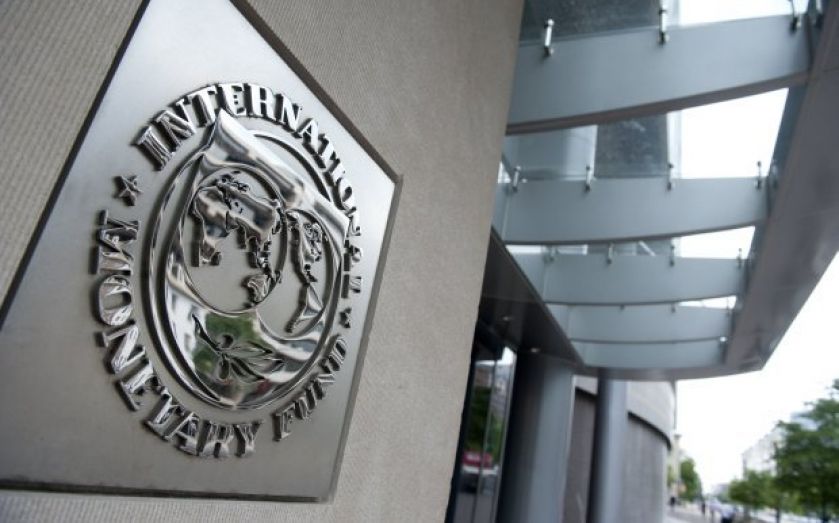
The International Monetary Fund (IMF) assessment of the Eurozone’s economic policies has just been released, and much of it does not make pleasant reading – despite noting the recent expansion, the Fund is calling on the European Central Bank (ECB) to set out on a quantitative easing programme.
 
If inflation remains too low the ECB should consider a substantial balance sheet expansion, including through asset purchases. The broadly neutral overall fiscal stance is appropriate but any negative growth surprises should not trigger additional consolidation efforts as this would be self-defeating.
 
The choice of words here is important – the Fund chose not to say that the ECB should purchase assets if expectations change, but if inflation remains too low. Almost no-one, including the ECB staff forecasters themselves, believe inflation will be adequately high by their own target for years to come. This is a call to do quantitative easing now.
 
ECB officials may also not to be too pleased that the IMF gives a “high” likelihood to the idea that inflation expectations will become unanchored and debt-deflation dynamics will emerge. Officials have been keen to stress that expectations are currently anchored and that they expect price growth to strengthen.
 
The Fund is less critical of the Eurozone’s fiscal policy, noting the bloc’s high public debt ratios, but says that the approach should remain “flexible” and that “large negative growth surprises should not trigger additional consolidation efforts”. 


There is a particularly grim section on youth unemployment – while the Eurozone’s overall unemployment levels seem to have stopped increasing (at a pretty high 11.6 per cent), there’s also not much sign of a significant reduction, with growth so weak.
 
And not only would growth need to be stronger – it would need to be about twice as high, close to three per cent. Even in 2016, the ECB only expects overall growth of below two per cent. In countries like Portugal and Spain, the IMF suggests growth would have to be three times as strong or more – a tall order which might simply be unachievable given the current constraints.


The picture for investment is similarly dreary – even in the most fully-recovered economies, private investment lags behind pre-crisis levels. Greece, Ireland, Portugal, Spain and Italy still have a shortfall of more than a quarter in comparison to 2007. As the above chart shows, the recovery so far has not coincided with any credit growth to corporations – the IMF cheerily sums up the potential for further expansion under the same circumstances.
 
Credit-less recoveries are rare, especially in advanced economies, which suggests risks to recovery unless credit growth resumes (IMF, 2014). In addition such recoveries are associated with lower investment and output growth than in recoveries with credit. This, in turn, could have long-term consequences through lower potential output.
 

Share this article

  • Facebook
  • X
  • LinkedIn
  • WhatsApp
  • Email

Similarly tagged content:

Sections

  • News

Categories

  • Business

Related Topics

  • Eurozone
  • Quantitative easing

Trending Articles

  • Five-star Mayfair hotel hit with HMRC winding-up petition

  • Nottingham Forest owner Marinakis sues Crystal Palace for defamation

  • Back to basics: Sainsbury’s gradual retreat from the British high street

  • Hargreaves Lansdown orders staff back to office

  • As it happened: Intel, Arm shares slide; Oil climbs higher

More from Morning Wire

  • IMF warns Bank of England against cutting interest rates

    Economics
    IMF Chief Kristalina Georgieva issues caution to Bank of England amid economic concerns
  • RS2 Financial Services GmbH Selected to Participate in ECB Digital Euro Pilot

    Business Wire
  • Revolut lands fresh banking licence after wrestling with Europe friction

    Fintech
    Revolut Banque Française ad on a Morris column in Paris, with the July Column and blurred traffic in the background.
  • Healey faces £24bn spending squeeze as inflation puts tax rises in play

    Economics
    Bank of England headquarters in 2025, showcasing modern architecture and iconic London skyline in the background.
  • Hold interest rates but ‘sound hawkish’, Morning Wire Shadow MPC tells Bank of England

    Economics
    Andrew Bailey, Governor of the Bank of England, with the Bank of England building and Union Jack flag in the background
  • How patient can the Bank of England be?

    AD
    Historic Royal Exchange building in London with modern skyscrapers behind, clear blue sky.
  • ATOZ Services Announces Strategic Growth Investment from Bregal Sagemount

    Business Wire
  • Bank of England may set the stage for interest rate hikes this year

    Economics
    Bank of England recession warning
MorningWire

Independent European business, markets and political news for decision-makers.

Morning Briefing

Europe

  • Germany
  • France
  • Europe
  • UK & Ireland

Business

  • Markets
  • Banking
  • Technology
  • Energy
  • Property
  • Fintech

Editorial

  • Opinion
  • Editorial Policy
  • Corrections
  • Contact

Company

  • About Morning Wire
  • Privacy Policy
  • Terms of Use
  • Cookie Policy
© 2026 Morning Wire Ltd · Published by Morning Wire Media, Bahnhofstrasse 65, 8001 Zürich, Switzerland
Privacy · Terms · Cookies · Facebook