Skip to content
Tuesday 11 August 2026London --:--Frankfurt --:--Zurich --:--
NewslettersSearchEN · DE
MorningWire

European business, markets and politics

FTSE 100
10,844.19
-0.17%
DAX
26,391.42
+0.26%
CAC 40
8,714.94
-0.13%
STOXX 50
6,551.22
+0.24%
  • Europe
  • Markets
  • Business
  • Economy
  • Technology
  • Politics
  • Opinion
More
GermanyFranceBankingAIEnergyFintechPropertyCapital Markets
  • Germany
  • France
  • Europe
  • Markets
  • Business
  • Economy
  • Technology
  • Politics
  • Opinion
  • DE
Monday 02 October 2023 2:00 pm  |  Updated:  Monday 02 October 2023 3:17 pm

IMF warns on unsustainable rising debt burden from climate change policies


By: Chris Dorrell

Add as a preferred source on Google
In 2025, the IMF expects growth in the UK to pick up to 1.6 per cent, predicting that disinflation would allow "an easing in financial conditions" and real income growth.

Policies to tackle climate change could send debt to unsustainable levels unless governments are able to find new revenue sources, the International Monetary Fund (IMF) warned today.

In the first chapter of its Fiscal Monitor released today, the international fiscal watchdog warned relying on government spending to tackle climate change could see debt levels increase by around 45 to 50 per cent of GDP by 2050.

“We consider this to be fiscally unsustainable,” Ruud de Mooij, assistant director in the IMF’s Fiscal Affairs Department said.

The IMF said governments all over the world are walking a tightrope between achieving climate goals and maintaining fiscal sustainability.

Many measures to cut carbon emissions are extremely expensive, such as ramping up government investment or offering subsidies for renewable energy firms. Governments are also likely to have to increase spending to offset the impact of climate change on the most vulnerable groups.

Debt levels will increase among both developed and developing economies, but the IMF warned that developing economies would struggle to deal with the increase due to higher existing debt levels.

“High debt, rising interest rates and weaker growth prospects will further make public finances harder to balance,” the authors cautioned.
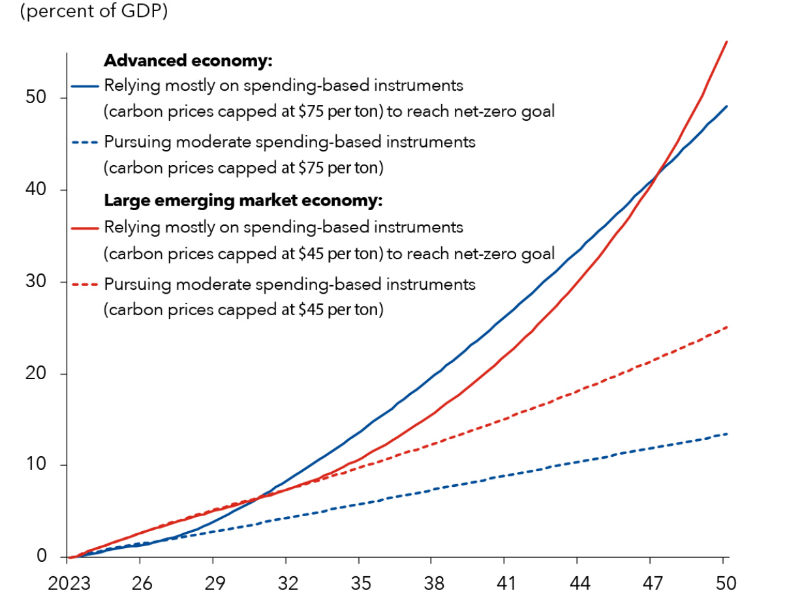
Source: IMF – Scaling up spending measures will be costly

All of this is likely to put increasing strain on public finances. Nevertheless, government intervention was still essential to bring about the scale of emissions reduction to ensure the world reaches net zero by 2050.

Read more

Pension pressure to help swell UK debt to three times size of economy

Two older women exercising at an outdoor gym in sunshine

The IMF recommended that governments implement more revenue based strategies, like carbon pricing. Carbon pricing measures put a cost on greenhouse gas emissions which are paid for by the polluter.

Such measures would both help reduce emissions, by penalising heavy carbon users, and create a new source of government income.

Postponing carbon pricing would add between 0.8 per cent and two per cent of GDP to public debt for each year of delay, the IMF reckoned.

De Mooij said that proper carbon pricing “steers all margins of behaviour in the right direction, whether it’s investment, whether it’s technological innovation, whether it’s energy saving, we need to get the prices right.”

“The additional benefit is that it raises some revenue. That can be used to relax the fiscal constraints,” he continued.

Increasing the share of revenue measures – like carbon pricing – could dramatically reduce the impact that going green has on public finances, the IMF said. In an indicative scenario, public debt in advanced economies would rise by 10−15 per cent of GDP by 2050 with a higher share of revenue measures.

However the authors suggested carbon pricing may be difficult to implement due to political constraints.

They also said it was “necessary but not always sufficient”, advocating a further mix of policies including subsidies and regulation to encourage the private sector to invest further in green projects.

Read more

The devastating prognosis for the UK’s public finances

Dramatic cloud formation over Westminster, capturing a striking skyline with iconic landmarks under a moody sky.

Share this article

  • Facebook
  • X
  • LinkedIn
  • WhatsApp
  • Email

Similarly tagged content:

Sections

  • Markets & Economics

Categories

  • Economics

Related Topics

  • Climate change
  • Green energy
  • IMF

Trending Articles

  • Five-star Mayfair hotel hit with HMRC winding-up petition

  • Nottingham Forest owner Marinakis sues Crystal Palace for defamation

  • Back to basics: Sainsbury’s gradual retreat from the British high street

  • Hargreaves Lansdown orders staff back to office

  • As it happened: Intel, Arm shares slide; Oil climbs higher

More from Morning Wire

  • Pension pressure to help swell UK debt to three times size of economy

    Economics
    Two older women exercising at an outdoor gym in sunshine
  • The devastating prognosis for the UK’s public finances

    Economic News/Analysis
    Dramatic cloud formation over Westminster, capturing a striking skyline with iconic landmarks under a moody sky.
  • Will Britain follow Japan’s great growth gamble?

    Opinion
    Japan Prime Minister Sanae Takaichi speaking at a press conference, highlighting her leadership and political agenda
  • A beginner’s guide to appeasing the bond market – and why it matters

    Markets
    Chancellor Healey speaking at a podium before a crowd, with the HM Treasury sign visible on the brick building.
  • OECD sounds alarm on pension triple lock in challenge to Burnham

    Economics
    Andy Burnham discussing AI advancements at a business conference podium with delegates in the background
  • From Mongolian camels to Tibetan verbs: the absurdity Ed Miliband’s aid spending plans

    Opinion
    Ed Miliband speaking at a podium during a press conference, addressing energy policy reforms and climate change initiatives.
  • IMF warns Bank of England against cutting interest rates

    Economics
    IMF Chief Kristalina Georgieva issues caution to Bank of England amid economic concerns
  • Meet the new energy minister who believes lower growth is “good news”

    Opinion
    Katie White, a woman with curly blonde hair, smiling in a navy blazer and white collared shirt against a dark background.
MorningWire

Independent European business, markets and political news for decision-makers.

Morning Briefing

Europe

  • Germany
  • France
  • Europe
  • UK & Ireland

Business

  • Markets
  • Banking
  • Technology
  • Energy
  • Property
  • Fintech

Editorial

  • Opinion
  • Editorial Policy
  • Corrections
  • Contact

Company

  • About Morning Wire
  • Privacy Policy
  • Terms of Use
  • Cookie Policy
© 2026 Morning Wire Ltd · Published by Morning Wire Media, Bahnhofstrasse 65, 8001 Zürich, Switzerland
Privacy · Terms · Cookies · Facebook