Inflation falls out of double digits to lowest level in a year but tops forecasts
UK inflation has slumped out of the double digits for the first time since last summer to its lowest level in over a year, but topped experts’ forecasts, official figures out today show.
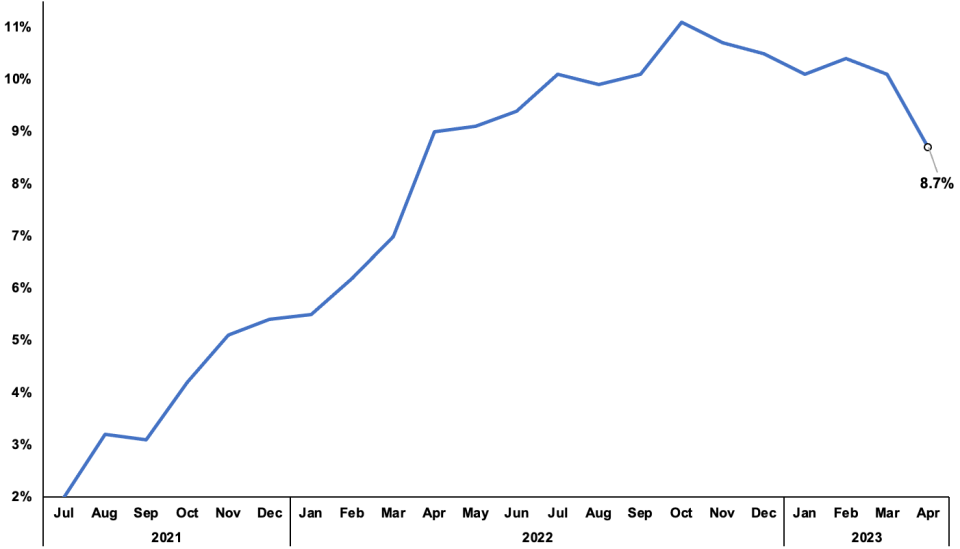
The rate of price increases dropped to 8.7 per cent in April, down from March’s shock rise to 10.1 per cent, the Office for National Statistics said.
That is the lowest number since March 2022.
The figure smashed market expectations of a drop to 8.2 per cent and the Bank of England’s expected fall to 8.4 per cent.
Core inflation – which strips out volatile food and energy price changes – leapt unexpectedly to 6.8 per cent, the highest level since March 1992.
That jump signals rising energy and food prices have pushed up prices elsewhere in the economy, raising the chances of high inflation sticking around for longer.
Yael Selfin, chief economist at KPMG UK, said: “April saw a welcome drop in headline inflation, but inflationary pressures remain sticky.”
Food prices continued their upward trajectory, piling pressure on the poorest families who spend a greater proportion of their budgets on groceries.
Though an overshoot, April’s number is tipped to kick start a slow inflation decline throughout this year that will see it slim to around five per cent by Christmas.
Economists at the Bank do not think it will return to their two per cent target until 2025, meaning inflation would have topped their remit for nearly four years.
It is thought that inflation was initially driven by a surge in demand after lockdowns colliding with strained supply chains.
Russia’s full-scale invasion of Ukraine jolted international energy prices higher, turbocharging UK inflation.
However, racing food prices have not become the main inflation culprit. The Bank earlier this month said nearly all of the additional inflation this year has been driven by soaring grocery costs.
The ONS said food prices jumped 19 per cent over the last year, the fastest acceleration in around four decades.
Markets and economists were divided over whether the Bank will raise interest rates again on 22 June before today’s inflation numbers, though the overshoot fashioned a consensus that the Bank will need to raise rates again.
Inflation has dropped to its lowest level since March 2022
“A further increase in Bank Rate to 4.75 per cent at the MPC’s next meeting on June 22, from 4.5 per cent, now is firmly on the table, following April’s higher-than-anticipated rate of CPI inflation,” Samuel Tombs, chief UK economist at consultancy Pantheon Macroeconomics, said.
Central banks tend to raise interest rates when price pressures heat up in an economy. Such moves make it more attractive for households to save rather than spend and more expensive for businesses to borrow which, in theory, trims demand and cools inflation.
Higher rates also push up mortgage costs, often slims house prices, which can make consumers less confident to splash out the cash.
Bank of England officials however last month said only around a third of the effects of their rate rises have fed through to the UK economy.
The Bank is navigating straining households and businesses even more via further rate rises to tackle inflation without engineering a recession. Yesterday, the International Monetary Fund ditched its recession call for the UK and raised 2023 GDP growth to 0.4 per cent from a 0.3 per cent contraction.
Its economists warned that interest may need to stay “higher for longer” to prevent inflation sticking around for too long.
The pound jumped 0.2 per cent against the US dollar on the news, suggesting investors are pricing in more rate rises from the Bank. London’s FTSE 100 slumped more than 1.5 per cent.
Governor Andrew Bailey and co have lifted rates twelve times in a row in the fastest tightening cycle since the 1980s.
Chancellor Jeremy Hunt welcomed the news, but warned on food prices.
“The IMF said yesterday we’ve acted decisively to tackle inflation but although it is positive that it is now in single digits, food prices are still rising too fast. So as well as helping families with around £3,000 of cost of living support this year and last, we must stick resolutely to the plan to get inflation down,” he said this morning.