
The Irish border issue tells us what the British government wants from Brexit

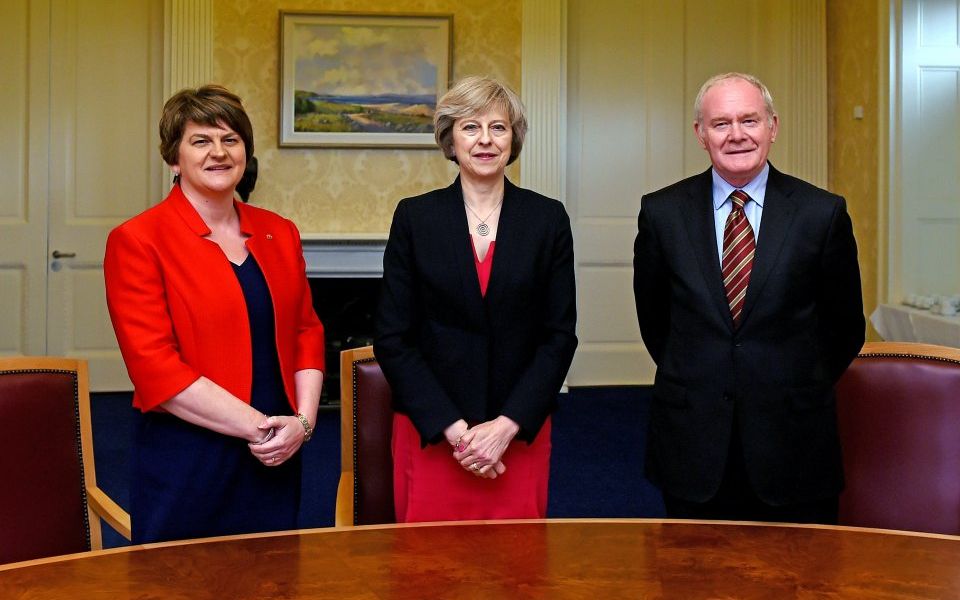
You have to feel a bit sorry for Mrs May. By Monday lunchtime she must have felt convinced she had achieved something that had appeared to be impossible, by settling the Irish border question.
It seems almost unthinkable that she would have struck a deal that saw regulatory alignment between the Republic of Ireland and Northern Ireland without having spoken to her Democratic Unionist Party (DUP) partners first.
So, if we give her the benefit of the doubt and assume she did speak to them before appearing to agree the wording with Jean-Claude Juncker, it can only mean one of two things.
Either DUP leader Arlene Foster got cold feet or she used the deal to flex her muscles to remind Mrs May that her government relied on DUP support for its very survival. While the second of those two possibilities seems very Machiavellian it would not be unusual for the DUP.
Former DUP leader Ian Paisley was somewhat famous for doing much the same to former Conservative Prime Minister John Major – publicly in the House of Commons during Prime Minister’s Questions no less.
As things stand a resolution to the Irish border issues seems further away than ever.
Had Mrs May been able to strike a deal on Britain’s divorce from the European Union (EU), on the basis of what was agreed on Monday, it would, arguably, have been a master stroke. Because in reality, trade negotiations would have already begun.
The British government’s solution to the Irish border question appears to have been a fudge of the highest order but it might have also opened up the possibility of fudges elsewhere.
The downside of the fudge was always going to be that if the government could do a special deal for Northern Ireland then why not Scotland? Why not London? London Mayor Sadiq Khanand Scottish First Minister Nicola Sturgeon were quick to tweet as much by Monday afternoon.
This isn't necessarily the sort of deal that “effectively” keeps Northern Ireland in the Single Market and the Customs Union as has been assumed.
What it may in fact be, is a deal which could be applied to the City or to those industries the Scottish economy relies on.
Whatever the protestations of the DUP, a deal that sees regulatory alignment in certain areas doesn’t keep Northern Ireland in either the Single Market or the Customs Union.
What it does is recognise regulations across borders as being acceptable and therefore not requiring customs checks. This is otherwise known as a mutual recognition agreement.
This would be part of any free trade deal Britain would hope to strike with the EU. In fact, the Brexit Secretary, David Davis said as much in the House of Commons on Tuesday.
So the Irish question could have given Mrs May her first win in trade negotiations with the EU. It also reveals a great deal about what the British government is hoping to achieve from Brexit negotiations.
If, and it remains a big if, Mrs May can make the Ireland deal stick, it opens the possibility that the City can continue to trade with the EU in much the same way as it currently does.
Why, if there can be mutual recognition for Irish dairy farmers crossing the border from the Republic into Northern Ireland, can’t there be mutual recognition for British banks and Insurers that want to continue to do business with the rest of Europe after Brexit?
Logically the answer would appear to be that there can be mutual recognition and there should, particularly given that British financial services regulators wrote most of the rules for their European counterparts in the first place.
If that opportunity can be grasped, the prophecies that hundreds of businesses would move to financial centres such as Paris and Frankfurt taking with them thousands of jobs, may not come true after all. But it remains a big if.