Is it high time to buy in super-prime London?

London’s super-prime market has been suffering from a glut of supply in the wake of damaging decision-making from successive governments. Ali Lyon asks, is the tide beginning to turn?
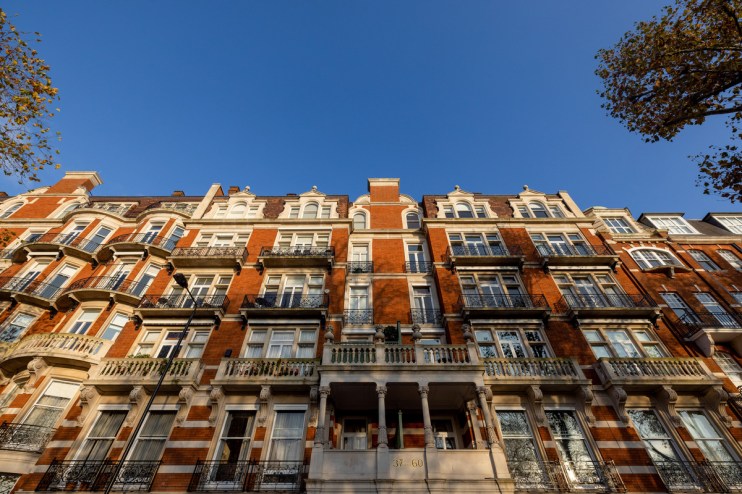
To take a walk down Mayfair’s historic Upper Grosvenor Street is to be confronted by a quiet, but dramatic, changing-of-the-guard afoot in one of London’s most sought after roads.
Its storied commercial occupants – from the Monegasque embassy, Michelin-starred Corrigan’s, and the Arab-British Chamber of Commerce – have all had roots there since at least 2008, and show no signs of developing itchy feet.
But cast one’s eyes to the apartments, mansion blocks and townhouses that fill the rest of the Duke of Westminster-owned thoroughfare, and an altogether different picture begins to emerge.
Because despite the road being under 250m long in total, there are currently, according to property site Rightmove, no fewer than 13 homes listed as for sale on the street, with vendors hoping their super-prime pied-a-terres will fetch anything from £4.5m to £14.5m.
The number of homes available to rent on the road brings the transition into even sharper relief. Prospective tenants hoping to lay down roots on the exclusive enclave, just a stone’s throw away from Hyde Park, will find themselves blessed with over 20 options.
That glut of homes for sale or to rent is not restricted to Upper Grosvenor Street. Across the capital, slack in the market continues to increase, while demand languishes.
According to property data firm Lonres’s June survey of the capital’s prime postcodes, the number of new sales instructions – a barometer for new supply on the market – was up 19 per cent year on year and over 20 per cent compared to average levels between 2017 and 2019.
Narrow that down to homes over £5m, and the flood of supply is even more apparent. New instructions in this super-prime bracket are up 43 per cent year on year, helping bring the number of high-end homes available up by over a quarter since 2024.
Super-prime properties at bottom of 10-year low ebb
After months of resistance from stubborn sellers unwilling to accept a haircut on one of their prized possessions, prices are starting to reflect the inevitable gravity of these brutal market dynamics.
Transactions remain stubbornly low, but homes that do sell for more than £10m are changing hands for 10 per cent, sometimes 20 per cent, lower than the price at which they were initially listed.
Stuart Bailey, head of London super prime sales at Knight Frank, branded the situation “the bottom of a 10-year low-ebb in super prime sales”.
The decline of the most exclusive end of London’s once world-leading property market dates back to 2016, with the UK’s decision to leave the European Union.
Prices are nominally still below where they were in 2014. But property professionals like Bailey say the decade-long decline has been compounded by recent political decision-making.
A look at latest filings from Qatari-owned property firm Real Estate Management (UK) also shows the picture is similarly dour across much of the upper end of London rental market.
The group owns and operates 10 newly completed apartments at the top of London’s Shard. But despite the group having first put its luxury flats on the lettings market two years ago, it has not managed to secure a tenant on a single one of the 10 homes that make up the scheme.
In a statement issued alongside its results, the property firm singled out the government’s decision to abolish the non-dom regime as especially damaging to interest in super-prime homes.
“The long-heralded change in UK tax rules applied to overseas residents, which were accelerated by the current UK administration to apply from April 2025, have had the feared impact of driving many such investors away from the UK,” they wrote.
Bailey agreed that the changing fiscal environment for wealthy foreigners has dampened the market – and is “the headline grabber”. But it is not the sole factor driving the surfeit supply.
“There are lots of sub-sectors in this super prime arena, but everything has an impact on sentiment. Confidence just compounds, and if non-doms leave, other people will follow suit,” he said.
This has not only led to a increase in supply on the sales market, but added to stock in at the upper end of lettings in the capital.
Nick Beckett, a partner in Knight Frank’s super prime lettings division, sees more and more homeowners in areas like Mayfair and St James’s letting their homes out almost by mistake as they reassess their long-term residence.
“In these times of uncertainty, lots of people are just holding their assets,” he said. “Homeowners are holding their assets rather than selling them, and using them when they come to London, or flipping over to becoming accidental landlords.”

Green shoots emerging?
There are, however, some signs that as international buyers evacuate the their amenity-rich bolt holes in Belgravia and St James’s, investors and buyers with an altogether different mindset are beginning to mop up some of the deals on offer.
Morning Wire understands the Grosvenor Estate, the largest landowner in central London, has been slowly expanding its portfolio of freehold residential properties as prices continue to come down.
“It’s a really interesting market,” a person familiar with the estate’s approach said. “The group has acquired quite a few residential assets recently, and it will continue to do that going forward.”
Meanwhile Bailey said that savvier, more domestic buyers in the market are also beginning to sniff out an opportunity to upsize or expand.
“If you understand what you’re looking at, then the opportunity is getting more and more blatant,” he said.
The signs of life are even more evident in the upper echelons of the lettings market. Beckett is increasingly seeing the right kind of rental homes being snapped up by a cohort far more open to renting than previous generations.
“Tenants are absolutely willing to pay a premium for perfect specification, turnkey properties,” he said. “And branded residences like Chelsea Barracks – with outdoor and indoor rackets clubs, swimming pools, gyms and and doormen – are really appealing to tennants.”
Becket added there is also a generational change at play that is bolstering super-prime lettings. “Fifteen years ago, people would think you would rent because you couldn’t afford to buy.” he said. “Now, however, renting is becoming a lifestyle choice in a world where people have an ever increasing amount of global mobility.”
But rather than painting those green shoots as the early signs of any political triumph, Bailey stressed that any recovery would be despite, not because of, the occupants of Number 10 and 11 Downing Street.
“You know, it’s only by default that we happen to be still a popular country, because of culture, language, geography, long-term stability,” he said.
“You do feel, as a humble estate agent, you’re on the front line of defending London against successive governments.”