Skip to content
Friday 7 August 2026London --:--Frankfurt --:--Zurich --:--
NewslettersSearchEN · DE
MorningWire

European business, markets and politics

FTSE 100
10,867.89
-0.19%
DAX
26,140.13
0.00%
CAC 40
8,699.71
0.00%
STOXX 50
6,502.56
0.00%
  • Europe
  • Markets
  • Business
  • Economy
  • Technology
  • Politics
  • Opinion
More
GermanyFranceBankingAIEnergyFintechPropertyCapital Markets
  • Germany
  • France
  • Europe
  • Markets
  • Business
  • Economy
  • Technology
  • Politics
  • Opinion
  • DE
Wednesday 22 May 2024 4:46 pm  |  Updated:  Wednesday 22 May 2024 8:41 pm

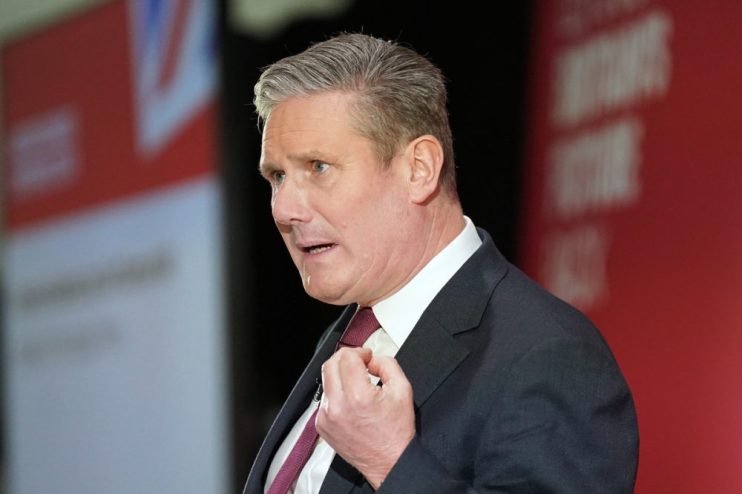
Election 2024: Is Keir Starmer ready for government?

By: Will Cooling

Add as a preferred source on Google
Revolution Bars' newly-appointed chair and seasoned investor Luke Johnson told Morning Wire that the reforms risk having the opposite effect.
Keir Starmer is over reliant on civil servants and is ignoring the public's interests, writes Silkie Carlo

If the pledge card Keir Starmer launched last week is anything to go by, the still doesn’t know what it will actually deliver if it gets elected, says Will Cooling

Last week Sir Keir Starmer put Labour’s election campaign on a new footing when he launched his pledge card. This attracted groans, as many commentators rushed to point out that Tony Blair’s famous pledge card played little role in securing New Labour victory in 1997. 

Like then, Labour and Starmer himself already enjoy a hefty polling lead, with little headroom for additional growth. But it would be wrong to dismiss the pledge card as a gimmick. Forcing politicians to specify what they will change if they get elected better communicates their priorities and values than a lengthy manifesto filled with long-winded platitudes. Indeed, this process of narrowing down their ambitions to a series of key priorities can be clarifying for the politicians themselves. 

It is a shame then, that Labour’s new pledge card too often retreats to generalities, lacking the specific details that the party offered in 1997. For example, on the economy they do not make a promise as clear as Blair’s pledge not to increase income tax and to cut VAT on household energy, with Starmer merely promising to keep taxes as low as possible. Likewise, whereas New Labour clearly pledged to halve sentencing and get young people off benefits through creating 250,000 subsidised training places, today’s party gives no numbers to the additional police officers, tougher sentences, and new town hubs with which it hopes to tackle anti-social behaviour. 

The lack of detail is more striking with regards to the pledge to set up Great British Energy, which seemingly by magic will cut customer bills and boost national security. That Starmer now feels the need to include a pledge on energy shows how the landscape has changed since 1997, but this pledge would be much more meaningful if he had specified what Labour will do differently beyond setting up a potentially superfluous state-owned energy company. Given the party has earmarked £8bn to spend on its environmental policies, it would surely be possible to explain how many new wind or solar farms it plans to build in the new parliament. This confusing of means with ends can also be seen in the immigration pledge. A new Border Security Patrol may well be needed, but there’s no detail about what it will do in practice, beyond a boast to utilise counter-terror powers to smash the gangs. 

At least in these areas there’s a vague sense of vision, unlike the education pledge, which implies that hiring less than 7000 additional teachers will somehow transform education. Again, Tony Blair set out a clearer, more exciting vision, promising to get class sizes under thirty for the youngest school pupils. One wonders whether a pledge to address the school infrastructure backlog would have made more sense.

There is however one pledge that gets the format. And that is health. Just as back in 1997 they promised to treat 100,000 extra patients, today Labour promises to create 40,000 additional medical appointments in the evening or weekend. Not only is it a tangible target, focused on the experience of the user not provider of a key public service, but it also speaks to the type of flexible, patient-focused NHS that Wes Streeting has talked about wanting to encourage. It shows a clarity of thought and communication, that is sadly lacking in the rest of the pledges. 

The weaknesses of Sir Keir Starmer’s pledge card won’t cost him the election, any more than the strengths of Tony Blair’s helped him win his. But what Blair’s pledge card did do, was show how focused Labour would be on delivery – something that would pay real dividends in government. If on the eve of a general election Labour still lacks clarity on what its policies will mean in practice, is it actually ready for government?

Read more

‘That’s reality’: Burnham will have to focus on international affairs, Starmer warns

Business conference attendees networking at a corporate event with banners and presentation screens in the background

Share this article

  • Facebook
  • X
  • LinkedIn
  • WhatsApp
  • Email

Similarly tagged content:

Sections

  • Opinion

Categories

  • Opinion

People & Organisations

  • General Election
  • Keir Starmer
  • Sir Keir Starmer

Related Topics

  • General Election 2024
  • Keir Starmer

Trending Articles

  • Rupert Lowe axes pensions triple lock and pledges tax cuts in economic plan

  • Revolut founder’s wealth set to balloon amid talks of share award at $500bn valuation

  • As it happened: Stocks rise as oil fluctuates after Red Sea attack; US-Iran deal ‘being circulated’

  • Liverpool owners tipped to sell – but not to Amazon boss Bezos – by former CEO

  • WPP slashes jobs as revenue continues to fall

More from Morning Wire

  • ‘That’s reality’: Burnham will have to focus on international affairs, Starmer warns

    Politics
    Business conference attendees networking at a corporate event with banners and presentation screens in the background
  • Top investment bank: Starmer and Reeves left UK ‘no better off than they found it’

    Economics
    Keir Starmer and Rachel Reeves discuss the Great British Summer Savings scheme at a press conference podium with banners b...
  • Keir Starmer wasn’t weird enough for Westminster

    Opinion
    Keir Starmer holding a football with a World Cup logo, smiling and engaging in a sports event discussion.
  • Has Nigel Farage peaked too soon?

    Opinion
    Nigel Farage delivering a speech in July 2026, wearing a suit, addressing an audience at a political event.
  • Victory wasted: The cautionary tale of Keir Starmer

    Opinion
    Keir Starmer exiting a building, dressed in a suit, amid media attention, reflecting leadership and political significance
  • Treasury minister: Meeting Nato defence pledge is Burnham’s job

    Politics
    UK defence strategy meeting, officials discussing military advancements and security measures in a conference room setting
  • Burnham to cut pub business rates by 20 per cent

    Hospitality
    Andy Burnham, Mayor of Greater Manchester, smiling in glasses, dark jacket, light blue shirt, blurred green background.
  • Reeves issues warning to successor as she battles to defend record

    Politics
    Reeves is eying mortgage reform as a key growth driver.
MorningWire

Independent European business, markets and political news for decision-makers.

Morning Briefing

Europe

  • Germany
  • France
  • Europe
  • UK & Ireland

Business

  • Markets
  • Banking
  • Technology
  • Energy
  • Property
  • Fintech

Editorial

  • Opinion
  • Editorial Policy
  • Corrections
  • Contact

Company

  • About Morning Wire
  • Privacy Policy
  • Terms of Use
  • Cookie Policy
© 2026 Morning Wire Ltd · Published by Morning Wire Media, Bahnhofstrasse 65, 8001 Zürich, Switzerland
Privacy · Terms · Cookies · Facebook